Signal Flooding and Information Value
Compound evidence detail1 SCR / 2 parts
- Observed-JBthe ethological evidence that adult dogs deploy specific social signals with situational selectivity and brief contextual deployment (Abrantes, Bekoff, Mech) together with the Bray, MacLean et al. 2021 retriever puppy demonstration that canine attention to human gestural cues is biologically pre-loaded
- Heuristicthe JB application generalizing the dog signal-precision pattern into a universal social-signaling principle and the corollary claim that high-frequency human verbal praise categorically degrades communicative information in household contexts
The core JB concern is not that praise is evil or that words never matter. It is that communication loses informational value when the same signals are delivered constantly, predictably, and without contrast. Signal-detection theory supports that logic at the general level, and dog studies on praise and gesture weighting support important parts of it in the lab. The stronger household claim, that families routinely flood the channel until dogs stop extracting useful meaning from it, remains a bounded synthesis rather than a finished longitudinal finding. Mixed Evidence
What It Means
The starting point is a distinction people rarely make. More communication is not the same thing as more information. A signal only carries high information value when its appearance changes what the receiver can infer. If the same output is happening all the time, the receiver quickly learns that the signal does not predict much. It becomes background.
Signal-detection theory gives that intuition formal language. Wiley framed animal communication in terms of how receivers separate useful signal from noise. The basic principle is simple enough for family life: predictability reduces informational value. A rare, context-linked signal tells the receiver something changed. Documented A constant signal tells the receiver almost nothing because it is always there.
That principle does not depend on dogs alone. It is broader communication theory. But dogs matter here because they are not passive listeners waiting for human speech. They are already a species built around timing, contrast, and social contingency. If that kind of receiver is bathed in repetitive verbal output, the theoretical prediction is straightforward. The channel should become less informative, not more.
Feuerbacher and Wynne give the most direct canine support for that concern. In their work comparing human social interaction forms, domestic dogs preferred petting over vocal praise. The point is not merely that dogs like touch. The sharper point is that vocal praise alone was a weak and unstable reinforcer, especially across repeated sessions. The value dropped quickly. That is exactly the kind of pattern you would expect when a signal becomes too predictable and too detached from high-value consequence.
The design matters. This was not a vague survey where people reported that their dogs "seemed to like petting." Dogs were given controlled choices and repeated exposure. Physical contact retained value better. Vocal praise did not hold up the same way. That does not prove verbal input is useless. It shows that verbal praise is a fragile signal if humans expect it to do all the communicative work by itself.
D'Aniello and colleagues add a second angle that is useful for families. In an incongruent-information setup, dogs gave heavier weight to gestural than vocal information. When the human body and the human voice did not say the same thing, the dogs tended to follow the gesture. That matters because it suggests the verbal channel does not sit automatically at the top of the hierarchy. Dogs may treat bodily or directional information as more reliable when the channels compete.
Taken together, those studies push against a very common human assumption, which is that talking more equals clarifying more. Documented The dog evidence suggests otherwise. Verbal praise may be less durable than touch, and speech may lose priority when it conflicts with bodily information. In practical terms, the human who narrates every second of life may feel highly communicative while becoming progressively less legible to the dog.
This is where the JB phrase "signal flooding" comes from. The documented part is not hard to say. Repetition, predictability, and low contrast reduce information value in communication systems, and dogs do not treat verbal praise as an endlessly strong channel. The heuristic part is the household extension: the modern family that praises constantly, repeats cues constantly, and fills silence constantly may be degrading its own signal-to-noise ratio over weeks and months.
That extension is plausible because family life is exactly where contrast gets flattened. "Good boy" may arrive after meaningful success, after neutral walking, after random eye contact, after a behavior the family did not even notice clearly, and after no behavior at all. Documented If the same phrase arrives across all those states, the phrase stops distinguishing one state from another. It becomes wallpaper.
The point is not to strip affection out of the home. Affection can still be abundant. The point is to separate warm background relationship from high-information signaling. A calm touch, soft presence, and stable routine can provide warmth without turning every second into commentary. Then, when the family does offer a cue, interruption, or moment of approval, the contrast remains intact.
This is also why JB prefers the "math professor" image to the "gym coach" image. The math professor is not cold. The math professor is discriminative. The signal appears when it contains information, not because silence feels uncomfortable to the adult. The gym coach image captures the opposite problem: energetic narration, repeated instructions, and high-frequency hype that may feel encouraging to humans while collapsing informational contrast for dogs.
A necessary boundary belongs here. The literature has not yet followed family dogs longitudinally while quantifying how signal-rich or signal-flooded each home is and then measuring downstream effects on attention, stress, or bond quality. Documented That is why the strongest household sentence must remain hypothetical. We can say the prediction is grounded. We cannot say the exact long-term family effect has been directly measured.
An everyday analogy is a notification system on a phone. If only a few alerts arrive, each one has potential value. If the phone is buzzing every ninety seconds, the owner starts ignoring all of them, including the important ones. Signal flooding in the bond works the same way. Frequency alone can destroy salience.
Why It Matters for Your Dog
For families, this entry changes the problem from "how do I say more?" to "how do I make what I say matter more?" The answer is usually not a cleverer phrase. It is contrast. Fewer repetitions. Fewer empty approvals. Better alignment between body, timing, and what the dog can actually infer.
That shift often improves life immediately. Dogs become easier to guide when signals arrive sparsely enough to retain value. Adults also become calmer because they are no longer trying to steer behavior through endless narration. The house gets quieter, and the quiet itself becomes part of the communication structure.
Mentorship is not speech poverty. It is signal economy. The adult says enough to teach, not so much that every cue dissolves into wallpaper.
This also helps families preserve affection without turning affection into static. Warmth can stay abundant while the information-bearing parts of communication become rarer, clearer, and easier for the dog to trust.
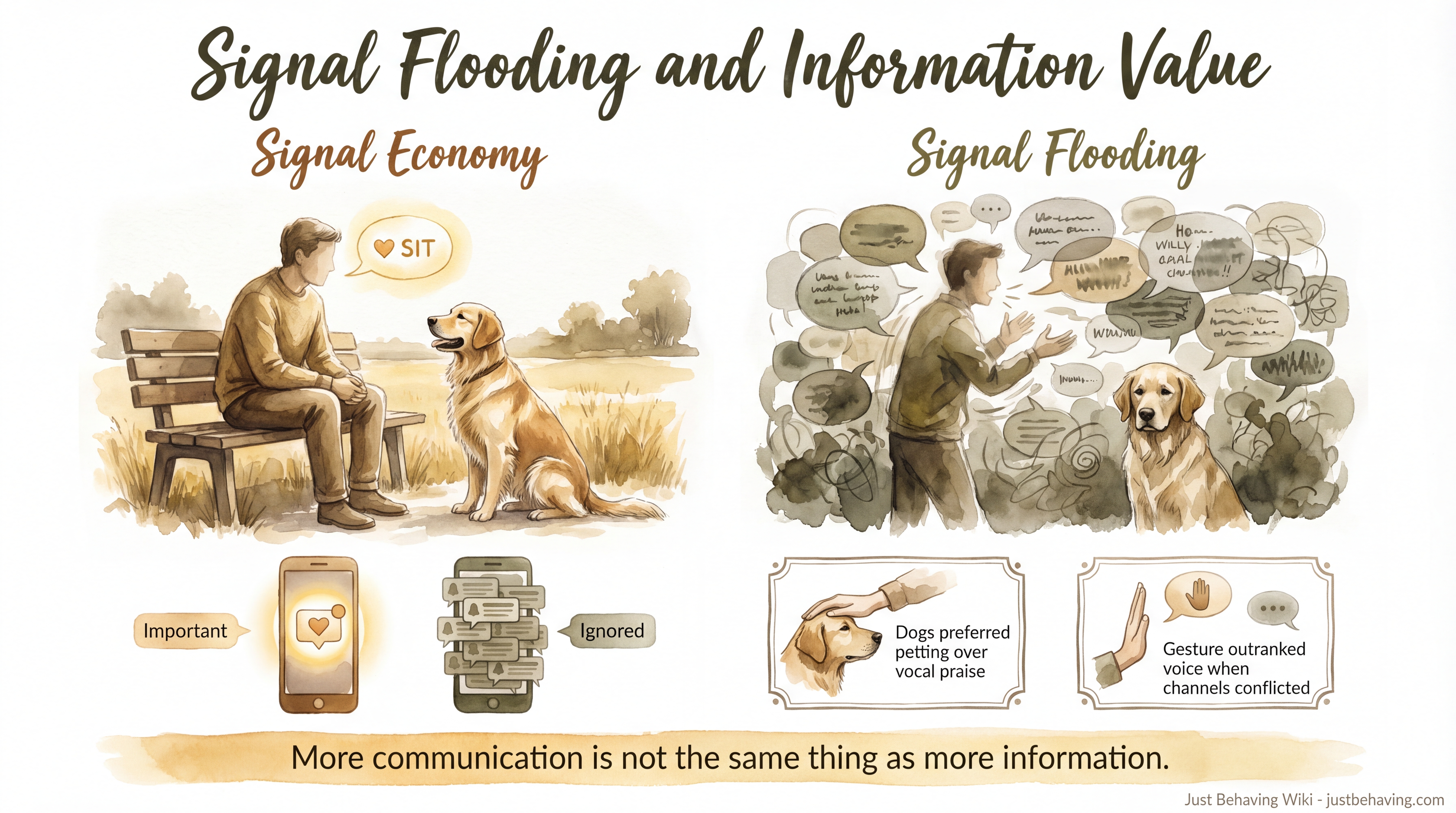
Constant praise and verbal overload reduce the information value of human signals, teaching the dog to filter out the very communication the owner relies on most.
Key Takeaways
- Signal-detection theory predicts that highly predictable, constantly repeated signals lose informational value and turn into noise.
- Dog studies show that verbal praise is a weaker and less durable channel than many humans assume, especially when compared with physical contact.
- When gesture and voice conflict, dogs often weight the gestural channel more heavily, which means speech is not automatically the dominant cue.
- The broader JB claim that many families flood the channel is a grounded synthesis, but the exact long-term household effect has not yet been directly measured.
The Evidence
This entry uses mixed-evidence claim-level tags beyond the dedicated EvidenceBlocks below. These tags mark claims that combine documented findings with observed practice, heuristic application, or unresolved gaps.
- Wiley, R. H. (2006, 2015)general animal communication
Formalized signal-detection principles showing that predictability and redundancy reduce the informational value of a signal.
- Feuerbacher, E. N., and Wynne, C. D. L. (2015)domestic dogs
Showed that dogs prefer petting to vocal praise and that verbal praise alone has limited and rapidly degrading functional value across repeated sessions. - D Aniello, B. et al. (2016)domestic dogs
Found that dogs give heavier weight to gestural than vocal information when the channels are incongruent, reinforcing the importance of the non-verbal channel. - SCR-052 synthesisdomestic dogs
Summarizes the documented canine claim as weaker and less durable reinforcement value for verbal praise relative to richer channels such as touch.
- SCR-003 boundaryfamily-raised dogs and humans
JB interprets constant praise, constant chatter, and repeated cueing as channel flooding that can degrade signal salience, but the household-scale claim remains observational and inferential rather than directly measured.
No published longitudinal family-home study has quantified signal frequency, signal contrast, and downstream effects on dog attention, stress recovery, or relationship clarity over time.
The lab literature shows praise limitations and channel hierarchy effects, but it has not yet specified the exact threshold at which normal family talk becomes true communicative flooding for dogs.
SCR References
Sources
D'Aniello, B., Semin, G. R., Alterisio, A., Aria, M., & Scandurra, A. (2016). The importance of gestural communication: A study of human-dog communication using incongruent information. Animal Cognition, 19(6), 1231-1235. https://doi.org/10.1007/s10071-016-1020-2
Feuerbacher, E. N., & Wynne, C. D. L. (2015). Shut up and pet me! Domestic dogs prefer petting to vocal praise in concurrent and single-alternative choice procedures. Behavioural Processes, 110, 47-59. https://doi.org/10.1016/j.beproc.2014.08.019
Wiley, R. H. (2006). Signal detection and animal communication. Advances in the Study of Behavior, 36, 217-247.