Maternal Correction as Communication
Compound evidence detail1 SCR / 2 parts
- Observed-JBthe ethological evidence that adult dogs deploy specific social signals with situational selectivity and brief contextual deployment (Abrantes, Bekoff, Mech) together with the Bray, MacLean et al. 2021 retriever puppy demonstration that canine attention to human gestural cues is biologically pre-loaded
- Heuristicthe JB application generalizing the dog signal-precision pattern into a universal social-signaling principle and the corollary claim that high-frequency human verbal praise categorically degrades communicative information in household contexts
The closest ethological parallel to JB Indirect Correction is not a trainer in a lesson ring. It is the adult canid managing immature behavior through spacing, access control, brief interruption, and withdrawal rather than through sustained force. The individual components of that picture are documented across weaning, social signaling, and maternal-care literature. The stronger step, bundling them into one named correction framework and carrying them directly into human family practice, remains an interpretive synthesis. Mixed Evidence
What It Means
When people hear the word correction, many of them picture punishment first. They imagine force, intimidation, loud disapproval, or pain. Maternal correction in canids points in a different direction. The adult is still setting limits, but the limits are usually communicated through changing access, changing proximity, changing tolerance, and ending or interrupting the interaction rather than through prolonged coercion.
Weaning is the clearest place to start because it turns the developmental logic into something visible. A nursing mother does not keep the puppy in an eternal state of open access. Over time she alters tolerance. Nursing bouts shorten, interbout intervals lengthen, and the conditions of access change. Packard, Mech, and Ream documented those kinds of structured shifts in wolves during weaning. The message is not random frustration. It is graduated independence.
Dog evidence from free-ranging populations points in the same general direction. Bhattacharjee and colleagues described weaning conflict and milk theft in free-ranging dogs, which shows that access negotiation between mother and pup is real, active, and not infinitely permissive. The important developmental lesson is not that mothers become cruel. It is that they stop treating every request as automatically grantable.
The notebook then names the practical component pieces more directly: spatial pressure, body blocking or positioning, teat blocking during weaning, brief vocalization, and disengagement through turning away or withdrawal of attention. That combination matters because it is patterned. These are low-drama ways of saying not now, enough, move away, or settle. They do not erase affiliation. In healthy social systems, they usually coexist with rapid return to ordinary interaction once the point lands.
This brief-return pattern is crucial. A correction that never ends is not information anymore. It becomes a condition. Maternal correction tends to be short, contextual, and followed by baseline restoration. That makes it legible. The young animal is not left wondering whether the whole relationship is under threat. The message is about the moment, not about permanent social exile.
The spatial piece matters first because it is upstream of speech. An adult body can deny a path, cover a resource, interrupt a climb, or make access temporarily unavailable. That is different from punishing after the fact. It tells the youngster what the current map is. Goodwin and van der Borg help here because they establish that stand over, displace, posture change, and other spatial behaviors are part of the communicative landscape in dogs. Documented
Disengagement matters just as much. Turning away, ending contact, withholding further social engagement, or refusing to continue the loop can all function as clear social information. Firnkes and the broader appeasement literature show that dogs are sensitive to orientation change and cut-off type behavior. Documented The notebook leans on this because quiet disengagement is one of the cleanest examples of correction as communication. The adult says the interaction is closed, and the closure itself carries the lesson.
Brief vocalization belongs in the pattern too, but with more caution. Canids obviously vocalize. Growls, barks, whines, and other sounds are part of social regulation. What is not well established is a distinct natural category equivalent to the human idea of calm vocal markers, a quiet, low-arousal, highly controlled correction syllable. That is why the notebook is careful here. Vocal elements can be part of the picture without claiming that every human marker has a direct natural twin.
This is where the unified JB frame begins. JB takes the documented components, spatial interruption, access denial, disengagement, brief signaling, and rapid return to baseline, and interprets them as one coherent correction logic. Heuristic That is philosophically strong. It is also the exact place where honesty matters. Science documents the parts more clearly than it documents the named whole.
Still, the parts are already enough to matter. They show that adult-young regulation in social mammals often works through controlled frustration and structured limit-setting, not through unbroken indulgence and not necessarily through harsh force either. Observed-JB That is important because it rescues correction from the false human choice between doing nothing and becoming punitive.
The family translation then becomes more precise. A human who blocks access briefly, changes position, ends the loop cleanly, or withdraws attention without emotional theatrics is acting more like a social regulator than like a punisher. The human is not magically becoming a dam. The human is borrowing a form: communicate the limit proportionally, then return to baseline. The claim of full species identity would be too strong. The structural resemblance is already strong enough to be useful.
This also clarifies why JB separates correction from punishment so sharply. Punishment centers the imposed cost. Correction, in the JB sense, centers the transmitted meaning. The mechanics can overlap in behavioral classification terms. The lived event can still be very different if the message is brief, readable, and embedded in an otherwise secure bond.
An everyday analogy is a parent placing a hand over a cookie jar, stepping into the path, and turning away from further negotiation rather than giving a long lecture or a slap. The limit is real. The relationship is still intact. The communication is in the structure of the response.
Why It Matters for Your Dog
For families, this entry is important because it restores a missing middle category. Many homes oscillate between over-permissiveness and overreaction because they cannot imagine correction that is both real and safe. Maternal-correction logic says there is another option: communicate the limit clearly, proportionally, and briefly.
That matters for the bond because puppies learn not only whether a limit exists, but what kind of social event a limit becomes. If every boundary turns into noise, the puppy learns that correction is chaotic. If boundaries are absent, the puppy learns that access is self-governed. If boundaries are brief, spatially legible, and followed by normal life, the puppy learns that correction can be survivable and informative.
The best practical lesson from maternal correction is proportionality. The message should be big enough to change the moment and small enough to preserve the relationship.
This is also why JB places so much value on ending the signal once the dog changes course. That is where communication proves it was communication. The adult did not need to keep going after the dog understood.
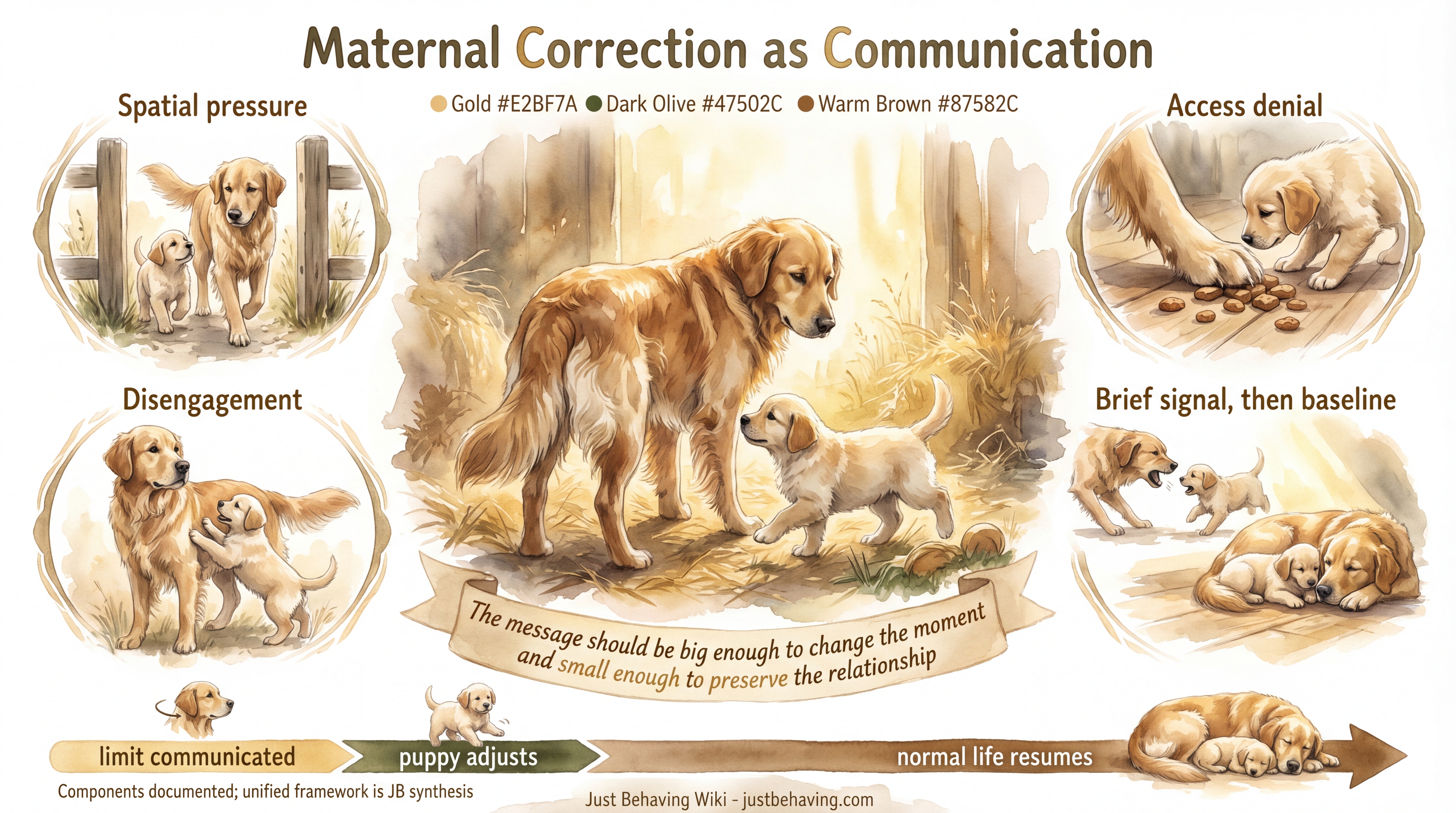
Canine mothers correct puppies through subtle postural and spatial signals that communicate disapproval without aggression, providing the biological template for Indirect Correction.
Key Takeaways
- Maternal correction in canids is best understood as access control, spacing, brief interruption, and disengagement rather than as punishment theater.
- Weaning research shows that mothers change tolerance and access gradually, which makes correction part of normal developmental communication.
- The individual components of JB Indirect Correction are better documented than the unified named framework itself.
- Families can borrow the proportionality logic without pretending that a human correction is biologically identical to every maternal-canine act.
The Evidence
This entry uses observed claim-level tags beyond the dedicated EvidenceBlocks below. These tags mark JB program observation or practice-derived claims that need dedicated EvidenceBlock coverage in a later content pass.
This entry uses mixed-evidence claim-level tags beyond the dedicated EvidenceBlocks below. These tags mark claims that combine documented findings with observed practice, heuristic application, or unresolved gaps.
- Packard, J. M., Mech, L. D., and Ream, R. R. (1992)wolves
Documented age-linked changes in nursing pattern and maternal termination during weaning, showing structured withdrawal of direct access. - Bhattacharjee, D. et al. (2017)free-ranging dogs
Documented weaning conflict and milk theft, confirming that maternal access regulation is an active developmental process in dogs.
- Goodwin, D. et al. (1997)domestic dogs
Defined spatial agonistic behaviors such as stand over and displace, supporting the communicative role of body-based interruption and access control. - van der Borg, J. A. M. et al. (2015)domestic dogs
Showed that posture and posture change function as formal social signals in dogs. - Firnkes, A. et al. (2017)domestic dogs
Documented turning away, sitting, and related appeasement signals in dog-human interaction, supporting disengagement as meaningful social behavior. - SCR-050 synthesisdomestic dogs
Supports low-intensity de-escalatory signaling as meaningful rather than folkloric.
- JB Indirect Correction synthesisfamily-raised dogs
JB unifies spatial pressure, body blocking, quiet disengagement, and brief signaling into one coherent correction framework. The individual components are documented more clearly than the named whole. - SCR-003 boundarydomestic dogs and humans
The idea that these signals work especially well when they are sparse, contextual, and followed by immediate baseline restoration is strongly consistent with canine signal precision, but remains a synthesis rather than a dedicated trial result.
No published study has directly compared a relationally structured human indirect-correction protocol against louder or more forceful household correction while measuring attachment quality or physiological outcomes.
The calm-vocal-marker piece remains the least directly grounded element. The literature supports vocal signaling generally, but not a sharply defined natural canine analog of the human low-arousal marker word.
SCR References
Sources
Bhattacharjee, D., Sau, S., Das, J., Bhadra, A., & Bhadra, A. (2017). Selfish pups: Weaning conflict and milk theft in free-ranging dogs. PLOS ONE, 12(2), e0170590. https://doi.org/10.1371/journal.pone.0170590
Firnkes, A., Bartels, A., Bidoli, E., & Erhard, M. (2017). Appeasement signals used by dogs during dog-human communication. Journal of Veterinary Behavior, 19, 35-44. https://doi.org/10.1016/j.jveb.2017.02.004
Goodwin, D., Bradshaw, J. W. S., & Wickens, S. M. (1997). Paedomorphosis affects agonistic visual signals of domestic dogs. Animal Behaviour, 53(2), 297-304. https://doi.org/10.1006/anbe.1996.0370
Packard, J. M., Mech, L. D., & Ream, R. R. (1992). Weaning in an arctic wolf pack: Behavioural mechanisms. Canadian Journal of Zoology, 70(7), 1269-1275. https://doi.org/10.1139/z92-178
van der Borg, J. A. M., Schilder, M. B. H., Vinke, C. M., & de Vries, H. (2015). Dominance in domestic dogs: A quantitative analysis of its behavioural measures. PLOS ONE, 10(8), e0133978. https://doi.org/10.1371/journal.pone.0133978