Social Referencing in Puppies
Social referencing in puppies means that a young dog uses the adults emotional response as information about how to interpret a novel or ambiguous situation. The key point is not only that the puppy notices the adult. The key point is that the adult appraisal becomes part of what the situation means. In dogs, that process is documented from the earliest rehoming window. Documented
What It Means
Social referencing is different from simple emotional contagion and different from obedience. In emotional contagion, one nervous system shifts with another. In obedience, the dog responds to an explicit signal. In social referencing, the puppy looks to a social partner for information about how to classify what is happening. The puppy is using the adult response as data.
That is why the classic Merola, Prato-Previde, and Marshall-Pescini paper matters so much. Dogs encountered an ambiguous object, a fan decorated with plastic ribbons, and then looked back to their people. Ambiguous When the caregiver gave positive emotional signals, approach increased. When the caregiver gave negative signals, avoidance increased. The dog was not only reacting to the object. The human evaluation was being incorporated into the dogs later response.
The developmental extension is what makes this entry belong in Category 12. Fugazza and colleagues showed that social referencing is already present in puppies from eight weeks of age. Even more important, the effect was still visible later when the puppy was tested alone after a delay. That means the human emotional appraisal did not disappear as soon as the human disappeared. The puppy carried part of the evaluation forward.
That persistence is the crucial point. If the puppy only changed behavior while the adult was visibly present, the phenomenon would still matter, but it would be narrower. The lasting effect suggests that the adult reaction altered how the puppy encoded the object or situation. The adult response became part of the memory trace.
This is one reason the entry is so relevant to the soft-landing framework. Newly rehomed puppies meet an avalanche of ambiguous stimuli: doorbells, appliances, strangers, grooming tables, car rides, crates, porch steps, and city noise. Ambiguous Social referencing means the puppy is not interpreting those things in isolation. The adults reaction is helping define whether the thing belongs in the "boring," "interesting," or "concerning" category.
The Bray retriever-puppy work helps explain why this channel is open so early. If retriever puppies already arrive predisposed to read human gestures and faces as meaningful, then it makes sense that they would also be ready to use human emotional appraisal as guidance very early. Bray does not by itself prove social referencing. It strengthens the developmental plausibility of why the puppy-human appraisal channel works from the beginning.
This is also why the science is more consequential than a simple slogan like "dogs pick up on your feelings." That phrase is not wrong, but it is thinner than the literature. Social referencing says that a puppy can use your visible emotional reaction to classify the environment. That is a more structured claim than mere mood pickup. It is about appraisal, not only atmosphere.
The relationship angle matters too. Social referencing is not an anonymous information channel. It works because the adult is socially meaningful to the puppy. The same object, viewed with no adult reference point, may be categorized differently. In a bond-centered framework, that means relationship quality affects not only comfort. It affects how environmental information gets routed.
The lasting-effect result is especially important for families who assume that only repeated formal lessons build long-term meaning. The puppy literature suggests otherwise. A relatively brief interaction with a trusted adults response can alter later behavior toward the same stimulus. The home is therefore full of unannounced lessons, especially in the first weeks after transition.
This is where restraint matters. The studies do not prove that one anxious moment permanently creates a fearful dog, and they do not prove that every later household reaction is stored indefinitely. Documented They document the mechanism and show that the effect can persist across the tested delay. Longer developmental claims require more caution.
The science also does not say that puppies are mind-reading in a human-like reflective sense. They do not need to be. The documented point is already strong enough: the puppy uses social information from the adult response to decide what a novel thing is and how to behave toward it.
An everyday analogy is a toddler hearing a strange noise at night and immediately checking the adults face. If the adults look relaxed, the noise becomes background. If the adults look alarmed, the same noise takes on a different meaning. Puppy social referencing appears to work in a similar way.
Why It Matters for Your Dog
For families, this entry matters because it changes what "being calm" means. Calmness is not only a tone preference or a courtesy to the puppy. It is part of how the puppy builds an emotional map of the household and the world outside it. Your reaction is not merely happening in front of the puppy. It is helping define the event for the puppy.
Social referencing is one of the strongest reasons JB treats adult calmness as developmental guidance rather than as surface-level good manners. The adult reaction becomes information.
This also protects against a common mistake after rehoming. Families often think the important work begins once they have a training plan. In reality, the plan has already begun because the puppy is classifying the environment from the adults behavior during the first crate introduction, the first vet lobby visit, the first thunderstorm, and the first stranger at the door. Documented
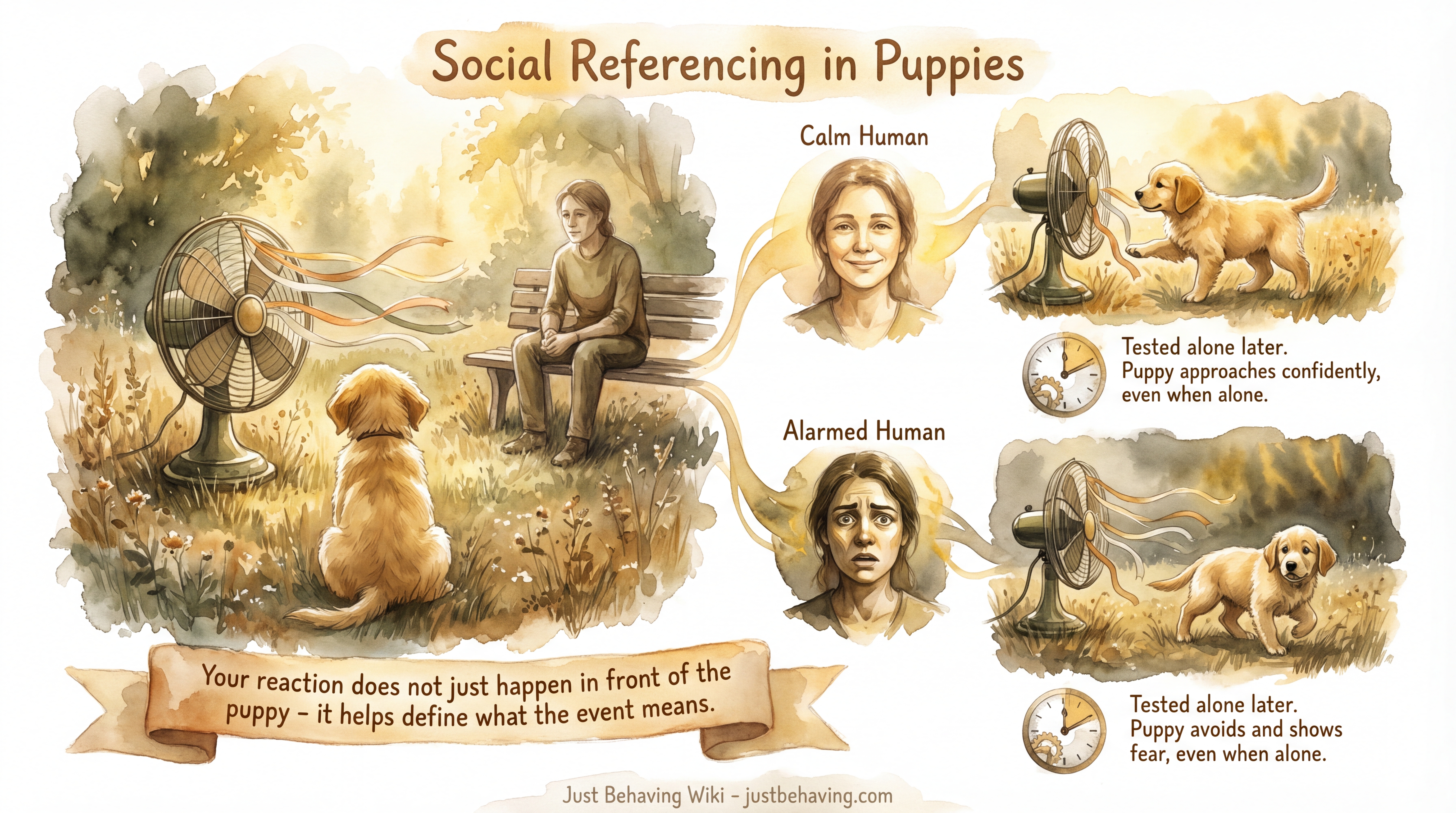
Puppies look to their caregiver's emotional reaction when facing something unfamiliar, using adult calm or alarm as a guide for their own response.
Key Takeaways
- Puppies use adult emotional responses as information about what novelty means, which is what makes social referencing more than simple mood pickup.
- The puppy literature shows this process from eight weeks, right at the age many puppies move to family homes.
- The lasting-effect finding matters because it suggests the adult appraisal can continue shaping puppy behavior after the adult is no longer present.
- For families, calmness helps teach that novelty is manageable, while visible alarm risks teaching the opposite.
The Evidence
This entry uses ambiguous claim-level tags beyond the dedicated EvidenceBlocks below. These tags mark claims where the literature remains unsettled or multiple interpretations coexist.
- Merola, I., Prato-Previde, E., and Marshall-Pescini, S. (2012)domestic dogs
Dogs used owner emotional signals to guide approach or avoidance toward an ambiguous object, establishing social referencing in dog-human dyads. - Fugazza, C. et al. (2018)domestic dogs
Found social referencing in puppies from eight weeks and showed a lasting effect on later behavior toward the ambiguous stimulus.
- Bray, E. E. et al. (2021)retriever puppies including Golden Retrievers
Showed that very young retriever puppies already treat human communicative behavior as meaningful without a trial-by-trial learning curve. - SCR-009 synthesisdomestic dogs
Summarizes the broader puppy literature as showing socially guided learning and use of human social information from eight weeks onward.
- SCR-051 and SCR-009 boundarydomestic dogs
The studies document early social referencing and delayed behavioral effects, but they do not prove that single exposures permanently fix long-term fear or confidence profiles across development.
No published longitudinal study has tracked whether puppies repeatedly exposed to calm versus alarmed caregiver reactions toward novelty develop measurably different long-term appraisal styles or anxiety risk.
SCR References
Sources
- Bray, E. E., Gnanadesikan, G. E., Horschler, D. J., Levy, K. M., Kennedy, B. S., Famula, T. R., & MacLean, E. L. (2021). Early-emerging and highly heritable sensitivity to human communication in dogs. Current Biology, 31(14), 3132-3136. https://doi.org/10.1016/j.cub.2021.04.055
- Fugazza, C., Pogany, A., Magnusson, M. S., & Miklosi, A. (2018). Presence and lasting effect of social referencing in dog puppies. Animal Behaviour, 141, 67-75. https://doi.org/10.1016/j.anbehav.2018.05.007
- Merola, I., Prato-Previde, E., & Marshall-Pescini, S. (2012). Social referencing in dog-owner dyads? Animal Cognition, 15(2), 175-185. https://doi.org/10.1007/s10071-011-0443-0