Autonomic Synchronization and the Mentor's State
Autonomic synchronization and the mentor state refers to a simple but high-stakes idea: the puppy is not only learning from what the adult does. The puppy is also learning inside the adults physiological state. Dog-human research now shows that adult state can reach the dog through real-time autonomic coupling and stress-related odor channels, which gives mentorship a biological layer as well as a behavioral one. Documented
What It Means
The fastest way to misunderstand mentorship is to treat it as a purely visual process. That would make the adult a moving example, but only at the level of observable action. The physiology literature says something stronger. The adult body itself is part of what the puppy has to interpret.
Koskela and colleagues provided the clearest recent anchor in 2024. They measured heart rate variability, or HRV, and physical activity in dog-human dyads across baseline periods and interaction tasks such as stroking, training, sniffing, and play. HRV is valuable because it tells us about autonomic regulation, not only outward movement. It is a window into how flexibly the body is organizing arousal.
The design matters because it was built to distinguish simple movement synchrony from deeper physiological coupling. If dog and human values only lined up when both were doing the same obvious physical act, the result would be interesting but limited. Koskela found something more specific. Activity aligned most clearly during structured tasks, while HRV alignment appeared most clearly during freer baseline periods. That helps separate behavioral coordination from autonomic co-modulation.
In plain language, dog and human were not only moving together. Their bodies were also organizing arousal together. That is what makes the mentor state scientifically important. A dog can be learning inside the adults regulation, not only beside the adults demonstration.
The study also showed that the signal was dyad-specific rather than a generic human effect. Documented The co-modulation story belongs to real relationships. That matters enormously for the bond category because it means the channel is not just "dogs react to people." It is "dogs and their people can become physiologically linked in relationship-shaped ways."
Katayama and colleagues reinforce the same point from a different angle. In their 2019 work, HRV correlation between dogs and their caregivers increased with duration of ownership. Estimated That means the channel strengthens with lived history. The mentor state is not only a species-level capacity switched on by proximity. It appears to deepen as the relationship deepens.
The odor literature then adds a second pathway that makes the mentorship claim harder to dismiss as mere body-language reading. Wilson showed that dogs can discriminate baseline human odor from stress odor. Parr-Cortes showed that exposure to unfamiliar human stress odor can alter canine cognition and learning performance. The dog does not need a lecture about the adults state. The body is already broadcasting it chemically.
This is where the title phrase "mentor state" earns its place. The adult is teaching two things at once. One lesson sits in the visible behavior: how to move through the doorway, how to recover after a startle, how to meet the visitor. Documented The other lesson sits in the physiological package carrying that behavior: tense or settled, regulated or activated, coherent or conflicted. The puppy experiences both.
That distinction also helps explain why social learning and calmness are inseparable in JB. If the adult demonstrates a quiet routine while internally broadcasting stress through posture, pace, odor, and autonomic activation, the overall lesson is mixed. The puppy does not only see the routine. The puppy lives in the signal stack carrying it.
This is also a place where precise language matters. The literature does not yet show that every calm adult permanently builds a calmer adult dog or that every stressed adult permanently dysregulates a puppy. Documented It shows documented channels by which adult state reaches the dog in real time and documented evidence that relationship history strengthens some forms of coupling. The strongest developmental permanence claims remain a step beyond the data.
Even with that restraint, the practical consequence is significant. In a relationship-centered developmental model, adult calm is not only about helping the human behave better. It is part of what the puppy is biologically learning from. Mentorship is therefore not just an action model. It is a state model.
This is why the "math professor" analogy matters so much here. A calm professor does not only demonstrate the problem steps. The professor also lends the student a regulated atmosphere in which the problem becomes thinkable. The gym-coach version of puppy raising may still show the motions, but it shows them inside a different nervous-system climate.
An everyday analogy is being a passenger in a car with an experienced driver. You are learning from steering choices, but you are also learning from the bodily tone of the trip. A smooth, settled driver makes the whole ride feel interpretable. A tense, jumpy driver makes the same road feel different before a single word is spoken.
Why It Matters for Your Dog
For families, this entry matters because it explains why adult state cannot be treated as a private issue separate from raising. The puppy is not only watching the adults decisions. The puppy is also receiving the adults regulation through channels the adult may not notice, including pace, tension, HRV-linked arousal, and odor.
The mentor-state literature is one of the strongest reasons JB treats calmness as infrastructure. Adult regulation is part of what the puppy is living inside while learning everything else.
This also gives families a more generous but more demanding frame. The goal is not emotional perfection. The goal is to stop pretending that the adults internal state is irrelevant. A family that slows down, organizes the room, and lowers its own activation is not doing self-care off to the side. It is changing the learning environment itself.
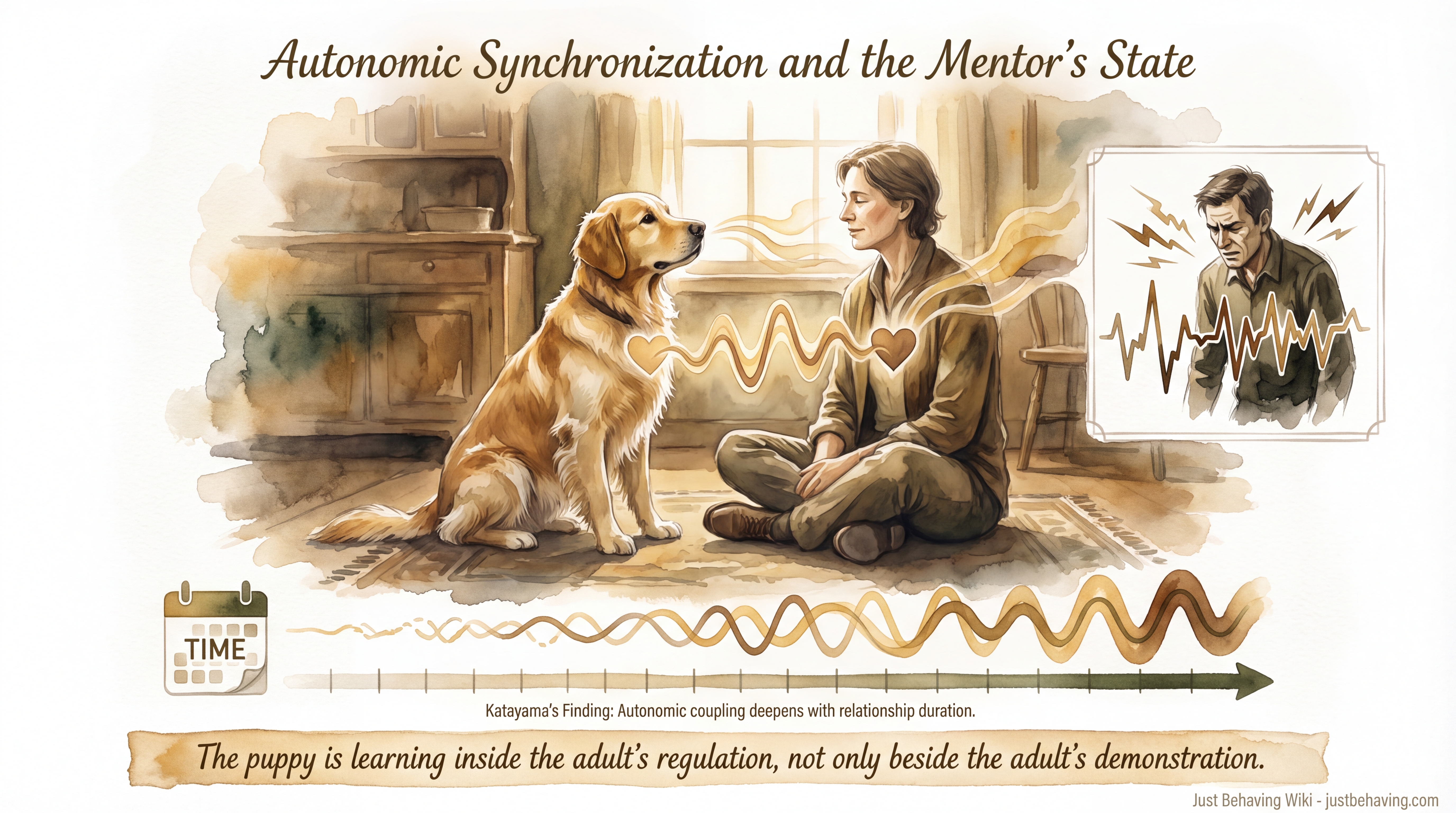
The mentor's autonomic state during shared moments shapes the puppy's physiological baseline, making calm leadership a biological input rather than just a philosophical preference.
Key Takeaways
- The adult state is part of the lesson because dog-human physiology can couple in real time, not only across long periods.
- Koskela showed dyad-specific HRV co-modulation, and Katayama showed that some autonomic coupling strengthens with relationship history.
- Stress can also reach the dog through odor, which means the adult body is broadcasting information even without obvious visible drama.
- The literature documents the channel clearly, while stronger claims about permanent developmental effects from calm versus stressed mentorship remain more bounded.
The Evidence
This entry uses estimated claim-level tags beyond the dedicated EvidenceBlocks below. These tags mark approximate ranges or timing claims that should remain bounded by the cited sources.
- Koskela, A. et al. (2024)domestic dogs and humans
Measured HRV and activity in dog-human dyads and found dyad-specific autonomic co-modulation that could not be reduced to shared motion alone. - Katayama, M. et al. (2019)domestic dogs and humans
Found that HRV correlation between dogs and owners increased with duration of ownership, supporting relationship-shaped autonomic coupling.
- Wilson, C. et al. (2022)domestic dogs
Showed that dogs can discriminate human baseline odor from stress odor. - Parr-Cortes, Z. et al. (2024)domestic dogs
Found that unfamiliar human stress odor altered canine cognition and learning performance, showing that the adult state can reach the dog through a chemical channel as well.
- SCR-106 and SCR-058 boundarydomestic dogs and humans
The literature documents real-time coupling and stress detection channels, but it does not yet prove that short-term mentor state differences automatically determine permanent adult temperamental outcomes.
No published puppy intervention trial has yet tested whether deliberately improving adult regulation during the socialization period changes later autonomic flexibility, novelty recovery, or household stability outcomes in the dog.
SCR References
Sources
- Katayama, M., Kubo, T., Mogi, K., Ikeda, K., Nagasawa, M., & Kikusui, T. (2019). Emotional contagion from humans to dogs is facilitated by duration of ownership. Frontiers in Psychology, 10, 1678. https://doi.org/10.3389/fpsyg.2019.01678
- Koskela, A., Tornqvist, H., Somppi, S., Tiira, K., Kykyri, V.-L., Hanninen, L., Kujala, J., Nagasawa, M., Kikusui, T., & Kujala, M. V. (2024). Behavioral and emotional co-modulation during dog-owner interaction measured by heart rate variability and activity. Scientific Reports, 14, 25201. https://doi.org/10.1038/s41598-024-76831-x
- Parr-Cortes, Z., Muller, C. T., Talas, L., Mendl, M. T., Guest, C., & Rooney, N. J. (2024). The odour of an unfamiliar stressed or relaxed person affects dogs responses to a cognitive bias test. Scientific Reports, 14, 16914. https://doi.org/10.1038/s41598-024-66147-1
- Wilson, C., Campbell, K., Petzel, Z., & Reeve, C. (2022). Dogs can discriminate between human baseline and psychological stress condition odours. PLOS ONE, 17(9), e0274143. https://doi.org/10.1371/journal.pone.0274143