Overimitation and Social Belonging
Overimitation means copying a demonstrated action even when that action is not necessary for solving the problem. In dogs, the strongest studies show that this inefficient copying is shaped by the social relationship with the demonstrator. The documented phenomenon is already important on its own. The deeper interpretation, that the dog is absorbing what trusted adults do because belonging matters, is the part that requires more careful language. Mixed Evidence
What It Means
Most simple problem-solving theories predict efficiency. If a learner understands which part of a demonstrated sequence actually produces the reward, the useless step should be dropped. Documented Overimitation becomes interesting precisely because that does not always happen. The learner preserves part of the demonstrated method even when the method is instrumentally wasteful.
Huber, Popovova, Riener, Salobir, and Cimarelli provided the clearest canine example in 2018. Dogs watched a demonstrator perform a two-step sequence: touch colored dots on a wall and then open a door to get food. The dot-touching action was causally irrelevant. It was spatially separate from the reward mechanism and did not help open the door. Yet around half of the dogs copied the irrelevant action when their caregiver demonstrated it.
The control contrast is what makes the paper so important. When an unfamiliar experimenter demonstrated the same irrelevant action sequence, very few dogs copied the useless step. Same task. Same reward. Same environment. Different social relationship. That means the explanation cannot live only in the physical structure of the problem. The identity of the model changes what the dog preserves.
This is already enough to challenge a purely efficiency-centered picture of canine social learning. The dogs were not merely extracting the shortest path to food. They were, at least some of the time, preserving something about the demonstrated method because of who had performed it.
The notebook is right to call this one of the most philosophically consequential findings in the social-learning literature. Once dogs copy the irrelevant part of a trusted adult's behavior, the household example becomes more consequential than simple outcome modeling. The adult is no longer only teaching "what works." The adult may also be teaching "how we do things here."
Mackie and Huber sharpened that point in 2023. In their study, dogs sometimes reproduced the irrelevant action after they had already obtained and eaten the food. Documented That is an especially uncomfortable result for narrow instrumental explanations because the obvious material goal had already been satisfied. If the useless action still gets repeated after reward consumption, then the copying is not cleanly reducible to food-seeking alone.
That does not prove a full human-style norm psychology, and the page should not drift there. The stronger and safer conclusion is that dogs show socially influenced, inefficient copying in a way that is sensitive to relationship. The mechanism may involve affiliation, attentional bias, social priming, or a blend of processes rather than formal norm enforcement in the human cultural sense.
Huber, Kubala, and Cimarelli tested the relationship-quality question more directly in 2022. The results trended in the predicted direction, with better caregiver relationships associated with more overimitation, but the effects did not reach robust significance across the full sample. Documented That matters because it keeps the entry honest. The belonging interpretation is plausible and supported indirectly, but the direct relationship-quality result is suggestive rather than conclusive.
The enhancement caveat is the most important scientific restraint here. Without stronger two-action controls, some of the observed copying could still reflect attention drawn to the irrelevant element rather than true preservation of a social rule or norm. In other words, the demonstrator may have made the dots salient rather than making the dog think the dots "belonged" in the sequence. That caveat does not erase the finding. It limits how grandly it should be interpreted.
Even with that limit, the documented layer is already powerful. Dogs copy causally unnecessary actions more when a trusted human demonstrates them than when a stranger does. That alone means the relationship changes what information survives observation. In a bond-centered framework, that is a major result.
This is also one of the clearest places where relationship and method stop being separable. A household full of hurried, noisy, or tense routines is not only teaching the puppy how to reach goals. It may be teaching the puppy which styles of action are worth preserving simply because trusted adults performed them. The dog may be copying the whole atmosphere around the act, not just the act.
The entry title uses "social belonging" on purpose, but as a bounded phrase. It is the best concise way to capture why the caregiver-versus-stranger difference matters. Dogs seem to preserve some demonstrated inefficiency more readily when it comes from their own people. That is consistent with belonging-based copying. It is not yet a final proof of canine norm psychology.
An everyday analogy is a child copying the unnecessary family step in a household ritual. The step may not be mechanically required, but it still carries social information because it signals how this group does the thing. Overimitation suggests dogs may sometimes process trusted adult behavior in a related way, even if the exact canine mechanism is narrower. Documented
Why It Matters for Your Dog
For families, this entry matters because it raises the developmental importance of style. If dogs can preserve useless steps from trusted humans, then the quality of the example matters at least as much as the visible end result. The puppy may be copying the pace, the rhythm, the tension, and the little unnecessary extras in the adults behavior, not only the practical goal the adults think they are teaching.
Overimitation is one reason JB treats the adult example as the curriculum. The puppy may be absorbing more than the final outcome because trusted adult behavior carries social weight of its own.
This also helps families understand why leadership in the JB sense is not theatrical dominance. The dog is not looking for more drama. The dog is looking for an adult worth aligning with. If alignment is part of the copying mechanism, then quiet, competent, consistent adults give the puppy better social material to preserve.
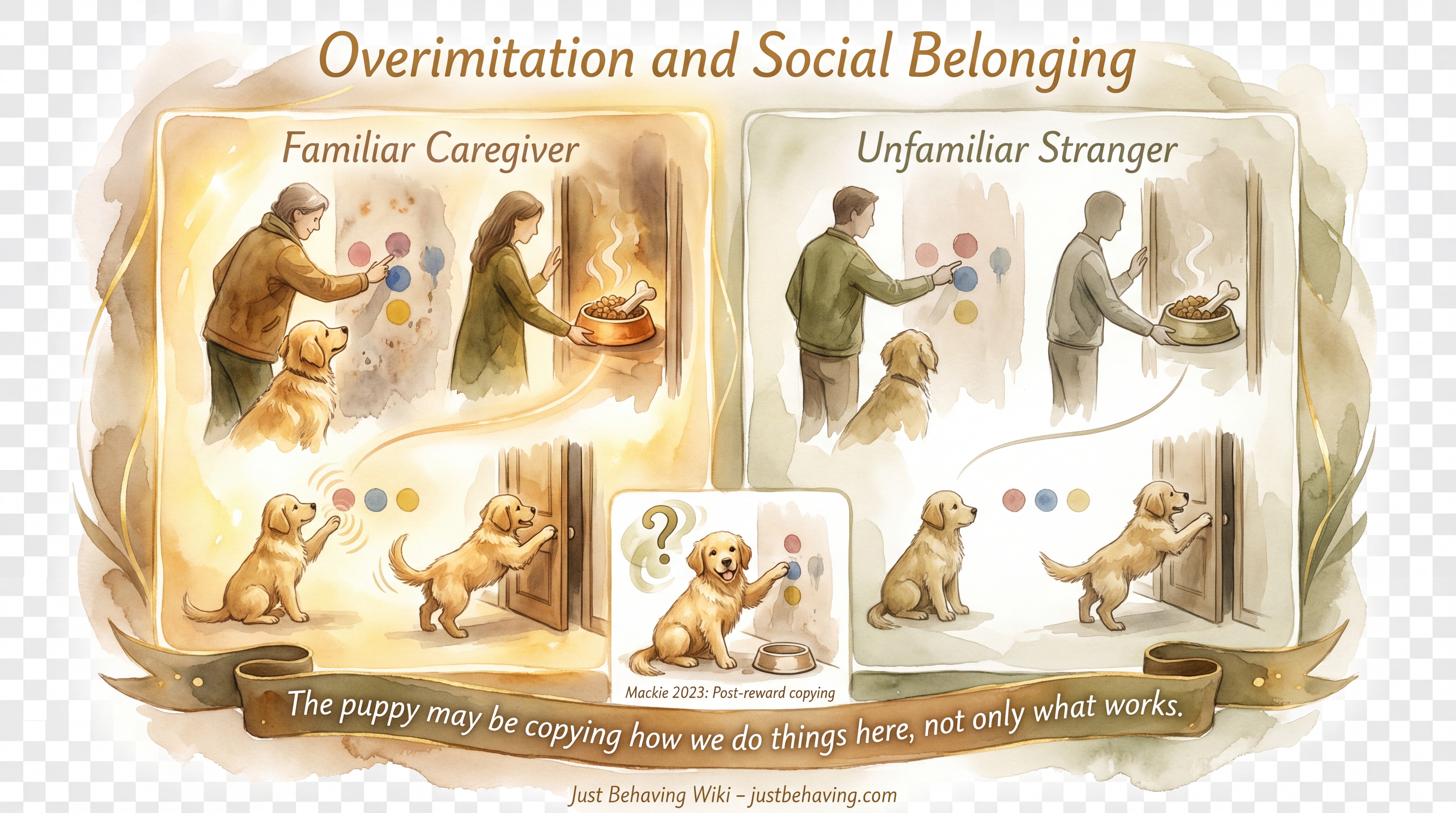
Some evidence suggests dogs may copy unnecessary actions from humans, raising the question of whether social belonging rather than efficiency drives parts of canine imitation.
Key Takeaways
- Dogs sometimes copy causally irrelevant actions from trusted humans, which is what makes overimitation so scientifically important.
- The caregiver-versus-stranger difference shows that social relationship changes what parts of a demonstration the dog preserves.
- The stronger interpretation that dogs are copying for social belonging is plausible and useful, but it still needs the enhancement caveat to travel with it.
- For families, this means the style of adult behavior may matter developmentally even when the unnecessary details look trivial to the human.
The Evidence
This entry uses mixed-evidence claim-level tags beyond the dedicated EvidenceBlocks below. These tags mark claims that combine documented findings with observed practice, heuristic application, or unresolved gaps.
- Huber, L. et al. (2018)domestic dogs
Around half of dogs copied a causally irrelevant caregiver-demonstrated action in a two-step task, while very few did so after a stranger demonstrated the same sequence. - Mackie, N., and Huber, L. (2023)domestic dogs
Showed that dogs sometimes reproduced the irrelevant action after the food had already been obtained and consumed, strengthening the case that copying is not only about immediate reward.
- Huber, L. et al. (2020)domestic dogs
Refined the overimitation picture and supported the conclusion that dogs sometimes preserve inefficient demonstrated actions. - Huber, L. et al. (2022)domestic dogs
Tested links between caregiver relationship quality and overimitation, with directional but not statistically decisive trends.
- SCR-010 boundarydomestic dogs
Dogs do show socially influenced inefficient copying, but stronger language about norm absorption or human-like cultural conformity still requires caution because enhancement-based alternatives have not been fully excluded.
No published naturalistic household study has yet measured how often puppies overimitate ordinary family routines outside laboratory tasks, and stronger two-action controls are still needed across the canine overimitation literature.
SCR References
Sources
- Huber, L., Kubala, D., & Cimarelli, G. (2022). Overimitation in dogs: Is there a link to the quality of the relationship with the caregiver? Animals, 12(3), 326. https://doi.org/10.3390/ani12030326
- Huber, L., Popovova, N., Riener, S., Salobir, K., & Cimarelli, G. (2018). Would dogs copy irrelevant actions from their human caregiver? Learning & Behavior, 46(4), 387-397. https://doi.org/10.3758/s13420-018-0336-z
- Huber, L., Salobir, K., Mundry, R., & Cimarelli, G. (2020). Selective overimitation in dogs. Learning & Behavior, 48, 113-123. https://doi.org/10.3758/s13420-019-00403-w
- Mackie, N., & Huber, L. (2023). Socially priming dogs in an overimitation task. Frontiers in Psychology, 14, 1183502. https://doi.org/10.3389/fpsyg.2023.1183502