Innate Social Cognition in Puppies
Innate social cognition in puppies refers to an early readiness to treat human communicative behavior as meaningful information rather than as meaningless movement. In retriever puppies, including Golden Retrievers, that readiness appears before extensive individualized training history can plausibly explain it. Documented
What It Means
This entry is not about obedience and it is not about how many commands a puppy can follow. It is about something more basic: whether the puppy arrives already biased to treat human gestures and attention as socially informative. That question matters because if the answer is yes, the human relationship starts carrying developmental weight immediately.
Bray, MacLean, and colleagues addressed that question with unusually strong design in 2021. They tested 375 retriever puppies, eight to ten weeks old, including Golden Retrievers. Documented These puppies had spent nearly all of their lives with littermates and their dam and had only minimal individualized interaction histories. That age and rearing context are exactly why the paper matters so much. The puppies were early enough that a rich personal reinforcement history with humans could not do all the explanatory work.
The tasks were simple but revealing. In one, a human indicated a baited location with a communicative cue such as pointing. In another, puppies were measured for social attention toward the human face. The puppies succeeded at rates that were already high from the start. They did not need repeated shaping inside the experimental task to begin using the human signal.
The strongest part of the paper is the flat performance profile across twelve trials. There was no meaningful learning curve. If the puppies had been solving the problem through rapid trial-and-error conditioning, performance should have climbed over repetitions. Documented Instead, the puppies looked ready from trial one. That is why the paper is routinely cited as evidence for biological preparedness rather than task acquisition during the experiment itself.
That does not mean "innate" should be translated into mystical language. It does not mean the puppy knows everything about living with humans. It means that at least one part of the social channel is preconfigured enough to operate with very little experience. The puppy arrives especially open to a type of information humans naturally give.
This is one reason the bond literature has to separate early social cognition from later household skill. A puppy that can use a human point is not therefore house-settled, emotionally mature, or behaviorally finished. The documented claim is narrower and stronger: the human communicative channel is open very early, at least in the retriever population tested.
The breed scope matters tremendously here. The study was not a generic all-breed puppy sample. Documented It was a retriever sample. For many kinds of science that would be a limitation first. For Just Behaving it is almost the reverse. Goldens sit directly inside the sampled population. That gives JB unusually good breed fit for a claim it already cares about philosophically. The boundary must still travel with the strength. We can say a lot about retrievers here. We should say less about every breed on earth.
The notebook correctly links this finding to domestication and heritability, but we need to phrase that carefully. The paper title itself points toward highly heritable sensitivity to human communication, and the flat performance pattern is consistent with that interpretation. Still, the practical lesson for families does not require a sweeping evolutionary speech. The important point is simpler. The puppy who comes home is already reading the adults more than many families realize.
This also helps explain why later social-learning findings are plausible from the beginning. Heuristic If a puppy is born ready to treat human signals as meaningful, then human demonstration does not have to fight its way into relevance. It is already relevant. Observational learning, social referencing, and breed-specific human demonstrator effects all make more sense against that background.
The result also protects against an overly technique-centered view of puppyhood. Families often assume that communication with the puppy begins when they intentionally teach something. The Bray finding suggests the opposite order. Communication begins because the puppy is already tuned to human social behavior. Formal teaching arrives later inside that existing channel.
There is an important restraint point too. The paper does not prove that every later bond claim is innate, and it does not prove that every human cue is equally privileged in every breed or every home. It gives us a very strong early starting point, not a complete developmental map. Environment, attachment quality, and household structure still matter tremendously in how the capacity gets expressed.
An everyday analogy is bringing home a radio that is already tuned near the right station. You still need to adjust the volume, keep the signal clean, and choose what gets played through it. But you are not starting from static. Retriever puppies appear to arrive already tuned toward human communication.
Why It Matters for Your Dog
For families, this entry matters because it says the puppy is not waiting passively for meaning to be attached to human behavior. The puppy is already extracting meaning from the adults in the room. That raises the importance of everyday posture, timing, calmness, and consistency long before a family ever worries about polished skills.
The early-social-cognition literature strengthens JB view that mentorship begins with who the adult is, not only with what the adult formally teaches. The puppy is already reading the human channel.
It also gives Golden families a rare scientific advantage. Because the relevant evidence is in retrievers, the breed JB raises is not sitting at the edge of generalization. It is sitting inside the sample. That does not license overclaiming, but it does mean that calm, readable human presence is not only philosophically aligned with the breed. It is evidence-aligned too.
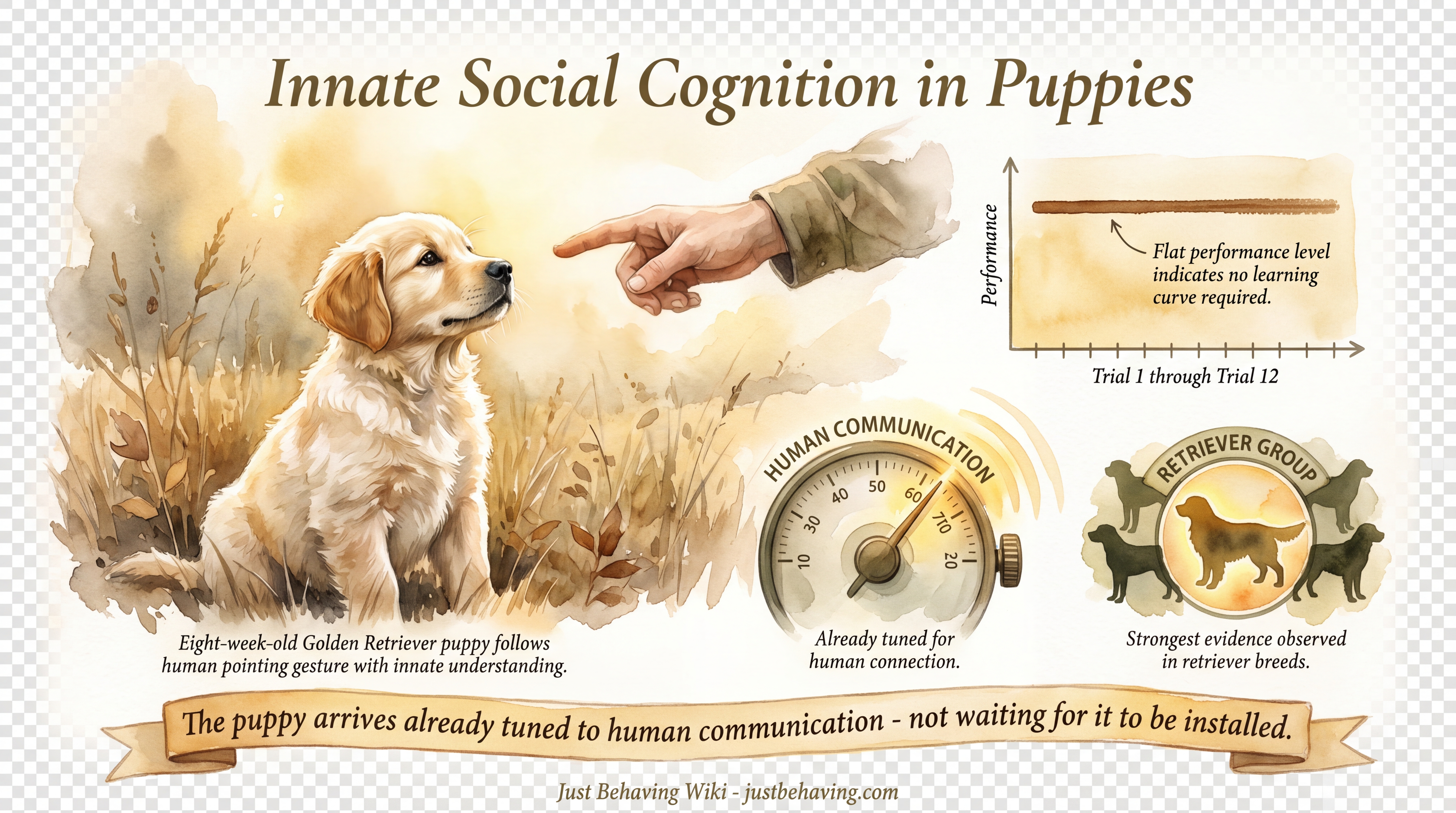
Retriever puppies comprehend human social-communicative gestures before any formal training, suggesting innate sensitivity rather than learned compliance.
Key Takeaways
- Retriever puppies, including Golden Retrievers, can use human communicative signals very early, before large individualized training histories exist.
- The lack of a learning curve across repeated trials is one of the strongest reasons the finding is interpreted as preparedness rather than rapid task conditioning.
- This early readiness is specific evidence about the human social channel, not proof that a young puppy is mature or broadly trained.
- For families, the result means human behavior is meaningful to the puppy from the beginning, not only after formal teaching starts.
The Evidence
- Bray, E. E. et al. (2021)retriever puppies including Golden Retrievers
Tested 375 puppies aged 8 to 10 weeks and found robust human social-communicative performance with no learning curve across twelve trials, supporting early preparedness rather than task conditioning. - SCR-051 synthesisretriever puppies including Golden Retrievers
Summarizes the retriever-puppy evidence as showing early robust human gesture comprehension without reinforcement history as the main explanation.
- Fugazza, C. et al. (2018)domestic dogs
Showed that eight-week-old puppies can learn from human and canine demonstrators, which fits the broader claim that the human social channel is open early. - Dobos, P., and Pongracz, P. (2023)domestic dogs
Found that cooperative breeds show stronger gains from human demonstrators, reinforcing the relevance of early human-oriented social cognition in human-cooperative dogs.
- SCR-051 scope noteretriever puppies
The finding directly supports early retriever preparedness for human communication, but it should not be written as if every breed has the same early social-cognitive profile.
No published longitudinal study has yet shown how early retriever gesture comprehension predicts later attachment quality, observational learning success, or household stability after rehoming.
SCR References
Sources
- Bray, E. E., Gnanadesikan, G. E., Horschler, D. J., Levy, K. M., Kennedy, B. S., Famula, T. R., & MacLean, E. L. (2021). Early-emerging and highly heritable sensitivity to human communication in dogs. Current Biology, 31(14), 3132-3136. https://doi.org/10.1016/j.cub.2021.04.055
- Dobos, P., & Pongracz, P. (2023). Would you detour with me? Association between functional breed selection and social learning in dogs sheds light on elements of dog-human cooperation. Animals, 13(12), 2001. https://doi.org/10.3390/ani13122001
- Fugazza, C., Moesta, A., Pogany, A., & Miklosi, A. (2018). Social learning from conspecifics and humans in dog puppies. Scientific Reports, 8, 9257. https://doi.org/10.1038/s41598-018-27654-0
- Lugosi, C. A., Udvarhelyi-Toth, K. M., Dobos, P., & Pongracz, P. (2024). Independent, but still observant: Dog breeds selected for functional independence learn better from a conspecific demonstrator than cooperative breeds in a detour task. BMC Biology, 22(1), 245. https://doi.org/10.1186/s12915-024-02046-1