Demonstrator Effects in Canine Social Learning
In social learning, the demonstration is never just information in the abstract. It comes from someone. For dogs, that matters a great deal. Documented The identity of the demonstrator changes what gets noticed, how strongly it is encoded, and in some cases whether the transfer happens at all.
This is one of the most useful findings in the canine literature because it shows that dogs are not passive video recorders. They are selective social learners. They attend differently depending on who is acting in front of them.
What It Means
Demonstrator effects refer to the way learning changes as a function of the model's identity. In dogs, the key variables usually include: familiar versus unfamiliar demonstrators, canine versus human demonstrators, caregiver versus stranger, and breed-weighted sensitivity to different demonstrator types. Observed-JB This matters because social learning is not just about what is shown. It is also about whose behavior the dog treats as worth following.
Why It Matters for Your Dog
What the Dog Literature Shows
The puppy work is especially revealing. Fugazza and colleagues showed that eight-week-old puppies learned from both human and canine demonstrators. That already tells us that dogs are not restricted to a single social-learning channel.
The same literature also suggests that demonstrator identity is not neutral. In some puppy tasks, unfamiliar adult conspecifics produced stronger observational effects than the puppies' own mothers. The safest reading is not that mothers are poor teachers. It is that different demonstrators may trigger different strategies, including less scrounging and more independent attention to the task when the model is not the primary source of direct resource access.
Adult dog work reinforces the same point from the human side. In overimitation studies, dogs copied causally irrelevant actions far more readily from their own caregivers than from unfamiliar experimenters. Documented That means the social relationship changes the probability of high-fidelity copying.
The breed-history literature pushes the point even further. Dogs bred for close cooperative work with humans show stronger gains from human demonstrators, while dogs bred for functional independence show stronger gains from conspecific demonstrators. Documented That finding does not say one group is incapable of using the other channel. It says channel weighting is not the same across breed histories.
Why Demonstrator Effects Matter Scientifically
Demonstrator effects matter because they reveal that canine social learning is model-based rather than purely stimulus-based. If dogs were only reacting to movement or novelty, who performed the action should matter much less. Instead, the literature repeatedly shows that social relationship, species, and selection history all modulate transfer.
That puts dogs in line with broader comparative work on model-based biases. Many social species do not copy indiscriminately. They copy the right individual, or at least the individual most likely to provide useful information under that species' ecology.
Dogs appear to do something similar, but with a domestication-shaped twist: human demonstrators can become exceptionally powerful for breeds selected toward close cooperation with humans.
Demonstrator effects show that social learning is selective. The model is part of the mechanism. Dogs do not absorb all examples equally.
Important Boundaries
Several constraints keep this page from drifting into overclaim. First, demonstrator effects do not prove that one channel is the only valid channel. A cooperative breed showing stronger learning from humans does not stop being able to learn from dogs. Documented A more independent breed showing stronger gains from conspecifics does not become blind to human cues.
Second, social relationship effects do not automatically prove deep attachment-cognition theories. In overimitation work, the safest documented point is that caregiver status changes copying behavior. Documented Stronger interpretive claims about norm absorption or identity signaling belong at a higher inference level.
Third, breeder and family application should stay modest. The science supports the importance of model identity. It does not yet provide a complete prescription for how many adult dogs, what degree of familiarity, or what exact home composition will maximize developmental outcome in every case.
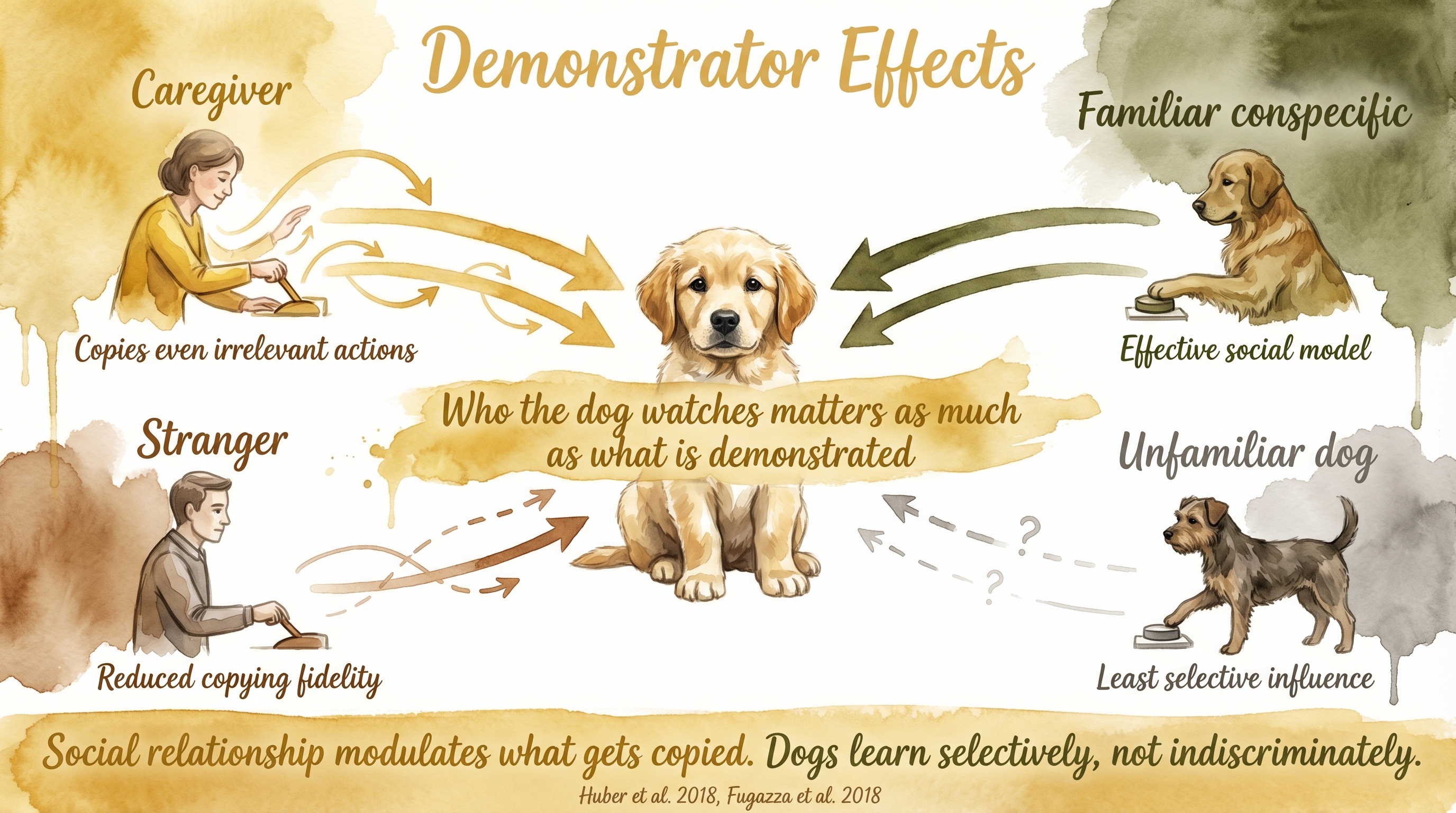
Who demonstrates matters as much as what is demonstrated - dogs learn preferentially from familiar, calm, high-status models.
Key Takeaways
- Who the dog is watching matters, not just what is being demonstrated.
- Dogs learn differently from caregivers, strangers, humans, and canine demonstrators.
- Breed selection history changes which demonstrator channel tends to carry the strongest advantage.
- These findings support selective social learning, not indiscriminate copying.
The Evidence
This entry uses observed claim-level tags beyond the dedicated EvidenceBlocks below. These tags mark JB program observation or practice-derived claims that need dedicated EvidenceBlock coverage in a later content pass.
- Fugazza, C. et al. (2018)domestic dogs
Puppies learned from both canine and human demonstrators, and demonstrator type altered performance patterns. - Huber, L. et al. (2018)domestic dogs
Dogs copied irrelevant actions from caregivers much more readily than from unfamiliar experimenters. - Huber, L. et al. (2022)domestic dogs
Explored whether relationship quality modulates overimitation, reinforcing the social-bond relevance of the demonstrator.
- Dobos, P., & Pongracz, P. (2023)domestic dogs
Found that breeds selected for human cooperation show stronger social-learning gains from human demonstrators. - Lugosi, C. A. et al. (2024)domestic dogs
Found that breeds selected for functional independence show stronger gains from conspecific demonstrators than cooperative breeds do.
- SCR synthesisdomestic dogs
The science supports selective sensitivity to different models, but exact household-level mentorship prescriptions remain an applied interpretation rather than a completed causal map.
No study has yet mapped the relative contribution of demonstrator identity, social relationship, and breed history in natural home environments versus controlled laboratory settings.
SCR References
Sources
- Dobos, P., & Pongracz, P. (2023). Would you detour with me? Association between functional breed selection and social learning in dogs sheds light on elements of dog-human cooperation. Animals, 13(12), 2001.
- Fugazza, C., Moesta, A., Pogany, A., & Miklosi, A. (2018). Social learning from conspecifics and humans in dog puppies. Scientific Reports, 8, 9257.
- Huber, L., Popovova, N., Riener, S., Salobir, K., & Cimarelli, G. (2018). Would dogs copy irrelevant actions from their human caregiver? Learning & Behavior, 46(4), 387-397.
- Huber, L., Kubala, D., & Cimarelli, G. (2022). Overimitation in dogs: Is there a link to the quality of the relationship with the caregiver? Animals, 12(3), 326.
- Lugosi, C. A., Udvarhelyi-Toth, K. M., Dobos, P., & Pongracz, P. (2024). Independent, but still observant: Dog breeds selected for functional independence learn better from a conspecific demonstrator than cooperative breeds in a detour task. BMC Biology, 22(1), 245.