Innate Versus Conditioned Signals
Puppies are not born knowing household vocabulary, but they are not blank social slates either. Retriever-puppy research shows that very young puppies arrive already prepared for some human communicative signals, especially gesture and face-oriented social information. The stronger JB framing, that natural social signals and engineered cue systems are fundamentally different communication architectures, is a reasoned synthesis built on top of that finding rather than a one-study conclusion. Documented
What It Means
The cleanest documented starting point is Bray and colleagues' retriever-puppy work. They tested 375 puppies between eight and ten weeks of age, a developmental window that matters enormously for JB because it overlaps the breeder-to-family transition. These were not mature family dogs with months of individualized training history. They were very young retriever puppies who had spent nearly all of their lives with dam and littermates.
The results were unusually strong. The puppies followed a human pointing gesture to hidden food at high rates and showed a robust tendency to attend to human faces. Documented Just as important, performance did not improve across twelve trials. There was no meaningful learning curve. That flat curve is the key scientific detail because it argues against a simple trial-by-trial conditioning explanation. The puppies looked ready from the start.
That is what "innate" means in the careful sense used here. It does not mean every possible human cue is pre-installed in the dog. It does not mean puppies understand English, house rules, or your personal preferences. It means the species, or at least retrievers in this sample, appears biologically prepared for certain forms of interspecific social communication before formal teaching history could plausibly explain the result.
The breed scope matters. Bray worked with retrievers, including Golden Retrievers. That is a strength for JB because it puts our breed directly inside the evidence base instead of asking us to borrow the claim from some distant population. Heuristic It is also a limit. The safest statement is strongest for retrievers and weaker for every breed on earth.
Once that groundwork is clear, the contrast with conditioned signals becomes much easier to see. A pointed finger, ostensive face orientation, and certain body-language cues seem to land in a system the puppy is already prepared to use. Mixed Evidence A clicker, a marker word, or the verbal command "sit" does not. Those signals become meaningful through experience, pairing, repetition, and contingency. They are learned vocabularies, not ready-made social affordances.
This does not make conditioned signals fraudulent. It only locates them correctly. They are constructed systems. The human builds them. The dog learns them. They can become reliable and useful, but they are not the same kind of thing as a signal the puppy was already organized to notice on day one.
That difference matters because modern dog culture often blurs the categories. People speak as if all cues are just cues, with the only question being how clearly or often they are reinforced. The notebook pushes against that flattening. Natural social signals and conditioned cue systems may both influence behavior, but they operate through different developmental histories. One channel arrives partly open. The other has to be installed.
The D'Aniello incongruent-information finding helps on the practical side of that contrast. When human gesture and human voice conflicted, dogs gave heavier weight to the gestural channel. That is not the same claim as Bray's innate-preparedness result, but the two fit together well. If the dog is socially prepared for bodily and directional information, it makes sense that the body can outrank speech when the channels disagree.
This is also why families so often think their dog is "ignoring words" while still responding quite accurately to posture, hand motion, pace, and direction. From the dog's perspective, the older channel may still be the clearer one. The human may be speaking a constructed vocabulary the dog only partly knows while simultaneously broadcasting a body-language message the dog reads with far less effort.
JB's phrase "pre-loaded language" is useful if it is handled carefully. The evidence does support the idea that retriever puppies are born prepared for some human social-communicative signals. Documented The phrase becomes too strong when it implies a fully formed grammar or a comprehensive built-in lexicon. The safer version is narrower: some social-signal channels are evolutionarily prepared, whereas conditioned vocabularies are acquired through experience.
That narrower formulation is already powerful. It means the early bond does not start with an empty receiver waiting for words to be attached one by one. It starts with a puppy who can already be reached by body, point, orientation, face, and tone contour before a formal cue system is fully in place. The family therefore has more communication available on day one than it may realize.
SCR-004 becomes relevant at the boundary. The notebook is careful not to confuse natural social communication with engineered training protocols. Operant processes exist in nature, of course. The narrower claim is that the specific human-designed mark-reward architecture has no documented natural canine analog as a standalone developmental system. That does not abolish conditioned learning. It simply means it should not be mistaken for the same thing as an evolved social signal channel.
An everyday analogy is a human infant who can follow gaze, orient to voice, and respond to pointing before learning the meaning of specific nouns. The infant is not blank, and the infant is not finished. Puppies seem to work that way too. Some channels are ready early. Others are built later.
Why It Matters for Your Dog
For families, this entry changes the first-month question from "how fast can I install vocabulary?" to "how clearly am I using the communication channels the puppy already has?" That is a major shift, because it places posture, orientation, calm gesture, and social readability upstream of word count.
It also explains why some homes get strange results from heavy verbalization. The adults may be pouring effort into a conditioned system that is still under construction while neglecting the older, clearer channel already available to the puppy. That does not mean words should disappear. It means words should ride on top of legible social information instead of trying to replace it.
Mentorship works so early because the puppy is not waiting to be taught how to notice the adult. The puppy already arrives prepared to read meaningful parts of the adult social signal set.
This also supports JB's larger raising-not-training distinction without exaggeration. Families do not need to reject learned cue systems to understand that a socially prepared puppy may grow best when the home first becomes a clear, readable organism rather than a nonstop vocabulary lesson.
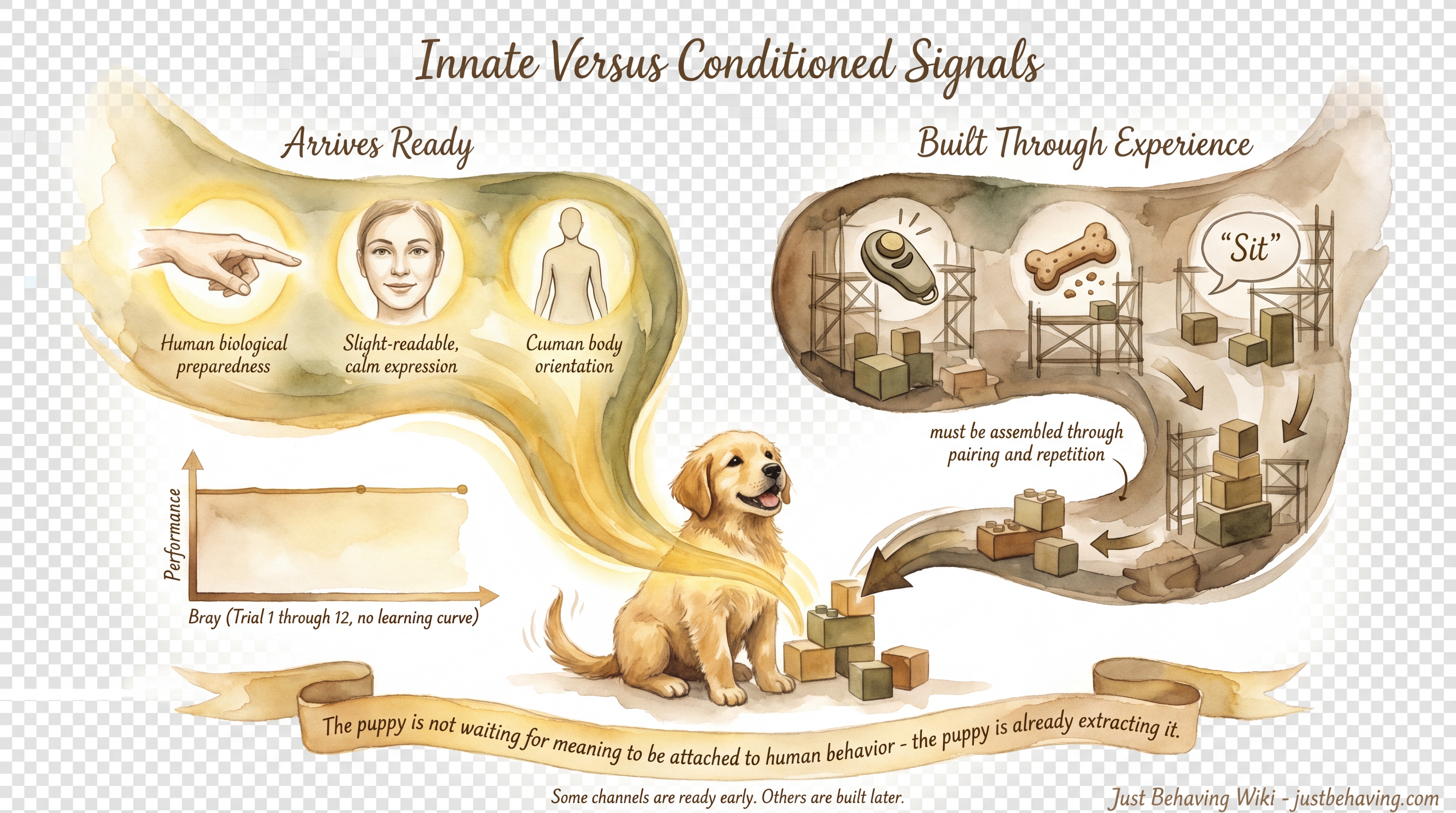
Dogs arrive with innate sensitivity to certain social signals while conditioned signals like clicker sounds must be built from scratch, a distinction that shapes how communication should be designed.
Key Takeaways
- Retriever puppies are biologically prepared for some human communicative signals by eight to ten weeks, which means the bond does not begin with an empty social receiver.
- Pointing, face-oriented social attention, and other evolved channels are different from constructed cue systems such as verbal commands and marker words.
- Conditioned signals can still be useful, but they have to be learned through experience rather than arriving pre-installed.
- Families usually communicate better in the first month when words ride on top of clear body language instead of trying to replace it.
The Evidence
This entry uses mixed-evidence claim-level tags beyond the dedicated EvidenceBlocks below. These tags mark claims that combine documented findings with observed practice, heuristic application, or unresolved gaps.
- Bray, E. E. et al. (2021)retriever puppies including Golden Retrievers
Tested 375 puppies aged 8 to 10 weeks and found strong human-gesture use and face-oriented social attention with no learning curve across twelve trials. - SCR-051 synthesisretriever puppies including Golden Retrievers
Summarizes the Bray finding as early-emerging and highly heritable sensitivity to human communication within retriever puppies.
- D Aniello, B. et al. (2016)domestic dogs
Showed that dogs weight gestural information more heavily than vocal information when the channels conflict. - Fugazza, C. et al. (2018)dog puppies
Showed that very young puppies can learn from human and conspecific demonstration, reinforcing that the social channel is open early in development.
- SCR-004 boundarydomestic dogs
The claim that engineered cue systems are categorically different from evolved social signals is a reasoned ethological framing, not a direct one-study proof that the two channels never interact. - JB pre-loaded-language synthesisfamily-raised retrievers
JB uses the phrase pre-loaded language to capture functional readiness for some social signals, but the phrase should not be mistaken for a claim that puppies arrive with a full built-in vocabulary.
No published developmental study has yet mapped exactly which human signal classes are evolutionarily prepared in puppies and which ones require substantial experience to become reliable.
The literature establishes early readiness for some channels, but it has not yet quantified how much early household success is explained by innate social-signal recognition versus rapidly acquired conditioned vocabulary.
SCR References
Sources
Bray, E. E., Gnanadesikan, G. E., Horschler, D. J., Levy, K. M., Kennedy, B. S., Famula, T. R., & MacLean, E. L. (2021). Early-emerging and highly heritable sensitivity to human communication in dogs. Current Biology, 31(14), 3132-3136. https://doi.org/10.1016/j.cub.2021.04.055
D'Aniello, B., Semin, G. R., Alterisio, A., Aria, M., & Scandurra, A. (2016). The importance of gestural communication: A study of human-dog communication using incongruent information. Animal Cognition, 19(6), 1231-1235. https://doi.org/10.1007/s10071-016-1020-2
Fugazza, C., Moesta, A., Pogany, A., & Miklosi, A. (2018). Social learning from conspecifics and humans in dog puppies. Scientific Reports, 8, 9257. https://doi.org/10.1038/s41598-018-27654-0