Spontaneous Recovery and Relapse
Spontaneous recovery and relapse are not side notes in extinction science. They are the reason JB treats prevention as superior to correction. If a behavior returns after time, after a context change, after one accidental reinforcement, or after only brief re-exposure, then the original learning was never truly gone. Documented
What It Means
The phrase "the dog started doing it again" sounds like ordinary household frustration. In learning theory, it is a clue.
Relapse phenomena show that an extinguished behavior has been suppressed, not deleted. Documented Bouton's work organizes that return into four recurring patterns:
Spontaneous recovery. The behavior comes back after time has passed, even if nothing obvious triggered it. The extinction memory weakens faster than the original association. Documented
Renewal. The behavior returns when the context changes. A dog that appears finished with a behavior at home suddenly performs it somewhere else because the inhibitory learning was attached to the training context. Documented
Reinstatement. A brief return of the original reinforcer can revive the old pattern. One guest who rewards jumping, one family member who laughs at mouthing, one exciting repetition after weeks of consistency can restart the circuit. Documented
Rapid reacquisition. When the old conditions return, relearning is faster than the first time. That speed-up is powerful evidence that the original trace remained in place under the surface.
The practical point is not that every extinguished behavior comes roaring back constantly. The point is that relapse belongs to the structure of extinction itself. Households do not fail because they are uniquely inconsistent. They fail because normal life supplies exactly the ingredients relapse needs.
Only one of these mechanisms - renewal - currently has direct canine evidence in the SCR via Gazit and colleagues. The broader relapse framework comes mainly from rodent and general learning literature, with canine application inferred from conserved learning processes. JB therefore needs to speak carefully. The mechanisms are robustly documented. Their day-to-day puppy examples remain application and translation.
Why It Matters for Your Dog
Relapse is what makes correction expensive over the long run.
A family can spend weeks suppressing a behavior and still face:
- its return after a vacation
- its return in a different house
- its return after one careless guest
- its faster return the second time around
Relapse is not evidence that the dog is manipulative or that the family failed morally. It is evidence that extinction leaves the original learning intact enough to recover.
This is why JB frames prevention as freedom from maintenance. A behavior that never achieved a real learning history has no spontaneous recovery, no renewal, no reinstatement, and no rapid reacquisition because there is no trace to recover. Documented
That difference matters most in family life, where people cannot create laboratory-perfect control over every visitor, room, routine, and emotional state.
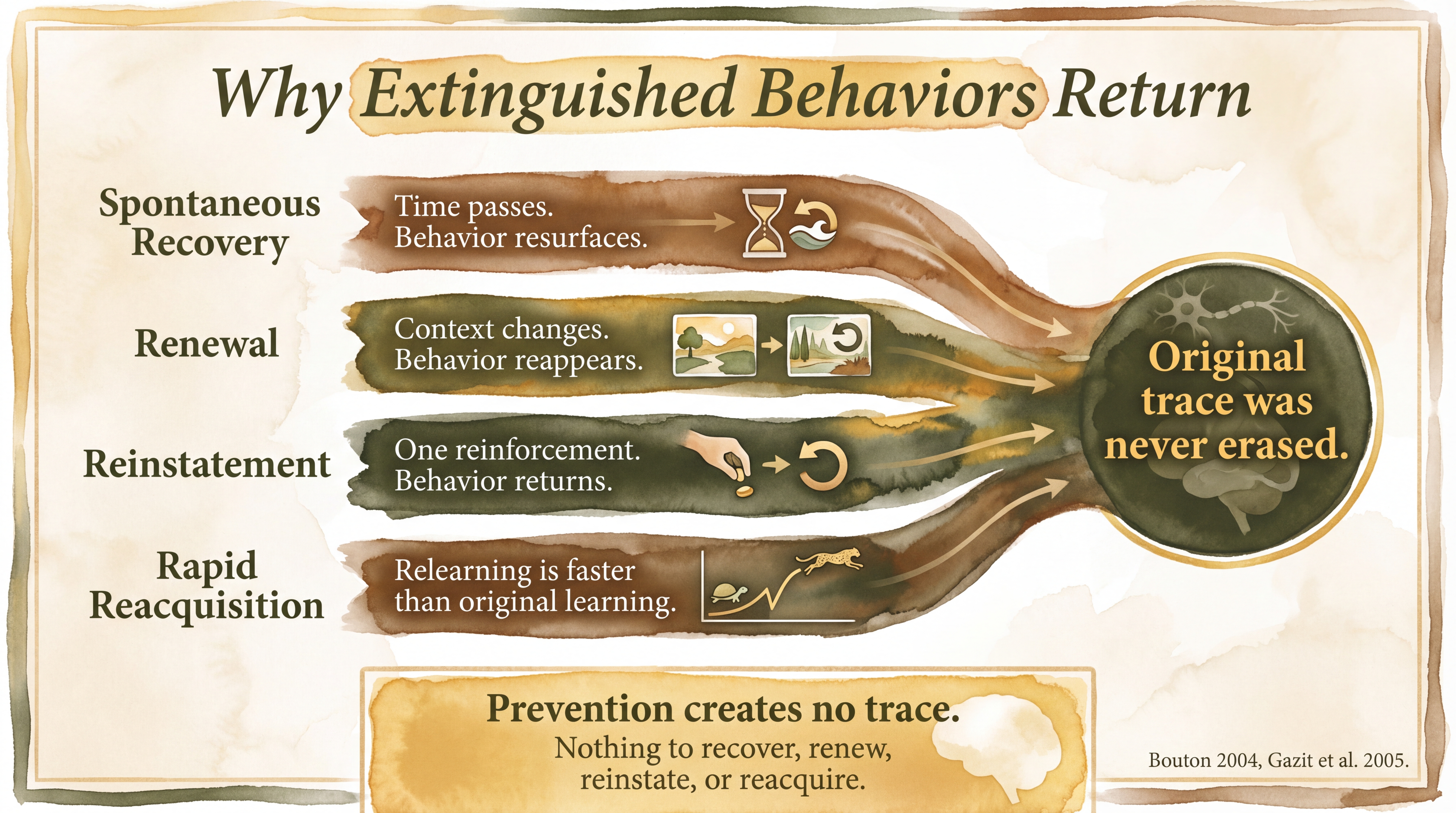
Four ways an extinguished behavior comes back - because the original trace was never erased.
Key Takeaways
- A behavior that was corrected can come back on its own after time passes, when the setting changes, or when someone accidentally reinforces it again - this is called relapse and it is normal, not a sign of failure.
- Once a dog has practiced a behavior many times, relearning it after correction happens much faster than the first time around, proving the original learning was never truly erased.
- Prevention avoids the entire relapse problem by keeping behaviors from becoming real learned patterns in the first place, which means freedom from constant maintenance.
The Evidence
- Pavlov, I. P. (1927)domestic dogs, historical conditioning work
First described spontaneous recovery after conditioned responses had apparently been extinguished. - Bouton, M. E. (2004)general learning models
Synthesized spontaneous recovery, renewal, reinstatement, and rapid reacquisition as core relapse mechanisms demonstrating persistence of original learning. - Gazit, I., Goldblatt, A., & Terkel, J. (2005)domestic dogs
Showed renewal in explosives detection dogs when behavior suppressed in one context reappeared in a different one.
Examples such as jumping returning at a relative's house or mouthing returning after a single slip are practical translations of the relapse framework. They are conceptually faithful to the science but are still applications rather than laboratory demonstrations of each exact household scenario.
No published study directly tests the specific claims or protocols described in this entry within a controlled canine trial.
SCR References
Sources
- Bouton, M. E. (2004). Context and behavioral processes in extinction. Learning & Memory, 11(5), 485-494.
- Gazit, I., Goldblatt, A., & Terkel, J. (2005). Explosives detection by dogs following an enhanced nose work training protocol. Applied Animal Behaviour Science, 90(3-4), 217-224.
- Rescorla, R. A. (2004). Spontaneous recovery. Learning & Memory, 11(5), 501-509.