Learned Controllability and Resilience
Resilience is not only about what the dog endures. It is also about what the dog learns to expect from the relationship and the environment around it. The controllability literature shows that predictable structure builds agency, while the attachment literature shows why that predictability is especially powerful when it comes through a stable caregiver. Documented
What It Means
The original helplessness experiments were conducted in dogs, and they remain historically important and ethically sobering. Dogs exposed to uncontrollable adversity later failed to act even when escape became possible. For years the story was told as learned helplessness. The later revision was sharper: passivity is the default under prolonged uncontrollable stress, and what organisms actually learn is controllability. Documented
That revision matters because it changes how resilience is understood. Resilience is not grit in the abstract. It grows when the organism can detect that action, signal, and consequence fit together in a legible way. In the modern neuroscience account, this involves prefrontal detection of controllability and inhibition of the default fear-passivity response. That circuitry was mapped in rodents, not in dogs, which is why the canine application must stay bounded.
Maier and Seligman describe a specific logic. Under severe uncontrollable stress, passivity is the built-in response. The animal does not need to learn defeat from scratch. What changes the picture is evidence of control. When outcomes become contingent on action, the medial prefrontal cortex detects that contingency and exerts top-down inhibition over the dorsal raphe nucleus, damping the stress cascade that otherwise supports passive, fearful responding. In plain language, the brain shifts from "nothing I do matters" to "my behavior can organize what happens next."
That level of detail matters because it protects the page from fuzzy motivational language. Controllability is not simply confidence. It is not generic optimism. It is the nervous system learning that action and outcome belong together in a reliable way. The organism can then stay cognitively online under challenge instead of dropping into passive non-response.
The species boundary still has to be stated clearly. The original behavioral phenomenon was established in dogs. The modern circuit map was established in rodents, and Maier and Seligman explicitly note that canine experiments ended before the biological mapping phase. So the claim divides in two. Dogs gave the field the foundational behavioral observation. Rodent work provided the mechanism. Carrying the mechanism back into dog-human raising is a strong mammalian inference, not a completed canine imaging result.
Once that distinction is clear, the practical translation becomes more technical and less sentimental. A controllability-rich household is one in which the dog can detect lawful connections between behavior and consequence. Sit calmly at the door and the door opens. Jump and the interaction pauses. Settle after excitement and access resumes. Walk into novelty with a readable adult and the situation stays parseable instead of chaotic. Those are not just manners lessons. They are repeated demonstrations that the environment has structure and that behavior can matter inside it.
That does not mean the household must become robotic or emotionally flat. Predictability is not sameness for its own sake. It means that the important contingencies stay legible enough for the dog to learn from them. The adult can still be warm, flexible, and alive. What the adult cannot be, if resilience is the goal, is random. The dog needs to be able to infer what the world is likely to do next.
The relationship lens matters here. A predictable caregiver is part of what makes the environment legible. When the same adult provides consistent boundaries, readable routines, and calm recovery after stress, the dog is not only receiving structure. The dog is learning that the social world can be interpreted and navigated rather than merely endured.
This is also where JB's Structured Leadership language fits unusually well. Consistent boundaries, calm adults, and reliable routines do not reduce freedom because they create a map. The dog does not have to guess whether today's rule is different from yesterday's or whether the adult will suddenly change intensity. In technical controllability terms, the household becomes legible enough for agency to be learned rather than randomly blocked.
That also shows why prevention and indirect correction belong in the same conversation. Prevention reduces the number of chaotic, high-cost learning episodes the dog has to absorb. Indirect correction, when it is calm and readable, preserves the link between action and outcome without tipping the dog into fear or confusion. Both pillars can therefore be understood as ways of protecting controllability inside the relationship rather than as isolated management tricks.
That is why challenge alone does not build resilience. Challenge inside chaos is just chaos. What helps is challenge nested inside enough predictability for the dog to recover, re-engage, and discover that effort matters. A routine, a boundary, or a correction that arrives in a calm and legible way tells the dog something very different from a rule that appears randomly or an adult whose behavior is impossible to parse.
This is why controllability belongs inside Category 12 and not only inside general behavioral science. The dog does not learn agency in a vacuum. Agency is often learned inside a bond. A relationship that is calm enough and consistent enough helps turn the environment from chaos into something usable.
The opposite is worth stating plainly as well. A loving but erratic household can still be low in controllability. If routines move constantly, boundaries shift by mood, and adults alternate between indulgence and frustration, the dog may receive plenty of affection while still learning very little about how to influence the environment successfully. Documented Predictability and warmth are not enemies here. They are partners.
This also guards against a common misunderstanding. Controllability does not mean the dog gets to negotiate every outcome or run the household by trial and error. It means the dog can discover stable links between behavior and consequence inside an adult-led environment. Agency in this sense is compatible with structure. In fact, structure is what makes agency learnable.
The attachment literature adds a second layer of support here. Documented Schoberl shows that attachment security changes cortisol regulation during challenge, and Coppola shows that human contact alone can reduce physiological stress cost in dogs. Those findings are not direct controllability experiments. They do show why relationship quality is the right place to apply the framework. If the caregiver changes what stress feels like, then the caregiver is also part of the environment in which agency is either learned or blocked.
One everyday analogy is learning to drive with a calm instructor rather than with an erratic one. The road is still demanding in both cases. What changes is whether the learner can connect action to outcome cleanly enough to build confidence. That is close to the difference between controllability and mere exposure.
Why It Matters for Your Dog
Families often think resilience means giving the dog more challenge. The stronger lesson is narrower and more useful. Resilience grows best when challenge sits inside predictability. A dog who cannot tell what the adults mean, what the rules are, or how recovery works is not learning bravery. That dog is spending energy inside interpretive chaos.
Learned controllability helps explain why JB treats consistent household structure as a developmental gift. The dog learns that behavior matters because the adults make the world readable.
This also protects families from overclaiming neuroscience. JB can responsibly say that predictable relationship structure is consistent with established controllability science. JB should not say that the full mPFC-DRN circuitry has already been directly demonstrated in ordinary household dogs. The practical guidance stays firm. The mechanism stays honestly hedged.
For families, that means resilience is built less by dramatic challenge programs than by ordinary daily legibility. Doors, greetings, departures, meals, rest periods, and recoveries after excitement all teach the dog whether behavior connects to consequence in a world that makes sense. Documented Those repeated, quiet lessons are often where durable resilience begins.
The deepest lesson is simple: a readable world is easier for a young dog to be brave in.
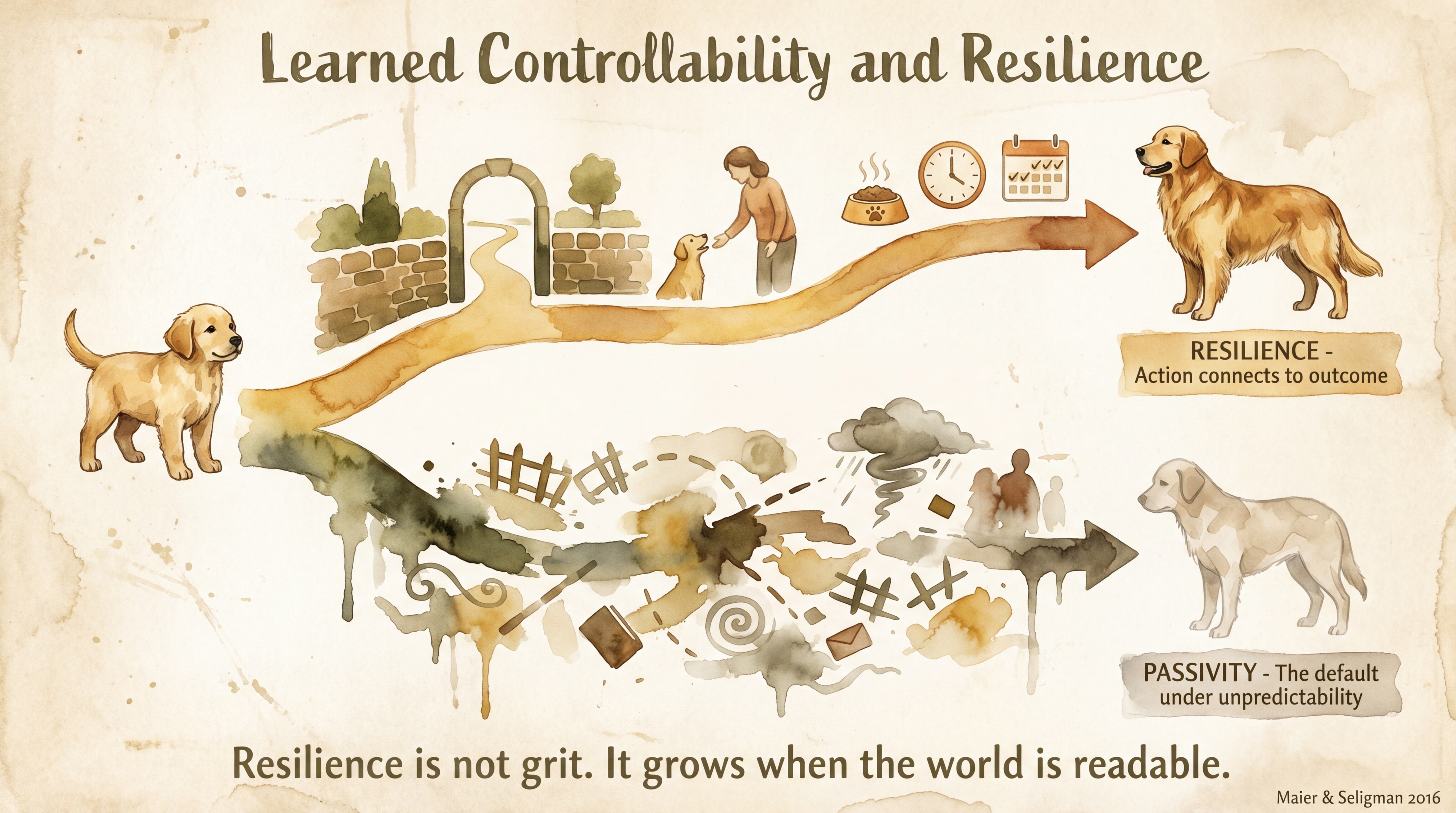
Predictable environments and reliable caregiving build resilience by teaching dogs that their world is controllable and responses matter.
Key Takeaways
- The controllability literature shifted the focus from learned helplessness to learned agency under predictable conditions.
- Dogs first established the core behavioral phenomenon, but the detailed modern neural circuitry was mapped in rodents rather than in household dogs.
- Predictable caregiving matters because agency is often learned inside a relationship, not outside one.
- A stable, readable adult helps convert challenge into resilience rather than confusion.
The Evidence
- Overmier, J. B., and Seligman, M. E. P. (1967)domestic dogs
Established the original behavioral phenomenon in which uncontrollable adversity impaired later adaptive responding even when escape later became possible. - Maier, S. F., and Seligman, M. E. P. (2016)multiple mammals
Reframed the theory by arguing that passivity is the default and that organisms learn controllability through predictable conditions, with the modern mechanism centered on medial prefrontal detection of control and inhibition of dorsal raphe stress signaling.
- Schoberl, I. et al. (2016)domestic dogs and humans
Showed that attachment security changes canine stress buffering, supporting the broader claim that bond quality shapes how challenge is processed. - Coppola, C. L. et al. (2006)domestic dogs
Found that human contact alone reduced cortisol in shelter dogs, showing that relationship conditions can alter physiological cost.
- SCR-020 boundarydomestic dogs and multiple mammals
The controllability framework is documented, but direct canine confirmation of the specific modern prefrontal circuitry remains absent. - JB synthesisdomestic dogs
Applying controllability science to calm household structure is a strong developmental inference, not a completed canine neuroimaging result.
No published puppy trial has directly compared predictable versus erratic caregiving environments and then measured long-term resilience outcomes as a formal developmental endpoint.
SCR References
Sources
- Coppola, C. L., Grandin, T., and Enns, R. M. (2006). Human interaction and cortisol: Can human contact reduce stress for shelter dogs? Physiology and Behavior, 87(3), 537-541. https://doi.org/10.1016/j.physbeh.2005.12.001
- Maier, S. F., and Seligman, M. E. P. (2016). Learned helplessness at fifty: Insights from neuroscience. Psychological Review, 123(4), 349-367. https://doi.org/10.1037/rev0000033
- Overmier, J. B., and Seligman, M. E. P. (1967). Effects of inescapable shock upon subsequent escape and avoidance responding. Journal of Comparative and Physiological Psychology, 63(1), 28-33.
- Schoberl, I., Beetz, A., Solomon, J., Gee, N., Kotrschal, K., and Wedl, M. (2016). Social factors influencing cortisol modulation in dogs during a strange situation procedure. Journal of Veterinary Behavior, 11, 77-85. https://doi.org/10.1016/j.jveb.2015.09.007