Deferred Imitation and Episodic-Like Memory
Deferred imitation means a dog can watch an action now and reproduce it later rather than only in the instant of observation. Episodic-like memory means the dog appears able to encode and later retrieve a memory of an observed event in a way that goes beyond simple immediate mimicry. Together, these findings make adult example more developmentally powerful than a one-moment copying story would suggest. Documented
What It Means
Many social-learning claims become less impressive once the delay disappears. If an observer copies only while the demonstrator is still present, the safest explanation may be simple arousal, attention, or immediate imitation pressure. The literature gets much more consequential when the observed event is retained and later used after the original scene has ended.
Fugazza and Miklosi's 2014 deferred-imitation paper is one of the clearest canine demonstrations of that stronger standard. Dogs were able to retain imitated behaviors over time rather than only in the exact moment they saw them. That matters because it shows that observation can produce memory, not merely momentary activation.
The 2016 Current Biology paper goes even further and is the more philosophically important result. Fugazza, Pogany, and Miklosi asked whether dogs could remember others actions after incidental encoding. The dogs observed a human perform an action, but they were not cued to imitate and had no obvious reason to expect that the observation would matter later. After a delay, they were unexpectedly given the imitation cue and reproduced the observed action.
That design changes everything. When an animal stores information it was not deliberately rehearsing for immediate use, the resulting memory looks very different from a standard stimulus-response chain. The dog was not simply primed by an obvious training setup. The dog encoded an event that later became behaviorally available.
This is why the term episodic-like memory gets used. The phrase is intentionally cautious. Researchers are not claiming that dogs possess human autobiographical memory in full reflective detail. They are claiming that dogs can remember something about a specific past event in a manner analogous to one important aspect of episodic memory. The "like" in the term is not decorative. It is the scientific guardrail.
Even with that caution, the result is big. A dog that can observe an act, store it incidentally, and retrieve it later is not learning in the same narrow way we usually picture when people talk about dog training. Observed-JB The representation is broader. The dog is carrying a memory of what someone else did through time and context.
That matters directly for the bond category because much of family life is not formal teaching. The puppy watches adults go through doorways, settle after visitors leave, react to new sounds, move around food, and recover after surprise. Documented Nobody announces that the lesson has started. Nobody always follows with a marker or a reward. If the dog has a documented capacity for deferred imitation and episodic-like memory, then those ordinary events become plausible developmental input rather than invisible background.
The DAID framework helps make sense of how this works, but the memory findings go beyond DAID as a narrow training protocol. Once the generalized imitation rule exists, the later papers show that the dog can use stored observational information more flexibly than a pure "copy now" account would allow. Documented The social model does not have to stay in the room for the lesson to keep working.
Fugazza and colleagues' 2023 cross-species action-matching work adds another important layer. Spontaneous action matching was documented in dog puppies, kittens, and wolf pups. That does not prove episodic-like memory in every one of those populations, but it does strengthen the idea that the broader capacity for socially guided action matching emerges early and is not limited to mature, intensively trained adult dogs.
This is where the mentorship model becomes much more concrete. If a puppy can carry forward observed events, then calmness and structure do not only matter in the immediate moment they are shown. They matter because they may be shaping what the puppy later reaches for when the adult is absent. That is the developmental value of a trustworthy model. The example keeps working after the example ends.
We still need restraint. The literature does not yet tell us exactly how often puppies store everyday household moments this way, how long those memories persist in natural settings, or which categories of observed behavior are most likely to be retained. Observed-JB The experimental work proves the capacity. It does not yet give a full map of its real-world distribution.
An everyday analogy is watching an experienced cook once and then finding yourself able to reproduce part of the sequence the next day, even though nobody told you to memorize it. You did not just copy motion. You carried an event forward and used it when the situation called for it.
Why It Matters for Your Dog
For families, this entry matters because it raises the developmental cost of casual adult behavior. If dogs can encode observed events more deeply than simple momentary copying, then the home is teaching even when nobody has decided to teach. The puppy may be storing how adults recover, pause, wait, orient, and settle, not only what formal cues mean.
Deferred imitation is one of the clearest reasons JB treats everyday example as active teaching. The dog does not only respond in the moment. The dog can carry the adult example forward.
This is also why calmness and readability matter so much in the first months. A noisy household teaches noisily through memory as well as through immediate arousal. A calm household gives the puppy better material to store. The question is not only what the puppy does while the adult is present. The question is what the puppy reaches for later because of what the adult showed.
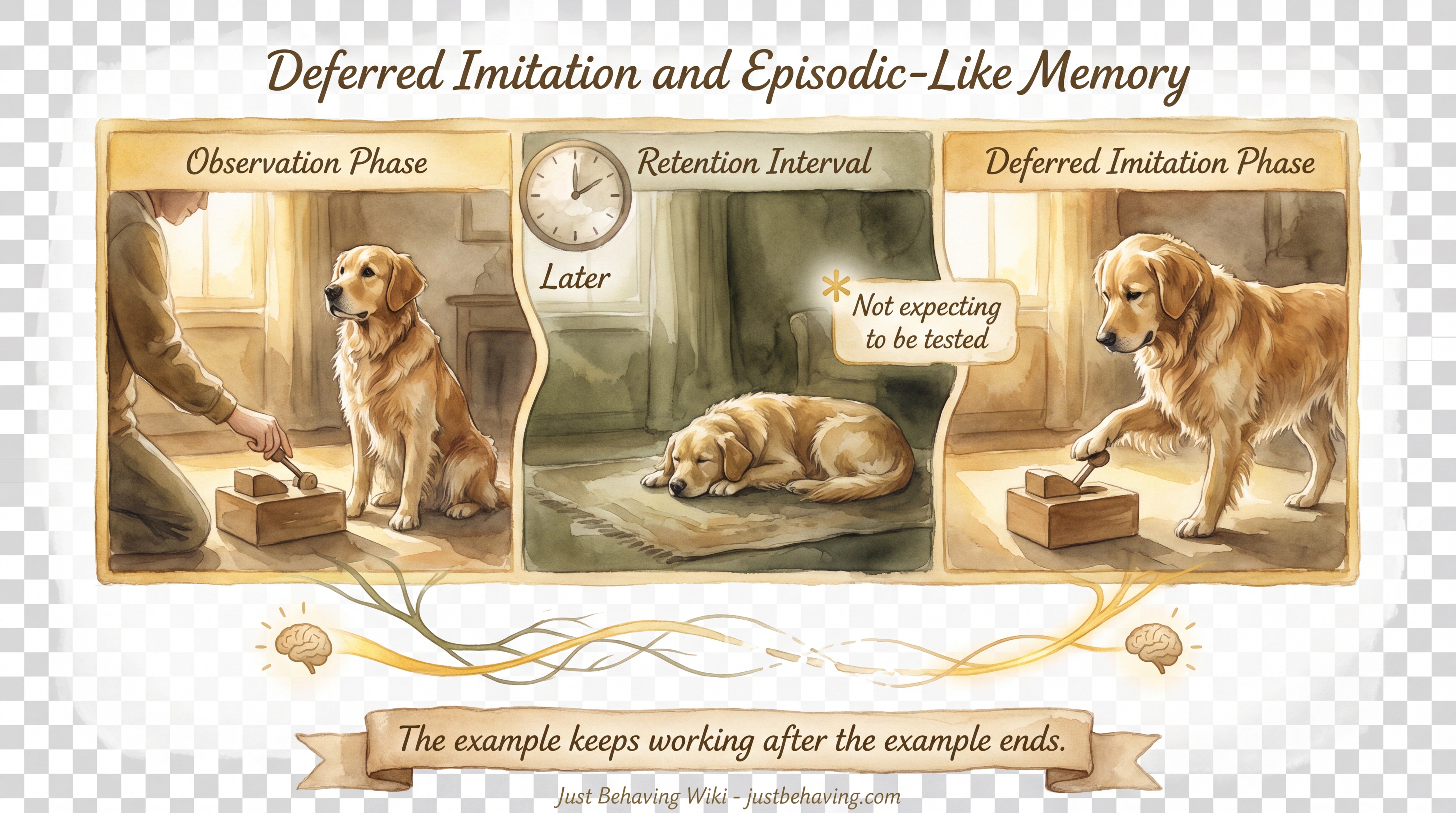
Dogs can reproduce observed actions after a delay without immediate practice, suggesting a form of episodic-like memory that supports social learning across time.
Key Takeaways
- Deferred imitation shows that dogs can retain observed actions and use them later rather than only in the moment of copying.
- Episodic-like memory is the cautious term for the finding that dogs can encode and later retrieve a memory of an observed event.
- That matters for family life because many of the strongest household lessons are demonstrated casually rather than taught formally.
- The science documents the capacity itself, while the exact real-world frequency and duration of these memories in ordinary puppy homes remain less mapped.
The Evidence
This entry uses observed claim-level tags beyond the dedicated EvidenceBlocks below. These tags mark JB program observation or practice-derived claims that need dedicated EvidenceBlock coverage in a later content pass.
- Fugazza, C., and Miklosi, A. (2014)domestic dogs
Demonstrated deferred imitation, showing that dogs retained observed actions beyond immediate copying. - Fugazza, C., Pogany, A., and Miklosi, A. (2016)domestic dogs
Showed incidental encoding and later recall of others actions, which the authors interpreted as evidence of episodic-like memory for observed events.
- Topal, J. et al. (2006)domestic dogs
Provided the broader Do As I Do framework showing that dogs can reproduce demonstrated human actions and action sequences. - Fugazza, C. et al. (2023)dog puppies, kittens, and wolf pups
Documented spontaneous action matching in young carnivores, reinforcing that socially guided action matching appears early in development and across related species.
- SCR-009 boundarydomestic dogs
The memory studies show that dogs can retain and later use observed information, but the exact frequency and strength of this process in ordinary household moments remains less directly measured than the laboratory tasks themselves.
No published naturalistic study has yet quantified how often puppies later reproduce or emotionally rely on everyday observed family routines outside structured social-learning experiments.
SCR References
Sources
- Fugazza, C., & Miklosi, A. (2014). Deferred imitation and declarative memory in domestic dogs. Animal Cognition, 17(2), 237-247. https://doi.org/10.1007/s10071-013-0656-5
- Fugazza, C., Petró, E., Miklosi, A., & Pogany, A. (2023). Spontaneous action matching in dog puppies, kittens and wolf pups. Scientific Reports, 13, 4147. https://doi.org/10.1038/s41598-023-31156-7
- Fugazza, C., Pogany, A., & Miklosi, A. (2016). Recall of others actions after incidental encoding reveals episodic-like memory in dogs. Current Biology, 26(23), 3209-3213. https://doi.org/10.1016/j.cub.2016.09.057
- Topal, J., Byrne, R. W., Miklosi, A., & Csanyi, V. (2006). Reproducing human actions and action sequences: Do as I Do in a dog. Animal Cognition, 9(4), 355-367. https://doi.org/10.1007/s10071-006-0051-6