Olfactory Stress Detection
Dogs do not need a human face, voice, or gesture to detect human stress. Controlled scent studies now show that dogs can discriminate baseline versus stress odor from humans, and later work suggests that stress odor can shift how dogs think and learn. The direct evidence is strongest with unfamiliar people. The familiar-owner household application is plausible, but it still needs careful language. Mixed Evidence
What It Means
When people talk about emotional contagion, they often picture body language, tone of voice, or movement quality. Dogs absolutely use those channels. But the olfactory work adds something deeper and harder to fake. Dogs can read chemistry. Human stress is not only visible. It is smellable.
Wilson et al. (2022) provided the clearest proof-of-principle study. Documented Four trained dogs were presented with breath and sweat samples taken from human participants before and after a laboratory stress task. The human participants did not merely report feeling stressed. They also showed physiological changes such as increased heart rate and blood pressure. The dogs successfully discriminated baseline from stress samples in a controlled within-person design, which is important because it reduces the chance that they were simply sorting different people rather than different states.
That is a major result even before we talk about household application. It means there is enough odor difference between baseline and acute psychological stress for dogs to detect it under controlled conditions. The dog does not need a dramatic behavioral display from the human. The human body is already broadcasting information chemically.
The study is also worth understanding as a proof-of-principle rather than as a prevalence study. Documented Only four dogs reached the testing phase, which is a small number. But the question was not whether all dogs in the population can do this under casual conditions. The question was whether a carefully controlled design could show that a genuine odor difference exists at all. On that narrower question, the answer was yes.
Parr-Cortes et al. (2024) takes the next step. In that study, 18 dogs were exposed to odor from unfamiliar stressed or relaxed humans before performing a cognitive bias task. In a cognitive bias paradigm, dogs are trained to distinguish a rewarded location from an unrewarded location, then tested with an ambiguous intermediate position. Approaching the ambiguous position more quickly is interpreted as a more optimistic or reward-expecting bias, while slower approach is interpreted as a more pessimistic or risk-averse bias.
After exposure to stress odor, the dogs became more hesitant with the ambiguous cue. Ambiguous In other words, the odor of human stress appeared to bias the dogs toward a more negative or cautious interpretation of uncertainty. That is a much stronger result than simple odor discrimination. It suggests that human stress odor can affect canine cognition and decision-making, not just canine detection ability.
That leap from detection to cognitive effect is exactly what makes the Parr-Cortes paper so important for JB. A dog who merely notices stress odor is one thing. A dog whose expectation about an uncertain task shifts after smelling stress odor is another. The second finding says the odor channel can alter how the dog approaches ambiguity, reward, and possibly learning itself. That makes the human physiological state part of the dogs working mind, not only part of the dogs sensory environment.
This is exactly why the page belongs in Category 12. The finding is not merely that dogs have impressive noses. The finding is that the human physiological state can alter the dogs internal processing through a channel the human may not even realize is active. Calmness, in JB language, becomes more than posture management. The body itself is part of the signal.
The boundary line, however, matters a great deal. Both the Wilson and Parr-Cortes studies used odor from unfamiliar people, not from the dogs own caregiver. Documented That means the strongest documented claim is about detection of stress state in humans generally, and about cognitive effects from unfamiliar-person odor specifically. The broader household claim, that dogs chronically detect and respond to stress odor from their own family members in comparable ways, is biologically reasonable but not directly demonstrated by these particular studies.
It is also worth remembering that these were laboratory tasks, not ordinary kitchen or living-room moments. The translation into household life is strong enough to be practically meaningful, but not so complete that we should pretend we already know the precise everyday dose-response. We know the channel exists. We know it can matter. We do not yet know exactly how often or how strongly it shapes ordinary home learning episodes with familiar adults.
That is not a trivial distinction. Familiarity could change response in multiple directions. A dog might be even more sensitive to a familiar person. Or the dog might process the same odor inside a different relational context. The current literature does not let us close that question fully. So the responsible sentence is two-part: unfamiliar-person stress odor detection is documented; the familiar-owner household extrapolation remains heuristic.
Even with that boundary, the practical meaning is substantial. Human adults often assume they are hiding tension if they keep their face neutral and voice controlled. The olfactory literature suggests that some of the most important information may already be in the air. The dog may be receiving "something is off" before the adult has consciously decided what to do.
This also helps explain why some dogs seem unsettled in ways the human cannot understand. The human may believe nothing outward happened. But the dogs environment includes odor cues the human cannot directly perceive. A room can change physiologically before it looks different socially.
An everyday analogy is a smoke alarm humans cannot hear but dogs can. The alarm may be faint, invisible, and outside our conscious attention, yet it still changes the atmosphere the dog has to interpret. The odor channel does not tell the whole story of the bond, but it makes the bond more biologically literal than many families expect.
Why It Matters for Your Dog
For families, this entry matters because it removes one last place to hide from the human variable. Even if an adult is trying to perform calmness perfectly, the dog may still be reading underlying stress through smell. That does not mean stressed people should feel guilty for having a nervous system. It means that real regulation matters more than performance of regulation.
The olfactory work supports JB emphasis on preventive household regulation. If stress is already in the air, the dog may be reacting before any overt mistake or correction happens.
This is also why families should not turn the finding into magic thinking. The current evidence does not prove that every training problem in the home is caused by owner stress odor. Documented What it does prove is that odor belongs in the list of channels through which human state reaches the dog, and that this channel can influence canine cognition under controlled conditions.
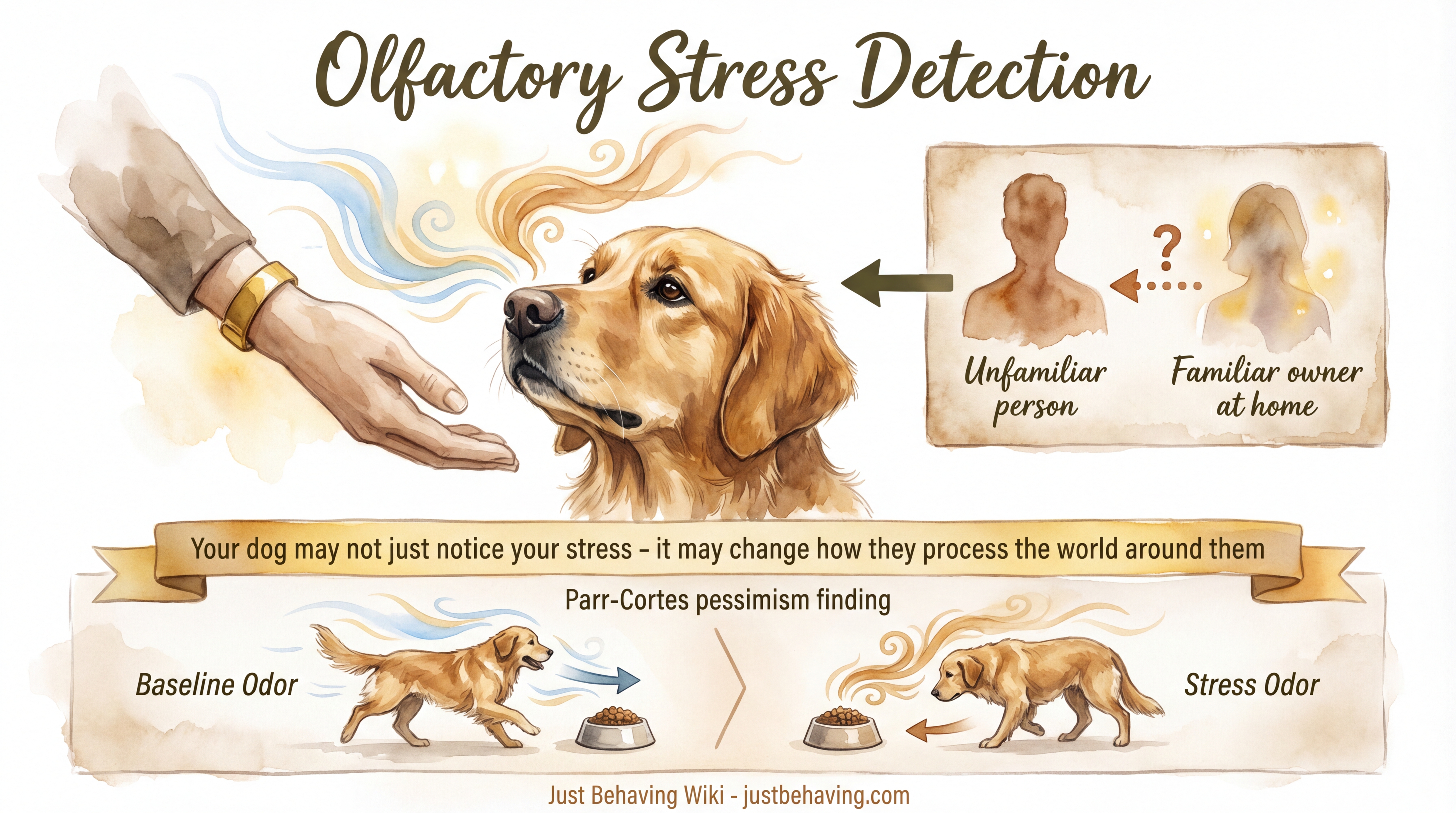
Dogs can detect human psychological stress through scent alone, meaning the owner's internal state is never truly hidden from the dog.
Key Takeaways
- Dogs can discriminate human baseline odor from human stress odor under controlled conditions.
- Stress odor can do more than signal state. It can also shift how dogs approach uncertain situations in a more pessimistic direction.
- The strongest direct evidence comes from unfamiliar-person studies, not from dogs sampling their own family members in the home.
- This makes calmness a physiological issue as well as a behavioral one, because the body broadcasts before words do.
The Evidence
This entry uses ambiguous claim-level tags beyond the dedicated EvidenceBlocks below. These tags mark claims where the literature remains unsettled or multiple interpretations coexist.
This entry uses mixed-evidence claim-level tags beyond the dedicated EvidenceBlocks below. These tags mark claims that combine documented findings with observed practice, heuristic application, or unresolved gaps.
- Wilson, C. et al. (2022)domestic dogs
Used four trained dogs and stress versus baseline breath and sweat samples from 36 human participants to show that dogs can discriminate psychological stress odor from baseline odor.
- Parr-Cortes, Z. et al. (2024)domestic dogs
Showed that odor from an unfamiliar stressed person shifted dogs toward slower and more pessimistic responses in a cognitive bias task, suggesting effects on learning-relevant processing rather than odor detection alone.
- SCR-058 boundarydomestic dogs and humans
The ability of dogs to detect unfamiliar human stress odor is documented, but comparable chronic effects from familiar-owner odor in everyday household life remain a bounded inference rather than a directly demonstrated effect.
No published study has directly tested whether dogs respond to chronic stress odor from their own familiar caregiver in the home with the same magnitude or pattern shown in unfamiliar-person laboratory studies.
SCR References
Sources
- Parr-Cortes, Z., Muller, C. T., Talas, L., Mendl, M. T., Guest, C., & Rooney, N. J. (2024). The odour of an unfamiliar stressed or relaxed person affects dogs responses to a cognitive bias test. Scientific Reports, 14, 16914. https://doi.org/10.1038/s41598-024-66147-1
- Wilson, C., Campbell, K., Petzel, Z., & Reeve, C. (2022). Dogs can discriminate between human baseline and psychological stress condition odours. PLOS ONE, 17(9), e0274143. https://doi.org/10.1371/journal.pone.0274143