The Weaning Transition
Weaning is not just the moment milk stops mattering. It is a broader developmental transition in which the puppy moves from direct maternal provisioning toward increasing behavioral and social independence. In dogs, the nutritional aspect is only one piece. The social functions of the dam and litter continue beyond the point at which solid food is already established. Documented-Cross-Species
What It Means
Why Weaning Is Bigger Than Feeding
If weaning is defined only as "the puppy can eat solids," the developmental picture becomes too narrow. The mother is doing more than transferring calories. She is also regulating access; changing tolerance patterns; shifting how the puppy works for contact and resources; and helping define the boundary between dependence and greater independence.
That is why the weaning transition is best understood as both nutritional and social.
The Cross-Species Logic
Parent-offspring conflict theory predicts that investment and tolerance will change over time. Documented That is not dysfunction. It is expected developmental design. Wolf and broader mammalian weaning literature show measurable reductions in direct access, changing nursing patterns, and increasing tolerance withdrawal as the young mature.
Dogs fit the general direction of that model even if the pet and breeder context is less dramatic than wild-canid life. Documented-Cross-Species
The Dog-Relevant Pieces
SCR-025 matters because the weaning period overlaps the early socialization window rather than sitting outside it. What happens during weaning is therefore happening during a high-leverage developmental phase.
SCR-037 adds another important nuance. More comfort is not always more developmental benefit. Maternal patterns that are too unchallenging may produce lower later resilience. That matters because it blocks a simplistic view in which prolonged ease is automatically equivalent to optimal development. Documented
SCR-053 is useful as a boundary on what later humans can substitute. Dog-human interaction is important, but it is not identical to the social functions that the dam and litter provide during the transition out of nursing.
Why It Matters for Your Dog
Why Placement Timing Debates Get Stuck
The eight-week placement norm often gets argued as though weaning alone should decide the answer. Observed-JB The real science is messier.
By that age many puppies can eat independently, but the broader developmental question is not solved by that fact alone. The dam and litter may still be contributing social calibration; graded tolerance withdrawal; rhythm and predictability; and recovery support during a high-plasticity window. Documented-Cross-Species
That does not automatically prove that later placement is always better. It means the argument cannot be reduced to food readiness.
The weaning transition is one of the clearest examples of why development should be framed as graduated independence rather than abrupt independence.
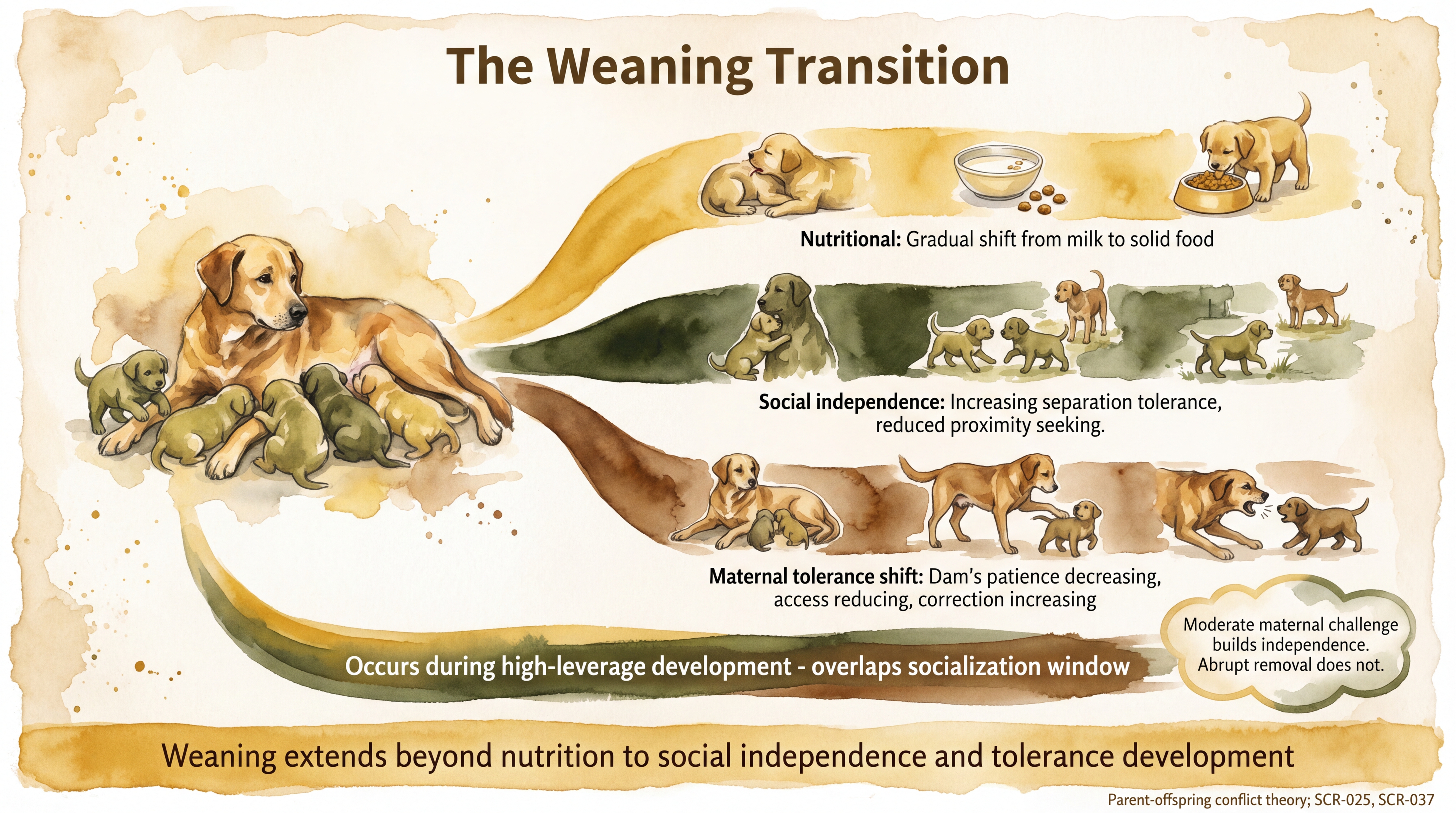
Weaning extends beyond nutrition to social independence and tolerance development.
Key Takeaways
- Weaning is a social-development transition as well as a nutritional one.
- The mother continues contributing developmental value after puppies can already eat solids.
- The socialization window overlaps the weaning phase, which increases the leverage of what happens there.
- Placement timing debates cannot be answered honestly by food readiness alone.
The Evidence
This entry uses observed claim-level tags beyond the dedicated EvidenceBlocks below. These tags mark JB program observation or practice-derived claims that need dedicated EvidenceBlock coverage in a later content pass.
- Trivers, R. L. (1974)general mammalian theory
Parent-offspring conflict predicts changing investment and tolerance across development. - Packard, J. M., Mech, L. D., & Ream, R. R. (1992)wolves
Documented age-linked changes in nursing bout duration, interbout interval, and maternal termination during weaning.
- SCR-025 synthesisdomestic dogs
The early socialization window overlaps the broader weaning phase, making this transition developmentally important rather than purely nutritional. - Bray, E. E. et al. (2017)domestic dogs including Golden Retrievers
Maternal style and challenge level were associated with later resilience outcomes, cautioning against equating maximum ease with optimum development.
- domestic dogs
No published canine study cleanly separates the long-term social effects of weaning, maternal tolerance withdrawal, and placement timing in pet-dog development.
SCR References
Sources
- Packard, J. M., Mech, L. D., & Ream, R. R. (1992). Weaning in an arctic wolf pack: Behavioral mechanisms. Canadian Journal of Zoology, 70(7), 1269-1275. DOI: 10.1139/z92-177.
- Bray, E. E., Sammel, M. D., Cheney, D. L., Serpell, J. A., & Seyfarth, R. M. (2017). Effects of maternal investment, temperament, and cognition on guide dog success. Proceedings of the National Academy of Sciences, 114(34), 9128-9133. DOI: 10.1073/pnas.1704303114.
- Trivers, R. L. (1974). Parent-offspring conflict. American Zoologist, 14(1), 249-264. DOI: 10.1093/icb/14.1.249.