Learned Controllability and Helplessness
Learned helplessness is one of the most influential and most ethically troubling bodies of research ever conducted with dogs. The original experiments showed that animals exposed to uncontrollable aversive events later failed to act even when escape became possible. The modern reinterpretation sharpened that story: passivity is the default under adversity, and what organisms actually learn is controllability. That revised account matters for attachment and caregiving science because predictable environments help build resilience, while chaotic or uncontrollable environments undermine it. Documented
What It Means
The Original Dog Experiments
Seligman and Maier's classic dog work exposed animals to aversive shocks under conditions where escape was impossible. Documented Later, when escape became available, some dogs failed to try. The interpretation was that helplessness had been learned.
Scientifically, the work became foundational. Ethically, it would not pass modern standards and should not be romanticized. The experiments are part of psychology's history, but they are also a reminder that some influential findings were produced under conditions no responsible contemporary canine researcher would defend.
The Modern Revision
The later Maier and Seligman revision changed the theoretical center of gravity. The key idea is that helplessness is not an active state the organism must acquire from scratch. Under uncontrollable adversity, passivity is the default. What is learned, when the environment permits it, is controllability.
That revision matters because it reframes resilience. Resilience is not just toughness. It is the product of environments where prediction, action, and consequence can be linked tightly enough for the organism to discover that responding matters.
In practical terms, controllability depends on legible contingencies, stable routines, enough predictability to form expectations, and enough safety to recover after stress. Documented This is why controllability science overlaps naturally with attachment science. A secure caregiver relationship and a predictable environment both help organize the world into something the young animal can act within rather than merely endure.
Why It Matters for Your Dog
Helplessness, Distress, and Welfare
SCR-020 documents the revised framework strongly enough to use it as a real scientific foundation. The dog-specific caution is narrower: the modern neural circuitry language around prefrontal implementation should not be overstated as though the exact pathway has already been imaged in dogs under household conditions.
That boundary does not weaken the main point. The behavioral principle is strong. When dogs live in environments where signals, routines, access, and responses are erratic, they have less opportunity to learn that their behavior matters in predictable ways. Documented When environments are coherent, controllability becomes easier to acquire.
This is why the topic belongs in an attachment-science dispatch. Attachment is partly about relationship, but it is also about whether the caregiver makes the world more understandable. Documented A dependable caregiver does not eliminate all stress. The caregiver helps convert stress from chaos into something navigable.
The concept of learned controllability is also important because it prevents sloppy interpretations of passive behavior. A quiet dog is not necessarily calm. A dog that stops trying may be shut down rather than settled. The helplessness literature is one reason welfare science treats reduced activity or compliance with caution when the surrounding context is aversive or inescapable.
The modern lesson is therefore double: uncontrollable stress can suppress adaptive action, and predictable environments help build the conditions under which adaptive action becomes possible. That is a more useful and less misleading takeaway than simply saying "dogs can learn helplessness."
The Ethical Boundary
The dog history here is impossible to ignore. Because the original experiments were so severe, contemporary writing should be careful not to present them as routine or admirable demonstrations of good science. They were historically important and ethically condemned.
The field's value now lies in the conceptual advance, not in any desire to repeat the procedure. Modern work builds on predictability, stress regulation, coping, and controllability without reenacting the original methodology. Documented
The pillar entry argues that structure builds resilience because it teaches the puppy the world is legible. This page stays at the evidence layer: controllability is the learned variable, passivity is the default under uncontrollable adversity, and predictable environments are developmentally important.
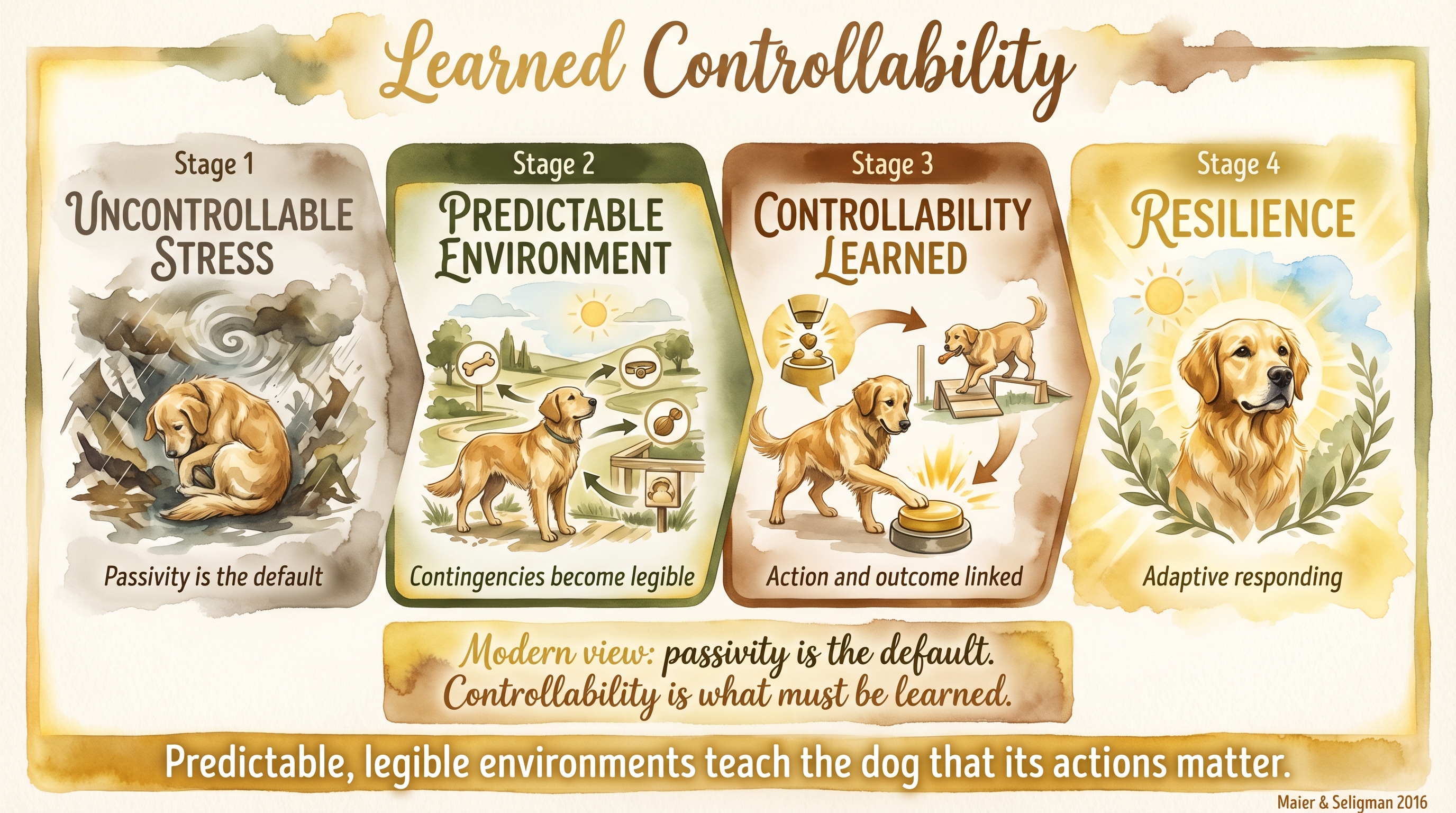
Controllability immunizes against helplessness - animals that learn their actions matter develop resilient stress responses.
Key Takeaways
- The original helplessness research in dogs was historically important and ethically unacceptable by modern standards.
- The modern interpretation is that passivity is the default and controllability is what organisms learn.
- Predictable environments matter because they teach the organism that action and outcome can be linked.
- The behavioral principle is strong even though some dog-specific neural implementation claims still need careful wording.
The Evidence
- Seligman, M. E. P., & Maier, S. F. (1967)domestic dogs
The original dog experiments established the behavioral phenomenon later termed learned helplessness. - Maier, S. F., & Seligman, M. E. P. (2016)multiple mammals
Reframed the theory by arguing that passivity is the default and that organisms learn controllability through predictable environments. - SCR-020 synthesismultiple mammals and domestic dogs
Supports the claim that predictability and controllability are central to resilience while cautioning against overclaiming dog-specific neural implementation.
- SCR-020 boundarydomestic dogs
Dog-specific neural-circuit language should be presented as consistent with the science, not as if the exact controllability circuitry has been directly mapped in ordinary canine caregiving contexts.
No published study has directly compared predictable versus unpredictable caregiving environments in puppies with systematic behavioral follow-up. The behavioral principle is strong; direct raising-experiment evidence would strengthen the canine application.
SCR References
Sources
- Maier, S. F., & Seligman, M. E. P. (2016). Learned helplessness at fifty: Insights from neuroscience. Psychological Review, 123(4), 349-367.
- Seligman, M. E. P., & Maier, S. F. (1967). Failure to escape traumatic shock. Journal of Experimental Psychology, 74(1), 1-9.