Internal Working Models - The Honest Gap
Compound evidence detail1 SCR / 2 parts
- Documentedthe human attachment evidence base together with the canine-direct secure-base findings (Topal 1998, Horn 2013) and Schoberl-documented physiological effects of secure caregiving in dogs
- Heuristicthe full attachment-theory apparatus transfer to canine relationships, including internal working models and attachment-classification systems
Internal working models are one of the most important ideas in human attachment theory and one of the clearest honest gaps in canine attachment science. Dogs behave in ways that are consistent with such models, but the deeper cognitive architecture has not been directly demonstrated in dogs. Heuristic
What It Means
In Bowlby framework, an internal working model is a durable representation built from repeated caregiver experience. It is how the young organism comes to expect what the caregiver is like, what the self can expect from the relationship, and how safety or uncertainty will probably unfold in the future. In human developmental psychology, that idea is central rather than optional.
In human attachment science, those models do real predictive work. A secure model supports approach under stress, effective use of reunion, and a return to exploration once comfort has been restored. Heuristic More avoidant patterns mute overt attachment behavior and shift the person away from relying on the caregiver even when stress is present. More ambivalent or resistant patterns heighten protest, contact seeking, and difficulty settling after reunion. The point is not only that the person "expects" something. The point is that repeated caregiving history gets translated into patterned strategies for approach, avoidance, reunion use, and stress regulation across contexts.
That is why the concept became so important. An internal working model is not a poetic synonym for memory. It is a working prediction system. It helps determine where attention goes under pressure, whether support is sought or suppressed, and whether the organism can settle enough for exploration to resume. In human developmental psychology, the construct links repeated relationship history to future behavioral organization without assuming the person consciously recalculates everything in each moment.
If the concept transfers to dogs even in bounded form, then what the dog may be carrying forward is not a worded belief like "my caregiver is safe." Heuristic It is something more embodied and procedural: when this person is present, exploration tends to work; when I return to this person, recovery tends to happen; when stress rises, this person is or is not usable. That is the level at which the idea becomes developmentally important. It turns thousands of past micro-interactions into the starting expectation the dog brings into the next one.
The attraction of the concept in dogs is obvious. Dogs do not respond to every human in the same way. They show relationship-specific patterns of proximity seeking, safe-haven use, reunion behavior, and stress buffering. Those patterned differences make it very tempting to say the dog must be carrying some internal map of the caregiver.
Savalli and Mariti argue exactly that. Their application of Bowlby to the dog-human bond proposes that dogs build relationship expectations through repeated cognitive and affective experiences with an attachment figure. Heuristic That is a coherent, biologically plausible way to frame the observed behavior.
The canine evidence becomes suggestive in a serious way when different lines of work are set beside one another. Solomon's classification work shows that dogs carry relationship-specific patterns into separation and reunion episodes rather than reacting identically to all humans. Schoberl's cortisol work shows that buffering depends on the specific attachment relationship, not merely on the presence of any kind person. Asher's adolescent-conflict work shows that developmental pushback is directed especially at the caregiver and is stronger when attachment indicators are less secure. Those are three different outputs, behavioral organization, physiological buffering, and developmental conflict, all pointing toward durable caregiver-specific expectations.
None of that proves a representational model in the strong neurocognitive sense. But it does raise the bar beyond simple familiarity. A dog that uses one person as a secure base, is physiologically buffered by that same person, and selectively strains that same relationship during adolescence is behaving as if past interaction history has been organized into a durable social template. That is exactly why the concept remains useful. It organizes the evidence without pretending the representation itself has already been opened and inspected.
What would stronger proof look like? It would require evidence that isolates the dog's carried-forward expectation independently of the usual attachment outputs, not just more observations that the dog seeks proximity, shows reunion behavior, or regulates differently with one person than another. Documented In other words, the field would need a way to detect the representation apart from the behaviors that currently imply it. That is the missing step, and naming it clearly helps prevent the concept from being used too loosely.
That is the honest middle position this page is defending. If we refuse the concept entirely, we lose a coherent way to connect the converging canine findings. If we announce it as fully proven canine fact, we outrun the evidence. The responsible move is to keep the model in use while keeping its status clearly marked.
That balance is not weakness. It is how a theory stays useful without becoming inflated.
The problem is that plausibility is not proof. The canine literature measures outputs that are compatible with internal working models. It does not isolate the model itself. Dogs behave as if they hold an internal representation of the caregiver. The field has not yet shown the deeper representational architecture in a way that is independent of the outward behavior.
That difference matters because this is exactly where slippage happens. A useful theoretical lens gets repeated often enough that it starts sounding like a directly demonstrated canine fact. The stronger and more disciplined sentence is narrower: internal working models are documented in humans, theoretically useful in dogs, and not yet directly proven in dogs.
At the same time, refusing the concept altogether would make the canine data flatter than it really is. Dogs do seem to carry relationship history into new moments in a way that is more structured than simple mood or transient association. The honest position is therefore not skeptical dismissal. It is bounded use. The model earns its place as an interpretive bridge, but not yet as a closed empirical finding.
This is especially helpful when thinking about rupture and repair. A single stressful moment does not define a relationship, because the dog is not entering that moment empty. The dog is bringing a history of what this adult usually means. That is exactly the kind of cumulative expectation internal-working-model language is trying to capture, even while the field remains careful about claiming too much.
An everyday analogy helps. If you watch someone return to the same coffee shop every morning, greet one barista warmly, avoid another, and relax fastest at a familiar table, you can infer that the person carries expectations into the room. What you cannot do from behavior alone is open the mind and inspect the representation itself. That is the position canine attachment science is in with internal working models.
Why It Matters for Your Dog
For families, the practical value of the concept is real even while the scientific ceiling remains cautious. It reminds us that relationships are cumulative. The dog is not only reacting to the present moment. The dog is also arriving with a history of what this particular human tends to mean.
JB can use the internal-working-model idea as a disciplined lens for why consistency matters, while still being explicit that the deeper cognitive machinery has not been directly demonstrated in dogs.
That is the balance worth keeping. The concept helps explain why repeated calm, predictable caregiving changes future responses. It should not be inflated into a claim that canine cognitive representations have already been mapped with the same confidence human attachment science can claim.
For families, that means the ordinary repetitions matter more than they often realize. Each calm reunion, each readable boundary, each predictable recovery after stress may be contributing to what the dog comes to expect from this specific person. JB does not need to overclaim canine cognition to say that history accumulates.
That is exactly why consistency has developmental weight. It is not only good manners. It is relationship memory in slow motion.
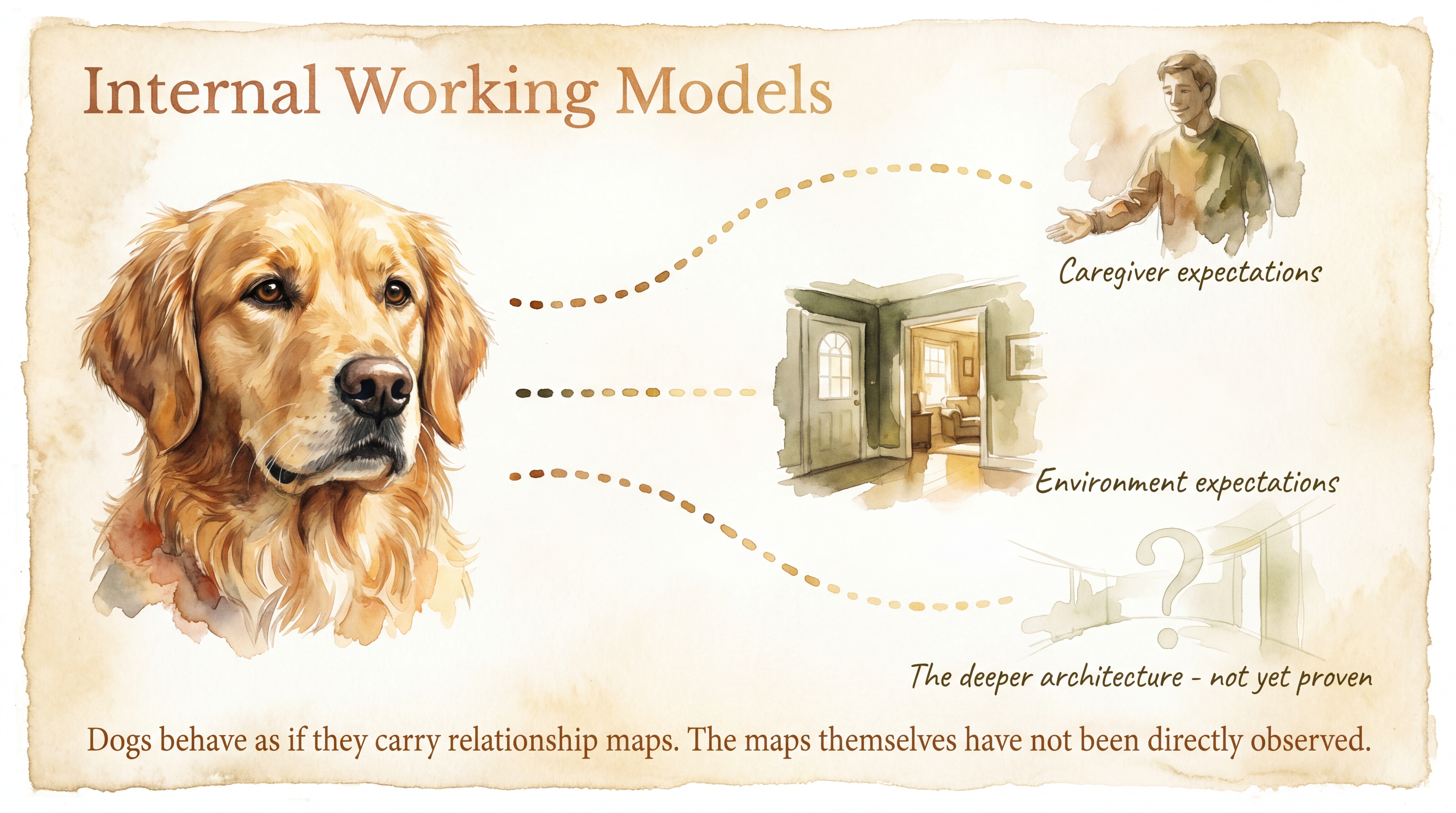
Internal working models are a powerful idea in human attachment science, but the evidence for their operation in dogs remains genuinely incomplete.
Key Takeaways
- Internal working models are a central documented idea in human attachment theory.
- Dogs show behavior that is consistent with relationship-specific internal expectations, which makes the concept useful in canine science.
- The direct canine proof is missing. The field observes outputs consistent with internal working models rather than the models themselves.
- The strongest responsible wording is that dogs behave as if they carry such models, not that the full construct has already been directly demonstrated.
The Evidence
- Bowlby, J. (1969/1982)humans
Placed internal working models at the center of attachment theory as durable expectations formed from repeated caregiver experience. - Ainsworth, M. D. S. et al. (1978)humans
Linked caregiver responsiveness, attachment organization, and later patterned relationship behavior within the broader attachment framework.
- Solomon, J. et al. (2019)domestic dogs
Found relationship-pattern variation in canine attachment classification work, supporting the idea that dogs carry durable caregiver-specific expectations. - Schoberl, I. et al. (2016)domestic dogs and humans
Showed that stress buffering depends on the specific attachment relationship, which is compatible with the idea of relationship-specific internal expectations.
- Savalli, C., and Mariti, C. (2020)domestic dogs
Applied Bowlby framework to dogs and proposed canine internal working models as a useful interpretive construct without claiming direct proof. - SCR-017 boundarydomestic dogs and humans
The full attachment-theory apparatus transfers to dogs only in bounded form, and internal working models are one of the clearest places where the canine evidence remains heuristic.
No published canine neurocognitive study has independently demonstrated internal working models in dogs apart from the behavioral outputs usually taken to imply them.
SCR References
Sources
- Ainsworth, M. D. S., Blehar, M. C., Waters, E., and Wall, S. (1978). Patterns of Attachment: A Psychological Study of the Strange Situation. Erlbaum.
- Bowlby, J. (1969/1982). Attachment and Loss, Volume 1: Attachment. Basic Books.
- Savalli, C., and Mariti, C. (2020). Would the dog be a person's child or best friend? Revisiting the dog-tutor attachment. Frontiers in Psychology, 11, 576713. https://doi.org/10.3389/fpsyg.2020.576713
- Schoberl, I., Beetz, A., Solomon, J., Gee, N., Kotrschal, K., and Wedl, M. (2016). Social factors influencing cortisol modulation in dogs during a strange situation procedure. Journal of Veterinary Behavior, 11, 77-85. https://doi.org/10.1016/j.jveb.2015.09.007
- Solomon, J., Beetz, A., Schoberl, I., Gee, N., and Kotrschal, K. (2019). Attachment security in companion dogs: Adaptation of Ainsworth classification procedures to dogs and their human caregivers. Attachment and Human Development, 21(4), 389-417. https://doi.org/10.1080/14616734.2018.1517813