Canine Attachment Classification
Compound evidence detail1 SCR / 2 parts
- Documentedthe human attachment evidence base together with the canine-direct secure-base findings (Topal 1998, Horn 2013) and Schoberl-documented physiological effects of secure caregiving in dogs
- Heuristicthe full attachment-theory apparatus transfer to canine relationships, including internal working models and attachment-classification systems
Attachment classification in dogs asks a harder question than attachment existence. It is one thing to show that dogs form attachment bonds with humans. It is another to sort those bonds into stable patterns such as secure, avoidant, ambivalent, or disorganized. The field has made real progress, but the strongest conclusion is still mixed: the bond is documented, while the fine-grained typology remains more bounded. Ambiguous
What It Means
In human attachment science, classification is a way of describing patterned relationship organization under stress. Documented A secure infant uses the caregiver as a safe haven and secure base. Insecure patterns change that organization. Some relationships mute proximity seeking, some intensify it without efficient calming, and some become contradictory or disorganized.
When dog researchers use that language, they are trying to capture the same kind of patterned variation without pretending dogs are human toddlers. That is useful because secure versus insecure relational organization carries more information than a simple friendly-unfriendly scale. It asks what happens to the bond when novelty, separation, and reunion put pressure on it.
Solomon and colleagues delivered the most important step forward. Their adaptation of Ainsworth-style classification procedures achieved substantial agreement among coders and produced a sample distribution that looked strikingly familiar from the human literature. At the same time, the friction inside the method was impossible to miss. More than one fifth of the sample required consensus discussion to classify, and a meaningful minority of dogs remained unclassifiable. That is not a failure. It is the field telling the truth about the boundary.
The Solomon paper becomes even more informative when the exact numbers stay attached to it. Inter-judge agreement reached 89 percent, with weighted kappa values of 0.78 in the primary sample and 0.70 in a reserved set of harder cases. Documented The sample split, 61 percent secure and 39 percent insecure, looked recognizably similar to human toddler distributions. But 22 percent of cases still required consensus discussion, and 14 percent could not be confidently classified at all. That is why this page treats classification as real science with real drag, not as a finished import from developmental psychology.
What does that 22 percent consensus-discussion rate actually tell us? It suggests the attachment signal is often visible in dogs, but the edges between categories remain blurrier than the cleanest versions of the human infant literature. Coders could agree strongly on many cases while still needing extended discussion for a substantial minority because a dog's behavior might look secure in one episode and more contradictory in another. That is not an embarrassment to the method. It is an honest sign that canine attachment classification is measuring something real through a tool that still carries interpretive friction.
Solomon's results were also not floating free of the rest of the relationship picture. Caregiver sensitivity ratings differentiated secure and insecure classifications, which is exactly the kind of external anchor the method needed. That does not close the case, but it does matter. If classification had no relationship at all to caregiver quality, the whole exercise would start to look like coders sorting noise. Instead, the method connected to a meaningful relational variable, which makes the classification effort look more valid even while its boundaries remain visible.
Fallani and colleagues sharpened the same caution from a different angle. Their counterbalanced version of the canine Strange Situation showed that order effects matter. When the sequence of caregiver and stranger entries is not carefully balanced, exploratory behavior, one of the core secure-base readouts, can be distorted by test structure rather than relationship quality alone. The classification story is therefore not only about the dog. It is also about the design of the instrument.
Earlier canine classification work points in the same direction. Researchers can code the observable mechanics of attachment behavior, proximity seeking, contact maintenance, reunion intensity, with high agreement. Documented Interpreting those mechanics into a psychological category is harder. That difference matters because it explains why the bond itself is on firmer ground than the full typology layered on top of it.
This is also where species differences probably matter in a deep way. Human infant categories were built around a human developmental package that includes human caregiver behavior, human infant signaling, and human social expectations. Documented Dogs share enough attachment function to make the comparison useful, but they do not share the whole package. Their signaling repertoire, dependence pattern, and developmental ecology are not identical. That is one reason a perfect category transfer would be surprising rather than automatic.
More recent work suggests the field is maturing rather than collapsing. The Dog-Human Attachment Scale developed by de Souza and colleagues in 2026 takes a more canine-specific route. Instead of importing every human category wholesale, it builds a measure from dog-relevant behavior patterns and identifies factors such as anxiety, avoidance, and insecurity. That is important because it moves the science from pure transfer toward species-sensitive refinement.
The DHAS result is useful partly because it does not force the field into a false choice between total transfer and total abandonment. de Souza and colleagues identified three factors, anxiety, avoidance, and insecurity, then used latent profile analysis to sort dogs into broader attachment profiles. That is a sign of methodological maturity. The field is no longer asking only whether dogs fit the original human boxes. It is also asking what the most canine-sensitive way is to describe structured variation in the bond.
That also explains why DHAS is not just a paper-and-pencil version of the Strange Situation. The SSP is an acute laboratory stress test built around novelty, separation, reunion, and direct observation. DHAS is a questionnaire instrument built from repeated daily-life behavior patterns and refined through factor analysis. Its anxiety, avoidance, and insecurity dimensions are not perfect one-to-one translations of the human toddler categories. They are an attempt to capture how the dog uses, resists, or inconsistently uses the caregiver across ordinary contexts where attachment may appear as a relational style rather than as a single laboratory snapshot.
That shift toward daily-life measurement matters for JB because the bond is lived mostly outside the laboratory. Families are not running reunion episodes in a controlled room every afternoon. They are living through greetings, departures, novelty, rest, frustration, and recovery in ordinary household time. A canine-sensitive instrument that tries to capture those repeated contexts may eventually prove more useful for the real dog-human relationship than a perfect imitation of the original infant procedure.
An everyday analogy helps here. Early classification work in dogs is a little like using a ruler designed for one species and then learning where the marks do and do not line up cleanly in another. The ruler is still useful. It is just not wise to pretend the fit is perfect.
Why It Matters for Your Dog
For families, the biggest value of attachment classification is not diagnostic labeling. It is conceptual clarity. The science supports taking secure versus insecure variation seriously. It does not support turning every difficult dog into a dramatic category story or assuming that one laboratory label explains the whole relationship.
Classification work supports the JB distinction between more secure and less secure relational organization. It does not prove that every human attachment category transfers into dogs without revision.
This protects families from two opposite mistakes. One mistake is denial, acting as if all bonds are the same once basic attachment has been demonstrated. The other is overreach, acting as if a human-style typology is already finished science in dogs. The more useful position sits between them: attachment quality varies, secure versus insecure patterns matter, and the finer category machinery is still being refined.
It also means families should be wary of self-diagnosing from internet labels alone. The practical value here is not assigning dramatic categories at home after one difficult week. The value is learning to notice whether the relationship becomes more organized or less organized under stress, and then raising the dog in ways that strengthen the organized side of the bond.
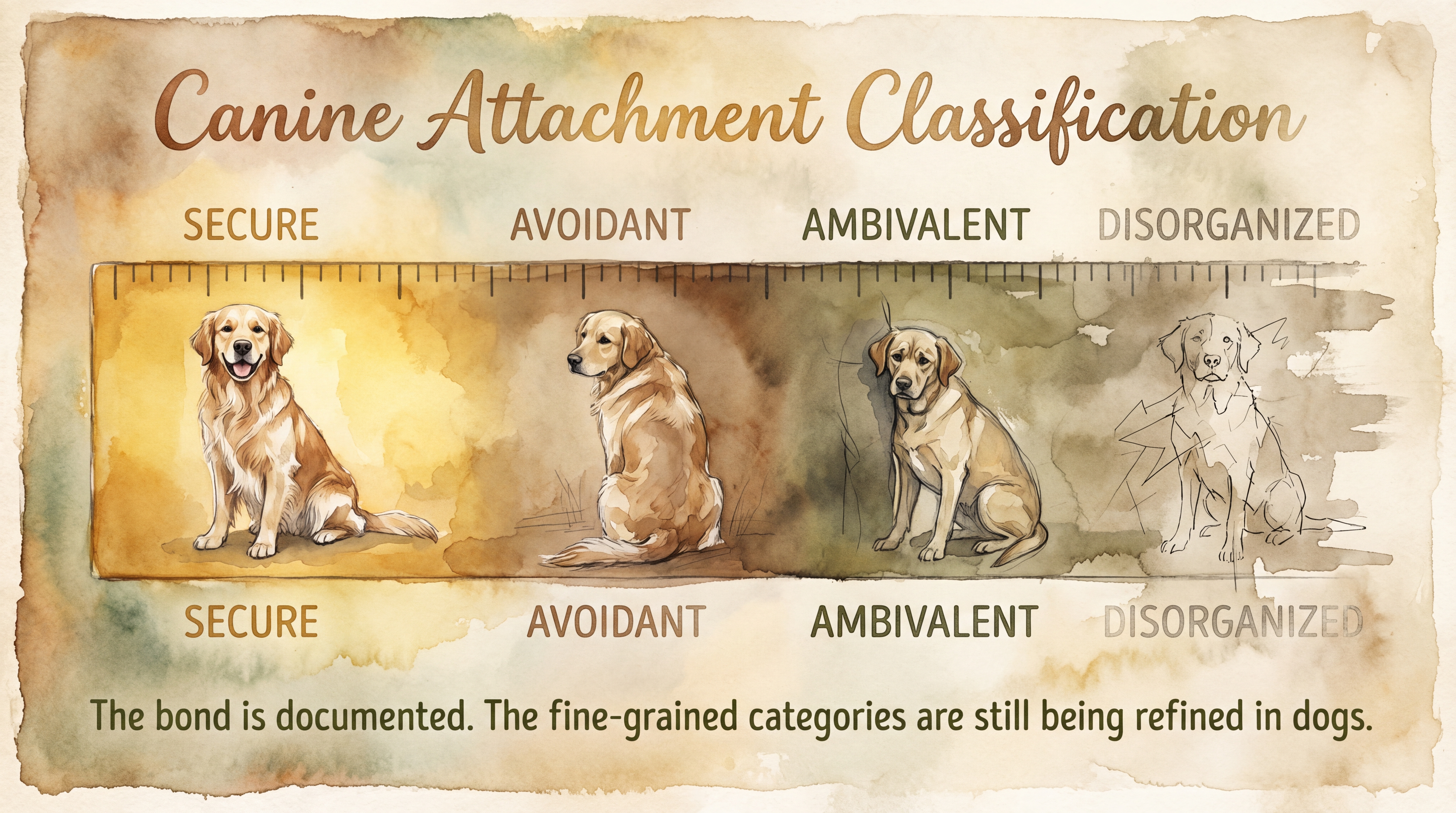
Strange Situation adaptations reveal that dogs form classifiable attachment patterns including secure, insecure-ambivalent, and avoidant styles.
Key Takeaways
- The existence of attachment variation in dogs is well supported, but fine-grained classification is more methodologically delicate than attachment existence itself.
- Secure versus insecure organization is the strongest practical distinction the field currently supports.
- Human-style categories remain useful as research tools, but they should not be treated as perfectly finished canine science.
- Canine-specific measures such as the DHAS suggest the field is evolving toward species-sensitive classification rather than abandoning classification altogether.
The Evidence
This entry uses ambiguous claim-level tags beyond the dedicated EvidenceBlocks below. These tags mark claims where the literature remains unsettled or multiple interpretations coexist.
- Solomon, J. et al. (2019)domestic dogs
Adapted Ainsworth-style classification procedures to dogs, reported 89 percent inter-judge agreement, and found meaningful secure versus insecure distinctions, while also documenting that 22 percent of cases required consensus discussion and 14 percent remained unclassifiable. - Fallani, G. et al. (2007)domestic dogs
Showed that a counterbalanced Strange Situation procedure matters because order effects can skew exploratory behavior, one of the key secure-base readouts, if caregiver and stranger sequences are not handled carefully. - de Souza, A. et al. (2026)domestic dogs
Developed the Dog-Human Attachment Scale and identified canine-specific dimensions such as anxiety, avoidance, and insecurity.
- Ainsworth, M. D. S. et al. (1978)humans
Established the Strange Situation framework and the secure, avoidant, and resistant attachment categories in infant-caregiver research.
- Savalli, C., and Mariti, C. (2020)domestic dogs
Argued that Bowlby framework transfer to dogs is useful while acknowledging that deeper cognitive constructs and strict category transfer remain incomplete. - SCR-017 boundarydomestic dogs and humans
The bond is documented in dogs, but the full human attachment apparatus, including internal working models and strict category mapping, remains partly heuristic in canine application.
No published longitudinal puppy study has yet shown that a canine attachment classification assigned early in life remains stable across development in the same way the strongest human attachment datasets have tracked stability and change.
SCR References
Sources
- Ainsworth, M. D. S., Blehar, M. C., Waters, E., and Wall, S. (1978). Patterns of Attachment: A Psychological Study of the Strange Situation. Erlbaum.
- de Souza, A., Mariti, C., Diverio, S., and colleagues. (2026). Development and validation of the Dog-Human Attachment Scale (DHAS). Frontiers in Ethology. https://doi.org/10.3389/fetho.2026.1752182
- Fallani, G., Prato-Previde, E., and Valsecchi, P. (2007). A counterbalanced version of Ainsworth's Strange Situation Procedure reveals secure-base effects in dog-human relationships. Applied Animal Behaviour Science, 109(2-4), 306-319. https://doi.org/10.1016/j.applanim.2007.04.002
- Savalli, C., and Mariti, C. (2020). Would attachment theory help improve the welfare of domestic dogs? Relevance of a theoretical framework from human psychology. Animals, 10(7), 1244. https://doi.org/10.3390/ani10071244
- Solomon, J., Beetz, A., Schoberl, I., Gee, N., and Kotrschal, K. (2019). Attachment security in companion dogs: Adaptation of Ainsworth classification procedures to dogs and their human caregivers. Attachment and Human Development, 21(4), 389-417. https://doi.org/10.1080/14616734.2018.1517813