Retriever Gesture Comprehension
Retriever gesture comprehension is one of the strongest pieces of evidence that young dogs, especially retrievers, are biologically prepared for cross-species social communication. The core finding is simple and powerful: eight-to-ten-week-old retriever puppies can use human pointing and related communicative gestures to solve object-choice tasks, and they show this ability without a learning curve across repeated trials. Documented
That matters because it argues against a purely conditioning-based explanation. Documented The puppies are not gradually figuring the task out through repeated reward history during the experiment. They arrive already prepared to use the human social signal.
What It Means
The classic object-choice task asks a puppy to locate hidden food after a human gives a cue, often by pointing, gazing, or providing another ostensive social signal. Observed-JB If the puppy systematically chooses the correct location above chance, the obvious next question is how it is doing that. One possibility is that the puppy is learning trial by trial. Another is that the puppy already possesses a species-typical bias to treat human gestures as informative. The retriever-puppy literature strongly supports the second explanation.
Bray, MacLean, and colleagues tested a very large sample of retriever puppies and found that performance was already high from the start and remained stable across twelve trials. Documented That flat curve matters as much as the success rate does. It indicates that the puppies are not building the skill inside the task through repeated reinforcement.
Why It Matters for Your Dog
Why Retrievers Matter Here
The breed scope is one of the strengths of this finding for Just Behaving and also one of its main boundaries. It is a strength because Golden Retrievers fall inside the sampled retriever population. The finding is therefore directly relevant to the breed scope JB actually works with. It is a boundary because the study does not justify writing as if every breed shows the same early gesture profile to the same degree. Documented Retriever puppies are the documented group. Extending the exact same claim to all puppies would overshoot the evidence. This is one reason the page belongs under behavioral science rather than as a loose slogan. The result is exciting, but it is only most useful when stated precisely.
How It Fits the Comparative Literature
Retriever gesture comprehension sits inside a broader pattern in which domestic dogs often outperform wolves and even some great apes on certain human cue tasks. Observed-JB The point is not that dogs are more intelligent overall. It is that they appear especially tuned to human communicative behavior.
That tuning is part of why domestic dogs are so interesting. Their cognition does not merely preserve ancestral canid learning systems. It appears to have been shaped by domestication toward close interspecific cooperation.
In retriever puppies, the early age is crucial. Because the ability is present before substantial individualized training history accumulates, the finding is hard to explain as a late product of explicit instruction. The most defensible interpretation is preparedness rather than drill-acquired skill.
Why It Matters for Your Dog
Why the Finding Matters
This finding matters at three levels. First, it is direct evidence that very young dogs can treat human social behavior as meaningful information. Second, it helps explain why human models can matter so much in later social-learning literature. A species that is prepared from puppyhood to attend to human cues is already half-structured for cross-species learning. Third, it provides one of the cleanest empirical bridges between domestication theory and developmental behavior. The human-oriented communication channel is not merely a cultural training artifact. At least in retrievers, it appears early and robustly.
Retriever gesture comprehension does not prove every later developmental claim, but it does show that the human communication channel is open very early in the breed group JB actually raises.
Important Boundaries
This page needs three cautions. First, the result is about retriever puppies specifically. It should not be flattened into a universal statement about all breeds. Second, the finding is about early comprehension of human communicative gestures, not about total obedience, trainability, or household maturity. A puppy understanding a point is not the same as a puppy being behaviorally finished. Third, preparedness does not eliminate experience. The puppies do not need conditioning to begin using the signal, but later development and environment still shape how that capacity is expressed.
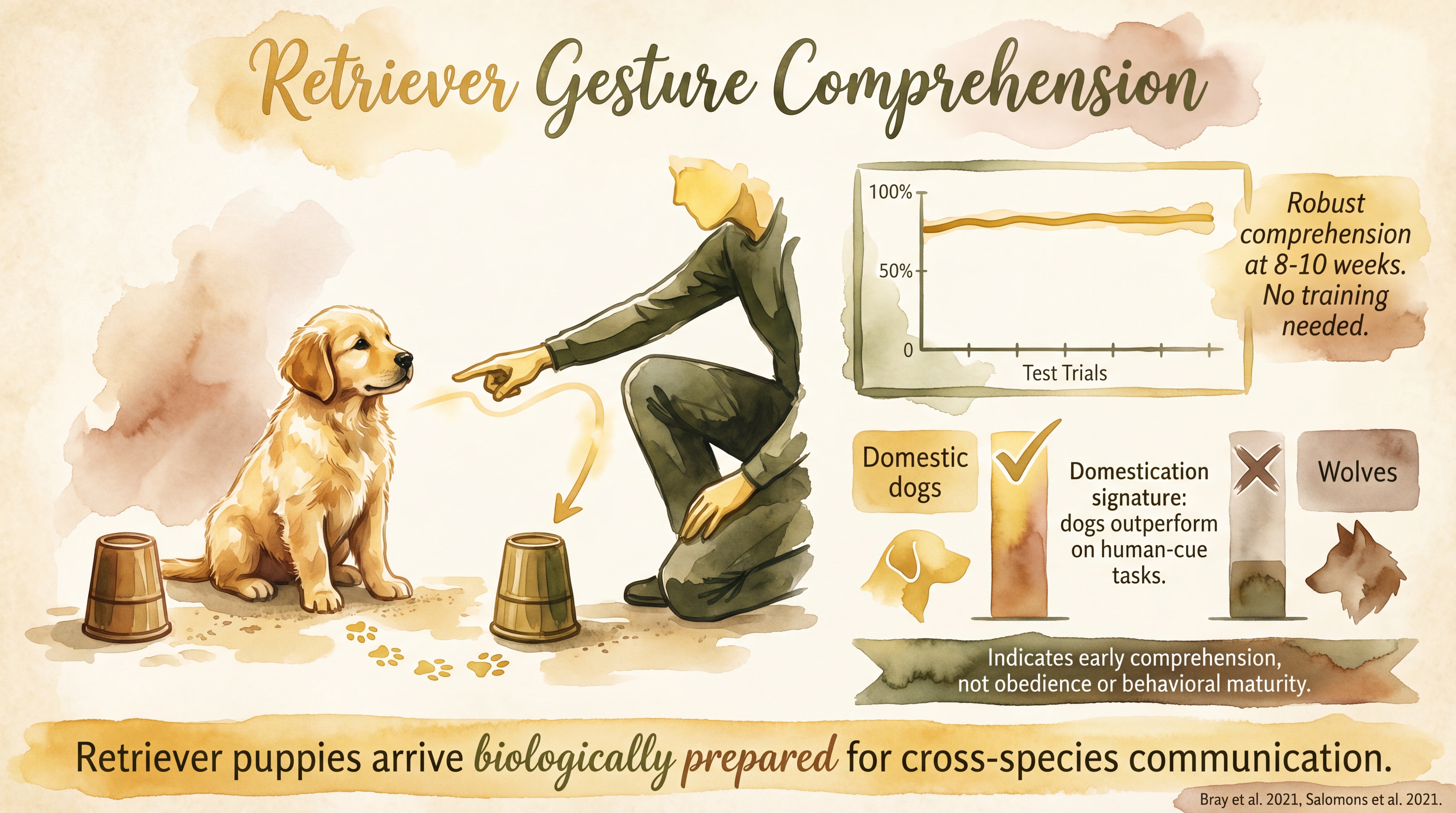
Retrievers show enhanced human gesture comprehension - reading pointing, gaze direction, and postural cues with breed-level sensitivity.
Key Takeaways
- Retriever puppies can understand human communicative gestures very early, before extensive individualized training history accumulates.
- The lack of a trial-by-trial learning curve is one of the strongest parts of the finding because it points to preparedness rather than conditioning.
- This is directly relevant to Golden Retrievers, which are part of the studied retriever group.
- The result supports early cross-species communication readiness, not a blanket claim that all breeds or all puppies work the same way.
The Evidence
This entry uses observed claim-level tags beyond the dedicated EvidenceBlocks below. These tags mark JB program observation or practice-derived claims that need dedicated EvidenceBlock coverage in a later content pass.
- Bray, E. E., MacLean, E. L., et al. (2021)retriever puppies including Golden Retrievers
Tested 375 puppies aged 8 to 10 weeks and found robust human gesture comprehension with no learning curve across twelve trials, supporting biological preparedness rather than trial-by-trial conditioning.
- Comparative domestication literaturedogs and wolves
Domestic dogs often show stronger human cue use than wolves in cooperative communication tasks, supporting the interpretation that domestication reshaped the social-cognitive channel toward humans.
- SCR-051 scope noteretriever puppies
The finding directly supports early retriever preparedness for interspecific communication, but it should not be generalized as if all breeds have identical early gesture profiles.
No study has yet examined whether early gesture comprehension in retriever puppies translates to differences in observational learning or social-referencing outcomes compared to breeds without similar early comprehension.
SCR References
Sources
- Bray, E. E., MacLean, E. L., et al. (2021). Early-emerging and highly heritable sensitivity to human communication in dogs. Current Biology, 31(14), 3132-3136.
- Salomons, H., Smith, K. C. M., Callahan-Beckel, M., Callahan, M., Levy, K., Kennedy, B. S., Bray, E. E., Gnanadesikan, G. E., Horschler, D. J., Gruen, M., Tan, J., White, P., vonHoldt, B. M., MacLean, E. L., and Hare, B. (2021). Cooperative communication with humans evolved to emerge early in domestic dogs. Current Biology, 31(14), 3137-3144.e11. DOI: 10.1016/j.cub.2021.06.051.
- Salomons, H., Smith, K. C. M., Callahan-Beckel, M., Callahan, M., Levy, K., Kennedy, B. S., Bray, E. E., Gnanadesikan, G. E., Horschler, D. J., Gruen, M., Tan, J., White, P., vonHoldt, B. M., MacLean, E. L., and Hare, B. (2021). Cooperative communication with humans evolved to emerge early in domestic dogs. Current Biology, 31(14), 3137-3144.e11. DOI: 10.1016/j.cub.2021.06.051.
- SCR-051 scope note: Bray 2021 verifies retriever puppy gesture sensitivity; Salomons 2021 verifies dog-wolf early communication contrast; do not overextend to all Golden Retriever family behavior.