Breed-Specific Learning Channels
Breed-specific learning channels means that the strongest social-learning route is not identical across all dogs. Modern comparative work suggests that breeds selected for close human cooperation gain more from human demonstrators, while breeds selected for functional independence gain more from conspecific demonstrators. Documented
What It Means
One of the easiest mistakes in dog science is to talk about "the dog" as if every breed carries the same social-learning profile. Category 12 cannot afford that flattening because the whole category is about relationship as mechanism. If relationship matters, then breed history may change which relationship channel does the most developmental work.
Lugosi and colleagues addressed this directly in 2024. Their study included 120 dogs from 47 breeds, with 116 dogs remaining in the analyzed sample. Documented The dogs were classified by functional selection history into broad groups of cooperative versus independent breeds. That distinction was not cosmetic. It reflected the kinds of working roles humans historically selected them for.
The task was a transparent V-shaped fence detour with a trained Border Collie acting as the conspecific demonstrator. Independent breeds improved after watching the dog demonstrator. Cooperative breeds did not show the same improvement from the conspecific model. That is a precise result with an important consequence: social learning is not absent in cooperative breeds, but the dog-demonstrator channel is not where their strongest advantage showed up in this paradigm.
Dobos and Pongracz then supplied the mirror image in 2023. Using a comparable logic with a human demonstrator, they found the opposite pattern. Documented Cooperative breeds showed stronger gains from the human demonstrator than independent breeds did. Once those two studies are read together, the picture becomes much clearer. Breed history appears to weight the channel, not simply the amount of intelligence.
That distinction matters. The studies do not say cooperative breeds are better learners in every setting, and they do not say independent breeds are less social in some global sense. Documented They say that selection history shapes whose example is most behaviorally informative under the tested conditions. The learner is real in both groups. The preferred mentor differs.
This is exactly where Golden Retrievers become scientifically important rather than sentimentally important. Goldens belong to the cooperative side of the modern breed landscape. They were selected for close partnership, attentiveness to human guidance, and work that depends on staying tuned to the person rather than solving everything at a distance. That does not merely make them pleasant companions. It likely helps explain why the human mentorship channel carries so much weight for them.
The result also helps reconcile something families often notice intuitively. A Golden puppy may seem to care more about what the humans are doing than about what another dog in the room is modeling, even though canine social influence is still present. The breed-specific learning literature suggests that this is not simply an anecdotal temperament quirk. It may reflect selection history acting on the social-learning system itself.
That does not downgrade the role of adult dogs. The bond category has already established that puppies can learn from canine demonstrators from eight weeks and that maternal and resident adult dog effects are outcome-relevant. The breed-channel findings simply say that for cooperative breeds, the human demonstration lane may be unusually powerful. In other words, the adult dog is not irrelevant. The human is unusually consequential.
There is a practical reason this page belongs in Category 12 rather than only in Behavioral Science. In a relationship-centered framework, the question is not merely "can the dog learn from X?" The question is "which relationship channel is carrying more of the developmental burden in this particular dog?" The Lugosi and Dobos papers push that question out of philosophy and into documented comparative cognition.
The boundary has to be named clearly. Breed-group averages are not destiny for individual dogs. These studies sort by functional history and look for group-level differences. Documented They do not say every Golden will always privilege human models or every independent breed will always ignore humans. The safer language is weighted tendency, not total rule.
The specific task matters too. Lugosi used a detour task with a canine demonstrator. Dobos used a human demonstrator. Those are strong designs for the question they ask, but they do not prove that every future task in every home will display the exact same magnitude of breed difference. Social-learning channels are influenced by age, setting, prior experience, attachment, and task structure as well as breed history.
Even with those boundaries, the result is one of the strongest support beams for the JB mentorship thesis. If cooperative breeds are especially prepared to learn from humans, then the adult in the room is not only a convenient substitute for the missing canine pack. For those breeds, the adult may be the primary route through which the developmental environment is interpreted.
An everyday analogy is classroom learning styles, but with caution. Some students learn most from seeing the teacher work a problem at the board. Others learn most by watching a peer do it beside them. Both are social routes. The difference is which model carries more weight. Breed-specific learning channels suggest dogs vary in a comparable way at the group level.
Why It Matters for Your Dog
For Golden families, this entry matters because it makes the human role heavier, not lighter. If the breed is predisposed to privilege the human demonstrator, then the adults example in the home becomes even more developmentally expensive. Calmness, structure, pacing, and emotional regulation are not extras around the lesson. They are part of the lesson.
The breed-channel literature is one of the clearest scientific reasons JB places such weight on the adult human in Golden Retriever homes. For cooperative breeds, the human example appears to be the strongest channel.
This also gives families permission to stop waiting for the puppy to discover maturity from other dogs alone. Adult dogs can help tremendously when they are present, but in a Golden household the human may still be the most powerful model in the room. The practical question is no longer whether the puppy is watching. It is whether the adults are worth copying.
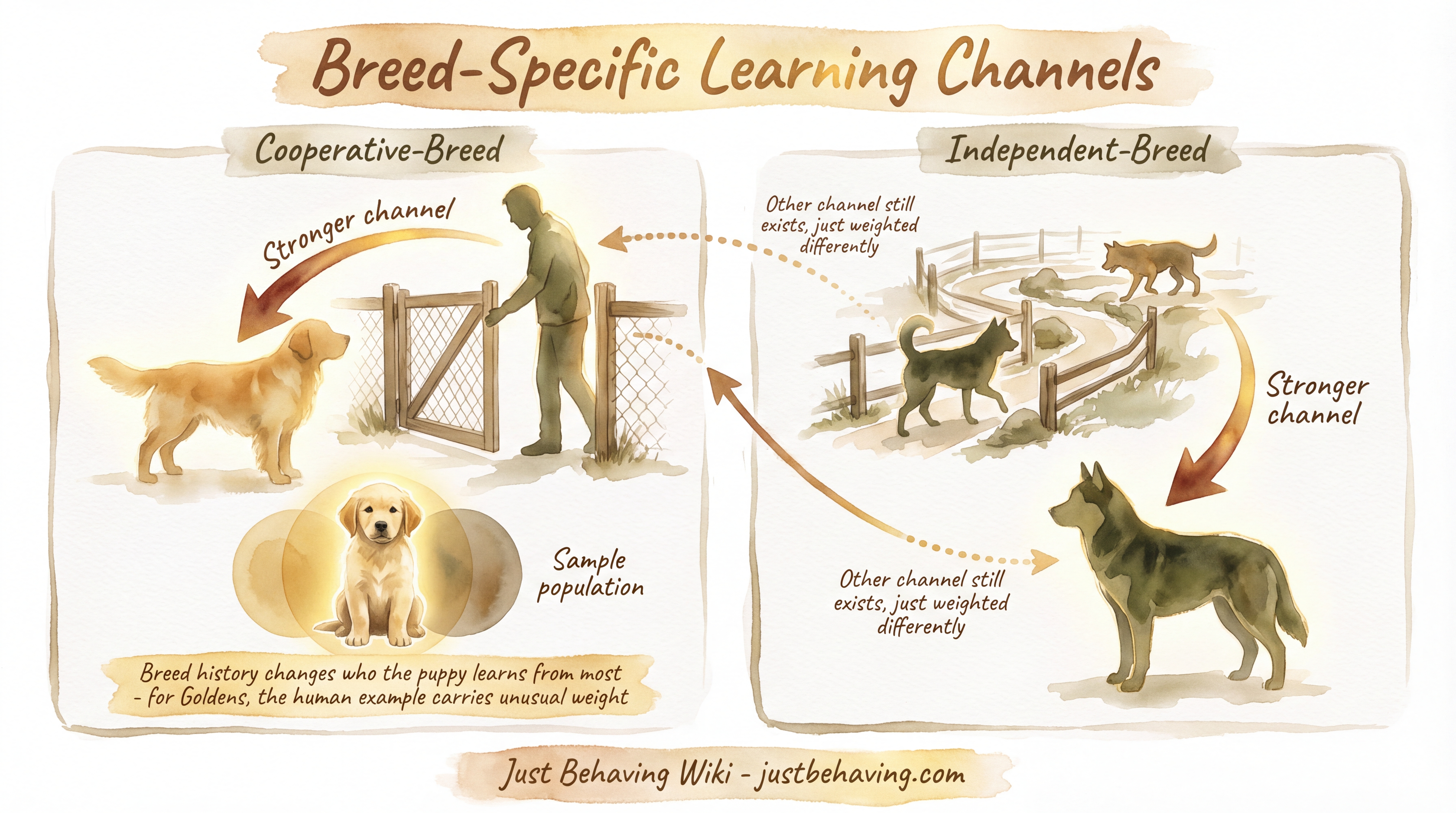
Breed heritage shapes which social learning channels are strongest, meaning a Golden Retriever's observational learning profile differs from that of a terrier or guardian breed.
Key Takeaways
- Breed history changes who dogs learn from most efficiently, not whether dogs can learn socially at all.
- Independent breeds show stronger gains from conspecific demonstrators in the modern detour literature, while cooperative breeds show stronger gains from human demonstrators.
- That matters directly for Golden Retrievers because Goldens sit inside the cooperative group rather than at the edge of generalization.
- The findings describe weighted breed tendencies, not destiny-level predictions for every individual dog or every task.
The Evidence
- Lugosi, C. A. et al. (2024)domestic dogs
In a 120-dog, 47-breed detour study, independent breeds improved more after a conspecific demonstration than cooperative breeds did. - Dobos, P., and Pongracz, P. (2023)domestic dogs
Found the complementary pattern with a human demonstrator, with cooperative breeds gaining more from the human model.
- Fugazza, C. et al. (2018)domestic dogs
Showed that puppies can learn from both canine and human demonstrators from eight weeks, establishing that both channels exist before breed weighting is considered. - SCR-039 synthesisdomestic dogs
Summarizes the comparative breed literature as showing that selection history shapes which demonstrator channel produces the stronger learning advantage.
- SCR-039 boundarydomestic dogs
The breed-channel findings support weighted tendencies tied to selection history, but they should not be written as if every individual dog within a breed learns in exactly the same way in every context.
No published developmental study has yet tracked whether breed-specific demonstrator preference interacts with attachment quality, puppy age, or household stress to change long-term outcomes after rehoming.
SCR References
Sources
- Bray, E. E., Gnanadesikan, G. E., Horschler, D. J., Levy, K. M., Kennedy, B. S., Famula, T. R., & MacLean, E. L. (2021). Early-emerging and highly heritable sensitivity to human communication in dogs. Current Biology, 31(14), 3132-3136. https://doi.org/10.1016/j.cub.2021.04.055
- Dobos, P., & Pongracz, P. (2023). Would you detour with me? Association between functional breed selection and social learning in dogs sheds light on elements of dog-human cooperation. Animals, 13(12), 2001. https://doi.org/10.3390/ani13122001
- Fugazza, C., Moesta, A., Pogany, A., & Miklosi, A. (2018). Social learning from conspecifics and humans in dog puppies. Scientific Reports, 8, 9257. https://doi.org/10.1038/s41598-018-27654-0
- Lugosi, C. A., Udvarhelyi-Toth, K. M., Dobos, P., & Pongracz, P. (2024). Independent, but still observant: Dog breeds selected for functional independence learn better from a conspecific demonstrator than cooperative breeds in a detour task. BMC Biology, 22(1), 245. https://doi.org/10.1186/s12915-024-02046-1