HPA-Axis Flexibility and Owner Psychology
The most useful stress question is often not "Is cortisol high?" but "How flexibly does the system respond?" The dog literature now shows that owner psychology, especially personality and attachment organization, predicts that flexibility in measurable ways. Documented
What It Means
The HPA axis is the hypothalamic-pituitary-adrenal axis, the endocrine cascade that coordinates much of the mammalian stress response. When families hear that phrase, they often imagine a simple stress meter: low cortisol good, high cortisol bad. Observed-JB That is not quite right. A healthy stress system is not silent. It is flexible.
That distinction is why the Schoberl 2017 paper matters. The researchers tested 132 owners and their dogs across different laboratory situations, measured salivary cortisol, and collected personality and relationship questionnaires for both sides of the dyad. Documented Instead of focusing only on one cortisol spike or one baseline value, they calculated the individual coefficient of variation of cortisol, usually written as iCV. In simple terms, iCV asks how much the cortisol level can move across different situations relative to its own average.
That may sound technical, but the plain-language meaning is important. A higher iCV reflects a system with more adaptive range. It can activate when the situation demands activation and recover when the challenge has passed. A lower iCV reflects a system that looks more rigid. It can suggest a dog that is physiologically stuck closer to one mode, whether that means chronic tension, blunted responsiveness, or reduced flexibility in switching states.
This is why flexibility matters more than the folk phrase "low stress." A dog with a very low average cortisol level is not automatically well regulated. The system might be low because it is calm and well buffered, or because it is flattened and less responsive. By contrast, iCV gives the field a better way to talk about resilience. Resilience is not the absence of activation. It is the capacity to move well and recover well.
Schoberl found that the human side of the dyad mattered a great deal. Documented Dogs of owners high in Neuroticism had lower iCV. Dogs of owners with insecure-ambivalent attachment to the dog also had lower iCV. Owners whose broader human-relationship questionnaires indicated human-directed separation anxiety or a strong desire for independence had dogs with lower iCV as well. Those patterns all point in the same direction: the dogs stress flexibility was linked more strongly to the social and psychological organization of the human partner than to the dog alone.
The positive side of the result matters just as much. Owner Agreeableness scaled positively with owner iCV, and in the broader Schoberl interpretation, the human partner was the more influential side of the dyadic system. That matters for JB because it supports a claim stronger than "dogs notice our mood." The social architecture the adult brings to the bond appears related to how flexibly the dog can physiologically handle challenge.
It is important not to flatten those findings into a caricature. The paper does not say that every anxious owner creates a biologically damaged dog, or that personality alone explains canine regulation. What it shows is association inside a live dyadic system. Owner personality, owner attachment style, and owner relationship orientation all predict how the dog stress system varies across challenge situations. That is already a substantial result.
The relationship with attachment theory is especially important here. Secure attachment work, including Schoberl 2016, already showed that dogs buffered better when the relationship to the caregiver was secure. Documented The 2017 paper extends the same basic logic one step further. It suggests that it is not only the presence of the caregiver that matters, but the kind of psychological partner the caregiver is.
This gives the phrase owner psychology real physiological weight. Neuroticism is not just a Big Five label in the abstract. In daily life it can mean more volatility, more anticipatory worry, more interpretive tension, and a more unsettled social field around the dog. Insecure-ambivalent attachment to the dog can mean the relationship itself becomes less clear, more fused, or less predictably regulating. The dog does not read those as questionnaire scores. The dog reads them as the environment.
One of the most useful corrections this paper offers is that a resilient dog is not simply a dog who never shows arousal. A resilient dog is a dog whose system can modulate. That dog can move up, come down, stay cognitively available, and not get stranded in one state. This is much closer to what JB means by calmness. Calmness is not emotional deadness. It is regulated range.
An everyday analogy is suspension on a vehicle. Good suspension does not mean the car never moves. It means the car handles bumps without losing control. iCV is closer to that kind of measurement than to a simple fuel gauge. The question is not "Did the system react?" It is "Can the system handle reaction well?"
The practical implication is that adult psychology belongs inside raising, not outside it. If owner personality and attachment variables help shape canine HPA flexibility, then human change is not a self-help side quest. It is part of the dogs developmental ecology. That does not make the adult the only variable. It makes the adult an important one in a way that endocrine data can actually see.
Why It Matters for Your Dog
For families, this entry helps explain why the same outward behavior can have very different biological meanings. Two dogs may both look quiet after a challenge. One may have recovered well. The other may have shut down or stayed physiologically stuck. Flexibility is what distinguishes resilience from mere stillness.
The HPA-flexibility literature supports JB insistence that calmness is a regulated state, not an absence of feeling. The goal is a dog that can move through stress well, not a dog that never reacts to anything.
This also gives families a more precise reason to care about their own steadiness. Adult emotional organization does not only shape the tone of the room. It may help shape how flexibly the dogs body responds to challenge over time. That makes human regulation part of raising, not merely part of presentation.
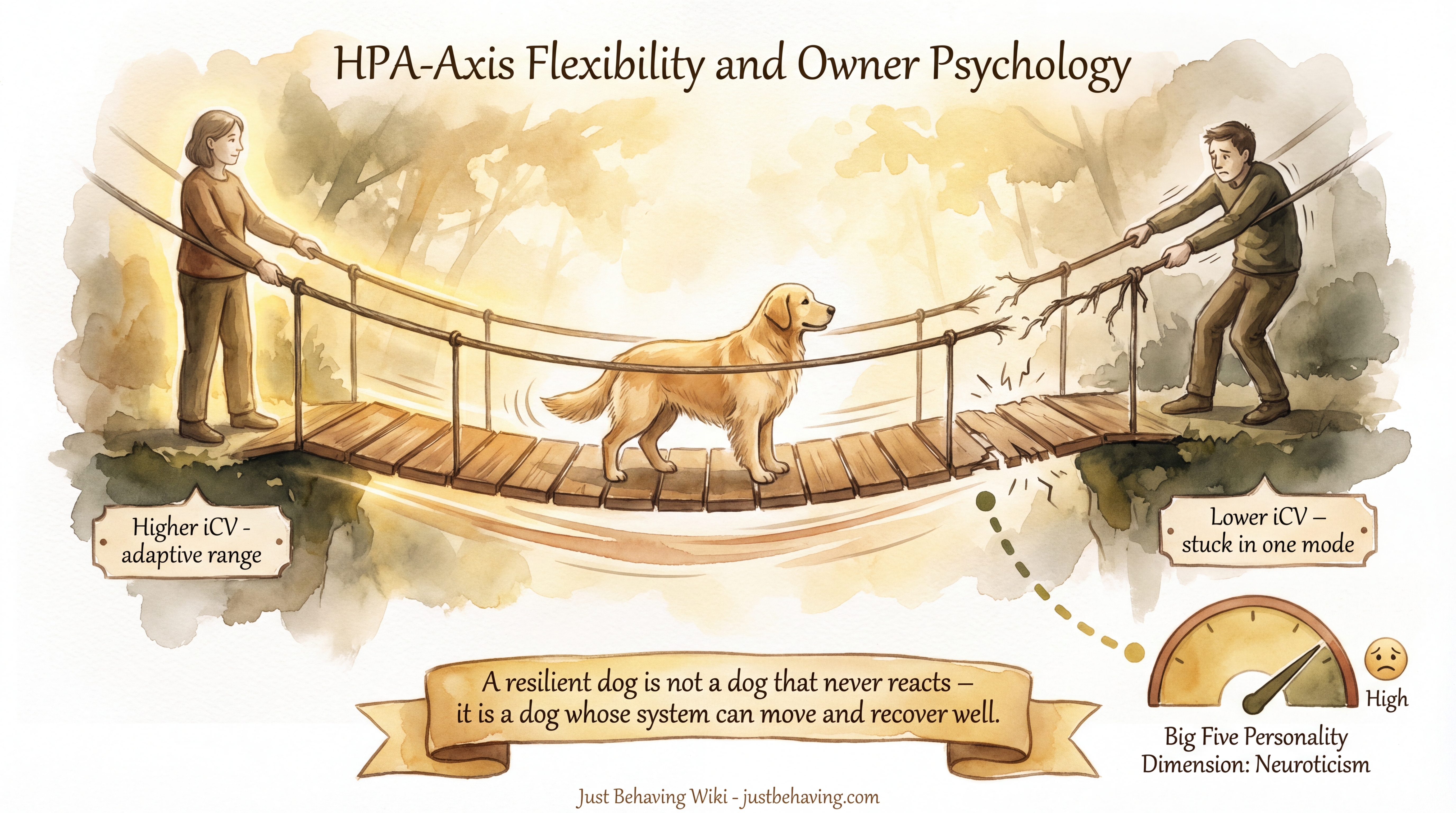
The owner's emotional profile shapes how flexibly the dog's stress-response system adapts, linking human psychology to canine physiological regulation.
Key Takeaways
- A well-functioning stress system is better described by flexibility than by simple cortisol height or low cortisol alone.
- Schoberl measured cortisol variability across multiple challenge situations and found that owner psychology predicted canine flexibility.
- Dogs of owners high in Neuroticism or insecure-ambivalent attachment showed lower cortisol flexibility, while the human partner emerged as the stronger side of the dyadic effect.
- This supports JB language about adult state as part of the dogs regulatory environment rather than as a background detail.
The Evidence
This entry uses observed claim-level tags beyond the dedicated EvidenceBlocks below. These tags mark JB program observation or practice-derived claims that need dedicated EvidenceBlock coverage in a later content pass.
- Schoberl, I. et al. (2017)domestic dogs and humans
Tested 132 owner-dog dyads across different laboratory situations, used salivary cortisol to calculate iCV, and found that owner Neuroticism and insecure-ambivalent attachment predicted lower canine cortisol flexibility. - SCR-059 synthesisdomestic dogs and humans
Frames the human partner as more influential than the dog in shaping cortisol variability and flexibility across the dyad.
- Schoberl, I. et al. (2016)domestic dogs and humans
Showed that secure attachment changed cortisol buffering during challenge, providing the broader relationship context for the later flexibility work.
- SCR-059 boundarydomestic dogs and humans
Owner psychological profile predicts canine HPA flexibility, but no intervention study has yet shown that changing the owner profile directly remakes dog endocrine flexibility through a controlled treatment pathway.
No published longitudinal family study has yet shown how quickly canine HPA flexibility improves when caregiver regulation, attachment quality, or household calmness improve in sustained real-world conditions.
SCR References
Sources
- Schoberl, I., Wedl, M., Bauer, B., Day, J., Mostl, E., & Kotrschal, K. (2017). Psychobiological factors affecting cortisol variability in human-dog dyads. PLOS ONE, 12(2), e0170707. https://doi.org/10.1371/journal.pone.0170707
- Schoberl, I., Beetz, A., Solomon, J., Gee, N., Kotrschal, K., & Wedl, M. (2016). Social factors influencing cortisol modulation in dogs during a strange situation procedure. Journal of Veterinary Behavior, 11, 77-85. https://doi.org/10.1016/j.jveb.2015.09.007