Disorganized and Avoidant Caregiving
Compound evidence detail1 SCR / 3 parts
- Documentedthe Baumrind authoritative-parenting literature in human child development
- Documentedthe canine correlational evidence linking dog-directed caregiving styles to attachment, attention, sociability, and problem-solving outcomes (van Herwijnen 2018/2020, Brubaker and Udell 2023)
- Heuristicthe JB inference that one specific caregiving style experimentally produces the best long-term developmental outcomes in dogs
The caregiving-style literature does not only identify a strong quadrant. It also identifies insecure ones. In dogs, the clearest recent evidence shows that disorganised and avoidant caregiving patterns predict separation-related problems, fearfulness, and aggression. These are not merely training errors. They are relationship-pattern findings. Documented
What It Means
The authoritative literature can sound abstract until it is contrasted with its alternatives. The 2025 LOCQ work by de Assis and colleagues helped sharpen that contrast by asking not only what good caregiving looks like, but what insecure caregiving looks like when measured directly in dog-owner relationships.
Their questionnaire isolated three insecure dimensions: disorganised, avoidant, and ambivalent. Disorganised caregiving captured inconsistency and reactivity, including patterns such as shouting, unstable responses, and anthropomorphic interpretations that cast the dog as intentionally trying to upset the family. Avoidant caregiving captured emotional distance, including a diminished sense that play or relational engagement is necessary. Ambivalent caregiving was also identified, but the strongest outcome patterns in the source synthesis cluster around the disorganised and avoidant sides.
That measurement move matters. Earlier caregiving-style work in dogs often began with human parenting frameworks and asked whether those same broad categories could be recognized around dogs. LOCQ asked a slightly different question: when caregivers answer dog-specific items, what insecure structure emerges from the data itself? The result was not random scatter. It was a patterned map of insecure caregiving dimensions that linked back to real problem outcomes.
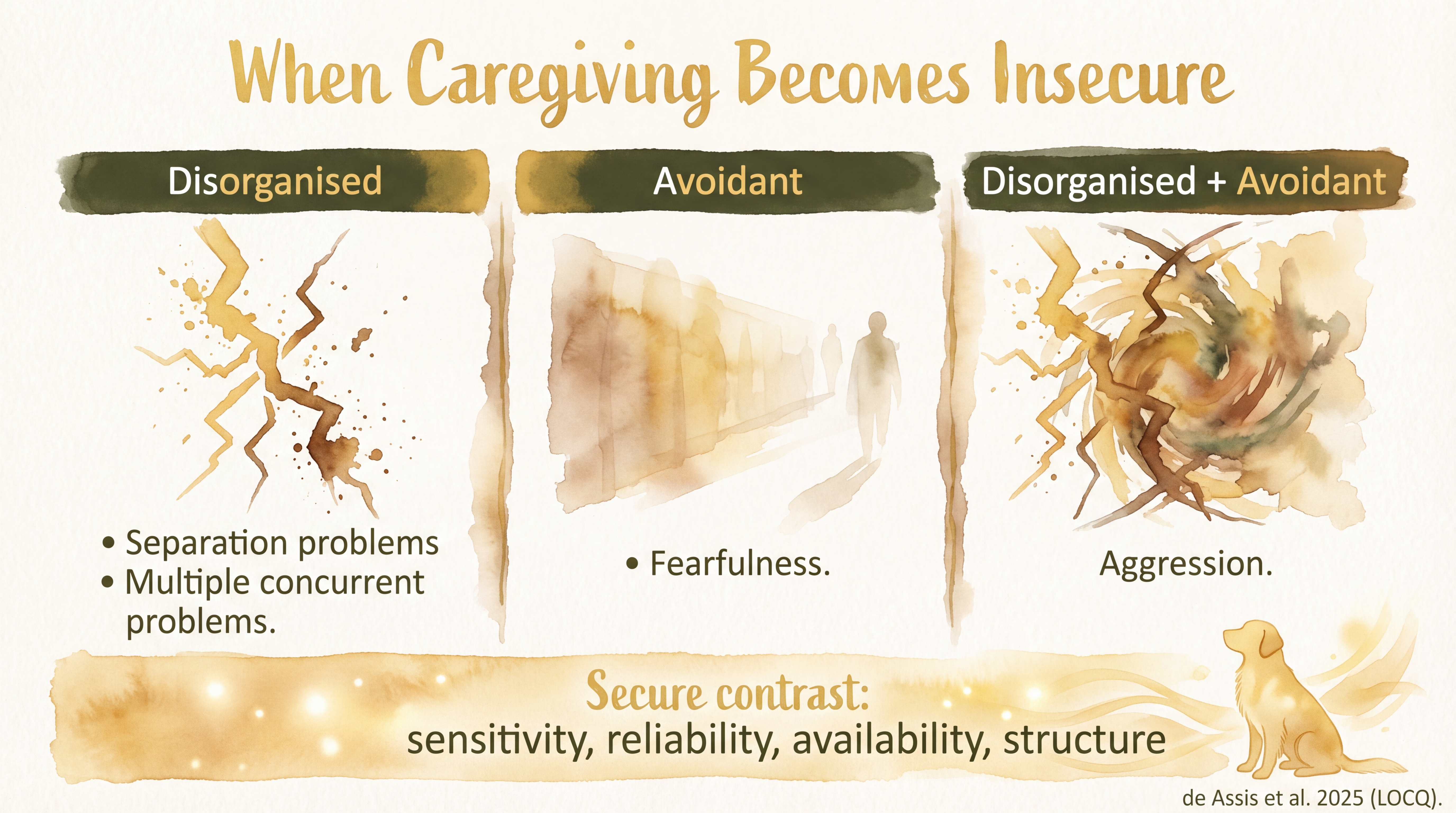
That matters because the dimensions are not just descriptive personality labels. They predicted concrete canine outcomes. High disorganised caregiving predicted separation-related problems and multiple concurrent behavior problems. High avoidant caregiving predicted fearfulness. High disorganised combined with high avoidant predicted aggression. Those are clinically meaningful outcomes, not subtle opinion shifts.
The multiple-problem finding is especially important. When one relationship dimension predicts not just one symptom but a broader pile-up of behavior problems, it suggests we are no longer looking at a narrow training defect. Documented We are looking at a developmental climate. The dog is organizing around a caregiver pattern that is not sufficiently stable, available, or legible.
One reason disorganised caregiving is so costly is that the dog cannot build a stable expectation around it. The response to the same behavior may change by mood, fatigue, frustration, or whatever story the adult tells themselves in the moment. Documented A young social mammal trying to organize around a caregiver needs more legibility than that. In JB language, the adult stops being usable.
The anthropomorphic-blame piece matters here too. If the adult interprets the dog's behavior as spiteful, manipulative, or intentionally upsetting, the adult is likely to respond to a false story rather than to the actual developmental problem in front of them. Documented That contaminates timing, emotional tone, and repair. The dog is then not only facing inconsistency. The dog is facing inconsistency wrapped in misreading.
Avoidant caregiving creates a different problem. The adult may not be openly explosive, but the relationship lacks enough emotional availability to function well as a secure base or safe haven. The dog is left with less usable social support, less guided co-regulation, and fewer reliable opportunities to orient through the adult. That is why fearfulness, rather than only overt disobedience, becomes such an important output in this cluster.
This is also why avoidant caregiving should not be mistaken for calmness. A quiet household can still be emotionally unavailable. The absence of overt drama does not automatically produce security if the dog cannot reliably access the adult as a source of support, play, shared attention, or organized recovery. In attachment terms, the question is not only whether the adult refrains from scaring the dog. It is whether the adult is present enough to be used.
The LOCQ findings become even more important when they are read next to the rest of the attachment literature. Schoberl showed that secure attachment changes cortisol buffering. Brubaker and Udell showed that authoritative caregiving covaries with stronger attachment and better task persistence. de Assis then showed what the inverse side looks like when caregiving quality degrades. Put together, those studies suggest that caregiving pattern is not only about manners or tone. It reaches attachment security, physiology, and behavior-problem expression.
The paper also offered an important positive contrast. Families reporting no behavior problems showed the lowest median scores across all three insecure dimensions, a pattern interpreted as consistent with secure caregiving marked by sensitivity, reliability, availability, and structure. That matters because it reminds us that secure caregiving is not simply the absence of yelling. It is the presence of a coherent adult.
The secure contrast is also slightly methodologically bounded, and it is worth stating why. In this study, secure caregiving is partly inferred from low insecure scores and better outcomes rather than built as a fully separate experimentally validated positive factor. Documented That is a real limit. But even with that limit in place, the data still do useful work. They show which caregiver patterns travel with fearfulness, aggression, and separation problems, and they show the outline of the healthier alternative.
This is one place where the dog-human bond lens is especially useful. Families often talk about behavior problems as if they are qualities sitting entirely inside the dog. The LOCQ results press back on that story. They do not say every problem is caused by the family. They do say that who the family is in the relationship is part of the outcome map.
The scientific ceiling still matters. LOCQ is questionnaire-based and therefore dependent on caregiver report rather than on a fully experimental design. The secure profile in this work is also partly inferred from low scores on insecure dimensions rather than from a separately isolated positive factor. Those are real boundaries. But they do not erase the force of the signal. The insecure caregiving dimensions tracked real canine problems in a way too structured to dismiss casually.
Why It Matters for Your Dog
For families, this entry is valuable because it gives shape to problems that otherwise stay vague. A relationship can be loving in intention and still be disorganised in practice. A relationship can avoid overt conflict and still be too distant to regulate with. The dog feels those patterns even if the adults do not have language for them yet.
Disorganised caregiving is one of the clearest scientific arguments for JB insistence on calm adults. Reactivity is not only unpleasant in the moment. It is associated with a poorer developmental climate for the dog.
This also changes what improvement means. Better outcomes are not only about teaching the dog more cues. They are also about making the adult more coherent, less reactive, and more available. That is a demanding message, but it is a useful one because it gives families something real to work on besides blaming the dog or endlessly changing methods.
Inconsistent or emotionally volatile caregiving creates confusion rather than security, producing dogs that cannot predict what their owner will do next.
Key Takeaways
- The strongest recent caregiving-style study identified disorganised, avoidant, and ambivalent insecure dimensions in dog-owner relationships.
- High disorganised caregiving predicted separation-related and multiple concurrent problems, while high avoidant caregiving predicted fearfulness.
- High disorganised plus high avoidant scores were associated with aggression, making the relationship pattern clinically meaningful rather than merely descriptive.
- The secure contrast is not just low conflict. It is sensitivity, reliability, availability, and structure.
The Evidence
- de Assis, L. S. et al. (2025)domestic dogs
Developed the LOCQ and identified disorganised, avoidant, and ambivalent caregiving dimensions that predicted separation problems, fearfulness, and aggression in dogs. - Brubaker, L., and Udell, M. A. R. (2023)domestic dogs
Reported that more authoritative caregiving aligned with stronger secure attachment and better persistence, providing a direct contrast to weaker caregiving profiles. - Schoberl, I. et al. (2016)domestic dogs and humans
Showed that secure attachment changes cortisol reactivity, reinforcing the broader point that relationship organization affects more than outward behavior.
- Ainsworth, M. D. S. et al. (1978)humans
Showed that inconsistent or poorly organized caregiving changes attachment organization under stress. - Baumrind, D. (1966, 1991)humans
Established that caregiving patterns differ in warmth and structure and that these differences matter developmentally.
- SCR-019 boundarydomestic dogs and humans
The caregiving-style signal is documented, but questionnaire-defined insecure dimensions and inferred secure profiles still stop short of a fully closed causal developmental model.
No published study has yet replicated the LOCQ insecure dimensions with direct observational coding across the breeder-to-family transition or through a randomized family intervention.
SCR References
Sources
- Ainsworth, M. D. S., Blehar, M. C., Waters, E., & Wall, S. (1978). Patterns of Attachment: A Psychological Study of the Strange Situation. Erlbaum.
- Baumrind, D. (1966). Effects of authoritative parental control on child behavior. Child Development, 37(4), 887-907.
- Baumrind, D. (1991). The influence of parenting style on adolescent competence and substance use. Journal of Early Adolescence, 11(1), 56-95.
- Brubaker, L., & Udell, M. A. R. (2023). Does pet parenting style predict the social and problem-solving behavior of pet dogs? Animal Cognition, 26(1), 345-356. https://doi.org/10.1007/s10071-022-01694-6
- de Assis, L. S., Georgetti, B., Burman, O. H. P., Pike, T. W., & Mills, D. S. (2025). Development of a dog owner caregiving style scale (Lincoln Owner Caregiving Questionnaire, LOCQ) and its relationship with behaviour problems in dogs. Applied Animal Behaviour Science, 287, 106628. https://doi.org/10.1016/j.applanim.2025.106628
- Schoberl, I., Beetz, A., Solomon, J., Gee, N., Kotrschal, K., & Wedl, M. (2016). Social factors influencing cortisol modulation in dogs during a strange situation procedure. Journal of Veterinary Behavior, 11, 77-85. https://doi.org/10.1016/j.jveb.2015.09.007