Cross-Species Mentorship Convergence
Cross-species mentorship convergence means that adult-guided competence transfer is not unique to domestic dogs. Across several highly social mammals, young individuals become capable by learning inside the knowledge, structure, and modified behavior of experienced adults. The comparative pattern is documented. The stronger step, applying that convergence to dogs as a whole-system mentorship model, is the part that requires careful hinge language. Mixed Evidence
What It Means
The reason this entry matters is biological plausibility. If adult-guided competence transfer were a dog-only oddity, then any philosophy built around it would rest on a narrow base. But if the same broad solution appears repeatedly across very different mammalian lineages, the prior probability rises that dogs may also rely on socially scaffolded development in important ways. Documented
Whiten and colleagues made one of the most influential comparative contributions in 1999 with their chimpanzee culture paper in Nature. The important point was not a single cute tool-use anecdote. It was that chimpanzee groups carried socially transmitted behavioral repertoires that differed across populations in ways not well explained by ecology or genetics alone. Competence could travel socially.
Thornton and McAuliffe then supplied one of the cleanest formal teaching examples in 2006. Meerkat adults adjusted prey difficulty to pup developmental stage, beginning with dead prey and moving toward live prey as the pups became more competent. That pattern met the classic Caro-Hauser teaching criteria because the adults modified behavior in the presence of naive young in a way that improved youngster learning. Documented
Bender, Herzing, and Bjorklund extended the same logic into cetaceans in 2009. Atlantic spotted dolphin mothers modified foraging behavior in the presence of calves in ways interpreted as teaching. The exact surface behavior differed from meerkats, of course, but the functional logic was familiar: the experienced adult changed what it did because a young learner was present. Documented
McComb and colleagues add a different but equally important kind of evidence in elephants. Their 2001 study showed that older matriarchs functioned as repositories of social knowledge, especially in threat discrimination. Groups led by older matriarchs made better collective decisions. That result does not look exactly like hands-on instruction, but it still demonstrates that adult experience can become a developmental and survival asset for the young through social organization.
Krutzen and colleagues' dolphin work on vertical transmission reinforces the same point from another angle. Learned foraging traditions can move down family lines through social rather than genetic inheritance. Again, the specific mechanism is not identical to the meerkat pattern. The important comparative lesson is that socially embedded competence transfer is not a one-species trick.
This is where the function-versus-mechanism distinction becomes essential. The convergent pattern across mammals is a functional one: helpless juveniles become more competent by living inside the behavior and knowledge of experienced adults. The mechanisms differ. Some cases are closer to formal teaching. Some are closer to observational learning or social buffering. Some are closer to leadership and knowledge storage. Convergence does not mean sameness.
That distinction protects the dog application from overreach. Dogs do not need to be literal meerkats or dolphins for the comparative frame to matter. They only need to share the relevant ecological and developmental problem: extended juvenile dependency, social living, and the need to become capable through time rather than by instinct alone.
The dog evidence then supplies the hinge. Puppies learn from demonstrators at eight weeks. Dogs retain observed action, use social referencing, copy inefficient caregiver behavior through overimitation, and appear especially human-oriented in cooperative breeds. Those are not yet formal Caro-Hauser teaching demonstrations in dogs. They are dog-specific evidence that makes the broader convergence frame scientifically useful rather than merely decorative.
This is also why the notebook is careful to note the missing piece. No published study has yet shown that adult dog-puppy interaction in domestic dogs formally satisfies the operational teaching criteria used in behavioral biology. Documented We do not currently have the decisive paper showing that adult dogs systematically modify behavior at cost to themselves in order to accelerate puppy learning under that definition.
That gap matters, but it does not erase the convergence. It simply keeps the final sentence honest. The documented comparative literature tells us that adult-guided competence transfer is a conserved solution across multiple highly social mammals. The dog literature tells us that puppies are unusually open to socially mediated learning from adults. The stronger claim that dogs instantiate a full mentorship system in the exact formal comparative sense remains a bounded inference.
This is one of the best examples in the whole wiki of why JB does not need to exaggerate to be distinctive. The cross-species frame is already powerful when written correctly. It says that nature has arrived at socially scaffolded development again and again. Dogs fit that world better than a purely technique-centered training picture suggests, even though the exact dog mechanism still needs more direct mapping.
An everyday analogy is apprenticeship across different trades. Carpentry, music, and medicine do not teach through identical gestures, tools, or evaluation systems. But all three rely on novices becoming capable around experienced adults. Cross-species mentorship convergence makes a similar claim at the level of biology.
Why It Matters for Your Dog
For families, this entry matters because it reframes mentorship as something larger than breeder preference or house style. If adult-guided competence transfer is a conserved solution in social mammals, then expecting a puppy to mature mainly through ambient adult example is not an eccentric romantic idea. It is a biologically plausible developmental bet.
The comparative literature does not prove every JB sentence. What it does do is place mentorship inside a repeated mammalian pattern, which makes the dog application more plausible and more scientifically proportionate.
This also keeps expectations balanced. Families do not need to believe that dogs are formal teaching animals in every strict sense. They only need to understand that young social mammals often become competent around competent adults. The question for the home then becomes very practical: what kind of adult is the puppy growing up around?
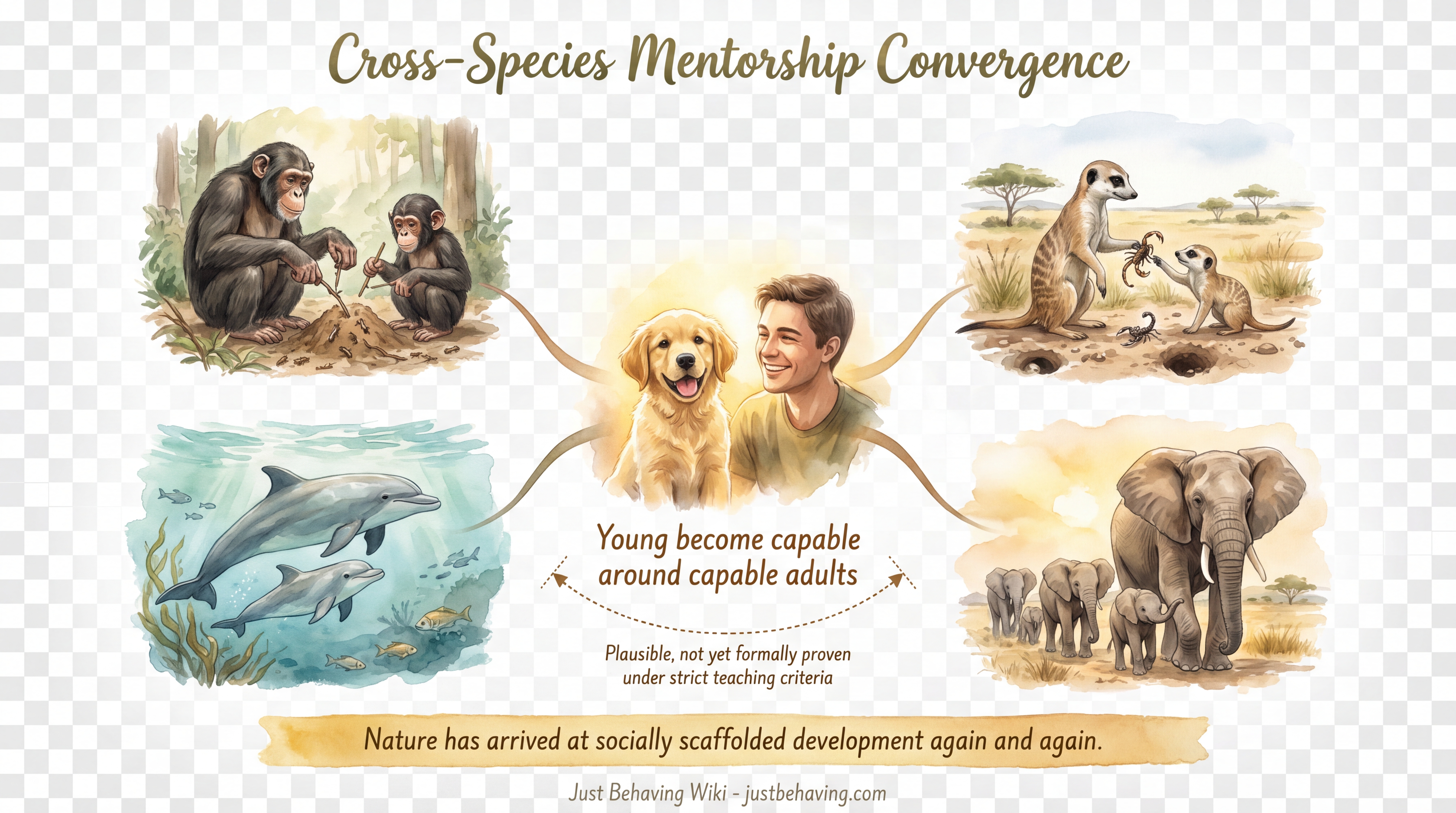
Mentorship through calm adult modeling appears across wolves, primates, elephants, and cetaceans, suggesting the Five Pillars describe a convergent biological strategy rather than a human invention.
Key Takeaways
- Adult-guided competence transfer is documented across several highly social mammals, including primates, cetaceans, meerkats, and elephants.
- The convergence is strongest at the level of function rather than identical mechanism, which is why species boundaries still matter.
- Dog-specific social-learning evidence makes the comparative frame scientifically useful, even though formal canine teaching has not been fully established under strict operational criteria.
- For families, the practical lesson is that mentorship is biologically plausible on comparative grounds and does not need to be treated as a soft metaphor.
The Evidence
This entry uses mixed-evidence claim-level tags beyond the dedicated EvidenceBlocks below. These tags mark claims that combine documented findings with observed practice, heuristic application, or unresolved gaps.
- Whiten, A. et al. (1999)chimpanzees
Documented socially transmitted behavioral repertoires across chimpanzee groups, showing that competence can travel culturally rather than only genetically. - Bender, C. E. et al. (2009)Atlantic spotted dolphins
Reported maternal behavioral modification in the presence of calves consistent with teaching during foraging. - Thornton, A., and McAuliffe, K. (2006)meerkats
Demonstrated adult scaffolding of pup prey handling that met strong formal teaching criteria. - McComb, K. et al. (2001)African elephants
Showed that older matriarchs function as repositories of social knowledge that improve group-level decision making.
- Fugazza, C. et al. (2018)domestic dogs
Showed that puppies from eight weeks can learn from canine and human demonstrators, supplying a direct dog anchor for adult-guided learning. - SCR-032 synthesismultiple highly social mammals
Summarizes adult-to-young competence transmission as a conserved cross-species developmental pattern rather than a one-species quirk.
- SCR-032 boundarydomestic dogs
The comparative pattern strongly supports biological plausibility for canine mentorship, but it does not prove that dogs instantiate the same mechanism mix or formal teaching criteria as every other species in the convergence set.
No published study has yet tested whether ordinary adult dog-puppy or human-puppy interactions in domestic dogs meet the formal Caro-Hauser operational definition of teaching.
SCR References
Sources
- Bender, C. E., Herzing, D. L., & Bjorklund, D. F. (2009). Evidence of teaching in Atlantic spotted dolphins by mother dolphins foraging in the presence of their calves. Animal Cognition, 12(1), 43-53. https://doi.org/10.1007/s10071-008-0169-9
- Caro, T. M., & Hauser, M. D. (1992). Is there teaching in nonhuman animals? Quarterly Review of Biology, 67(2), 151-174. https://doi.org/10.1086/417553
- Fugazza, C., Moesta, A., Pogany, A., & Miklosi, A. (2018). Social learning from conspecifics and humans in dog puppies. Scientific Reports, 8, 9257. https://doi.org/10.1038/s41598-018-27654-0
- Krutzen, M., Mann, J., Heithaus, M. R., Connor, R. C., Bejder, L., & Sherwin, W. B. (2005). Cultural transmission of tool use in bottlenose dolphins. Proceedings of the National Academy of Sciences, 102(25), 8939-8943. https://doi.org/10.1073/pnas.0500232102
- McComb, K., Moss, C. J., Durant, S. M., Baker, L., & Sayialel, S. (2001). Matriarchs as repositories of social knowledge in African elephants. Science, 292(5516), 491-494. https://doi.org/10.1126/science.1057895
- Thornton, A., & McAuliffe, K. (2006). Teaching in wild meerkats. Science, 313(5784), 227-229. https://doi.org/10.1126/science.1128727
- Whiten, A., Goodall, J., McGrew, W. C., Nishida, T., Reynolds, V., Sugiyama, Y., Tutin, C. E. G., Wrangham, R. W., & Boesch, C. (1999). Cultures in chimpanzees. Nature, 399, 682-685. https://doi.org/10.1038/21415