Cross-Species Mentorship in Dogs
Compound evidence detail1 SCR / 2 parts
- Documentedthe cross-species evidence for mentorship convergence in non-canid mammals, including chimpanzee tool-use transmission (Inoue-Nakamura and Matsuzawa 1997), dolphin foraging transmission, meerkat prey-handling teaching, and elephant matriarchal knowledge transfer
- Heuristicthe JB application of the cross-species convergence to dog raising, mapping the pattern in function rather than mechanism, with no formal canine teaching study under the strict definition
Cross-species mentorship is the idea that useful competence can be transferred from one species to another through social processes. In the canine case, the most relevant form is dog learning from human models. Documented Domestic dogs are unusually willing to treat humans as socially meaningful partners, and that makes them an important case in comparative cognition.
This page needs careful wording. The broad cross-species pattern of adult-to-young competence transfer is documented across several social mammals. Documented-Cross-Species The stronger claim that domestic dogs are raised through a stable, mentorship-like human channel in the same formal sense remains more interpretive. That is why this page sits at a mixed evidence level.
What It Means
Cross-species mentorship is broader than simple cue following. It refers to cases where one species takes another species seriously enough, socially and cognitively, for the other individual's behavior to shape learning, orientation, or problem solving.
Dogs are a strong candidate for this because domestication appears to have selected for human-oriented social sensitivity. Dogs do not merely coexist with people. In many tasks they monitor human movement, gesture, emotional response, and action structure in ways that are unusually cooperative for a non-primate species. Mixed Evidence
That does not mean dogs and humans share one seamless learning system. Documented It means dogs are unusually open to human social input.
The Comparative Pattern
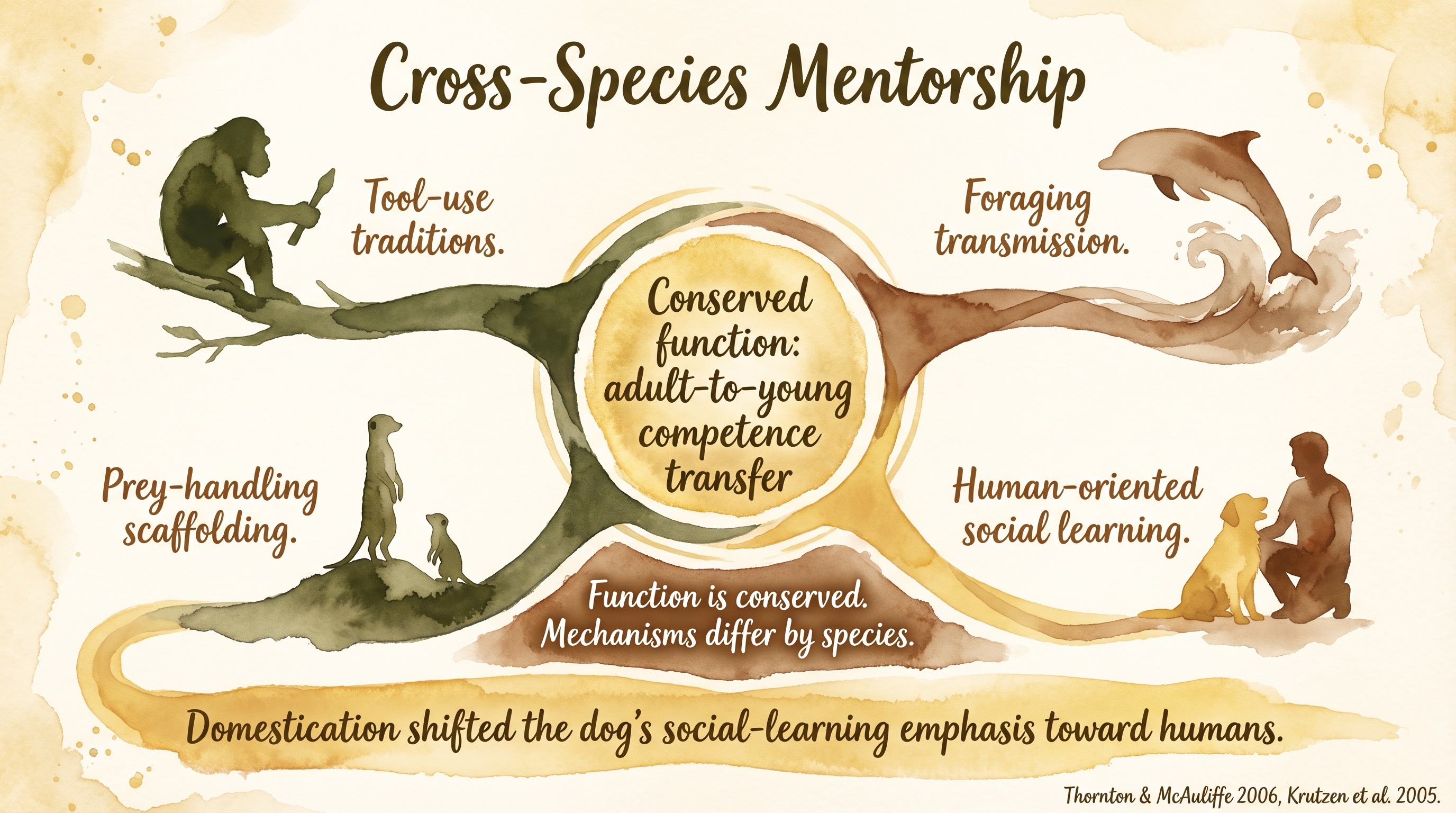
The clearest documented layer here is cross-species convergence rather than dog specificity. Across highly social mammals, adults transmit competence to younger individuals through social channels.
The classic examples include chimpanzees transmitting tool-use traditions through prolonged observation, dolphins with vertical transmission of foraging traditions from older to younger animals, meerkats with adults scaffolding prey handling through graduated help, and elephants where older matriarchs function as repositories of social knowledge.
These cases do not all involve the same mechanism. Some look more like teaching, some more like observational learning, and some more like leadership or knowledge buffering. What unites them is the pattern: competence does not have to be rediscovered from scratch in every generation. That cross-species pattern is the documented part of SCR-032. Documented
Where Dogs Fit
Dogs fit this picture in a narrower and more cautious way. They clearly learn from humans in a variety of tasks, and they are unusual among domestic species in their willingness to take human gestures and demonstrations as informative. But the formal comparative claim has to stay precise.
The documented convergence shows that adult-to-young competence transmission is a conserved pattern across social mammals. It does not automatically prove that dogs use the same mechanisms as chimpanzees, dolphins, or meerkats.
That is the key boundary. The conserved feature is the function. The mechanism can differ substantially by species. Domestic dogs are especially relevant because their domestication history appears to have shifted their social-learning emphasis toward humans. In that sense, cross-species mentorship in dogs is not a metaphor. It is a plausible comparative interpretation of a real domestication outcome. But it is still an interpretation when framed at the level of whole-life developmental theory.
Why It Matters for Your Dog
This page matters because it protects two truths at once. First, it protects against understatement: dogs are not merely animals that tolerate humans while independently solving everything important. Their social-cognitive profile is deeply human-oriented. Second, it protects against overstatement: cross-species examples do not let us import every concept from one species into another as if nothing changes. Dogs are not meerkats with tails that wag more, and humans are not canine parents in a literal ethological sense. The comparison is useful only when the boundary is preserved.
The Main Boundary
The biggest boundary is that dogs are not yet a classic teaching model in the strict behavioral-biology sense. The Caro-Hauser definition of teaching requires specific operational criteria, including behavior modification by the tutor in the presence of a naive observer and evidence that the observer learns faster as a result. Documented Dogs are discussed in this neighborhood, but adult dog-puppy and human-puppy interactions have not been mapped this way comprehensively enough to claim formal canine teaching as a settled category.
That is why the page stays mixed: documented for the cross-species convergence itself and heuristic for the broader inference that domestic dogs operate through the same mentorship logic at a system level.
The comparative literature supports the plausibility of adult-guided competence transfer as a mammalian pattern. The specifically canine-human developmental application remains strongest when it is phrased as biologically grounded and evidence-aligned, not as a proved universal law.
No published study has directly tested whether JB-style human mentorship produces measurably better long-term behavioral or learning outcomes in puppies compared to non-mentorship or alternative social-learning approaches.
Cross-species mentorship works because dogs read human social signals through the same channels they use with adult dogs.
Key Takeaways
- Adult-to-young competence transfer is a documented pattern across several highly social mammals.
- Dogs are highly relevant to this literature because they are unusually willing to learn from humans.
- The conserved part is the function of competence transfer, not a single identical mechanism across species.
- Cross-species mentorship is a useful canine framework when kept evidence-aligned and not overstated into a proved universal teaching model.
The Evidence
This entry uses mixed-evidence claim-level tags beyond the dedicated EvidenceBlocks below. These tags mark claims that combine documented findings with observed practice, heuristic application, or unresolved gaps.
- Inoue-Nakamura, N., & Matsuzawa, T. (1997)chimpanzees
Documented socially transmitted tool-use competence in young chimpanzees. - Krutzen, M. et al. (2005)bottlenose dolphins
Documented vertical transmission of foraging behavior. - Thornton, A., & McAuliffe, K. (2006)meerkats
Demonstrated adult scaffolding of young prey handling that meets strong teaching criteria. - McComb, K. et al. (2001)African elephants
Showed that older matriarchs function as knowledge repositories that affect group competence.
- Social-learning source synthesisdomestic dogs
Domestic dogs are unusually open to human demonstrators and human communicative behavior, making them a strong case for cross-species learning relevance.
- SCR-032 boundarydomestic dogs
The cross-species pattern documents a conserved function, but the inference that dogs use the same mentorship mechanisms at a whole-system level remains interpretive. - Caro and Hauser frameworkmultiple species
Dogs have not yet been fully established as a classic teaching model under the strict operational definition used in behavioral biology.
SCR References
Sources
- Caro, T. M., & Hauser, M. D. (1992). Is there teaching in nonhuman animals? Quarterly Review of Biology, 67(2), 151-174.
- Inoue-Nakamura, N., & Matsuzawa, T. (1997). Development of stone tool use by wild chimpanzees. Journal of Comparative Psychology, 111(2), 159-173.
- Krutzen, M., Mann, J., Heithaus, M. R., Connor, R. C., Bejder, L., & Sherwin, W. B. (2005). Cultural transmission of tool use in bottlenose dolphins. Proceedings of the National Academy of Sciences, 102(25), 8939-8943.
- McComb, K., Moss, C. J., Durant, S. M., Baker, L., & Sayialel, S. (2001). Matriarchs as repositories of social knowledge in African elephants. Science, 292(5516), 491-494.
- Thornton, A., & McAuliffe, K. (2006). Teaching in wild meerkats. Science, 313(5784), 227-229.