Breed-Specific Learning Channels
Breed-specific learning channels describe a bounded but important finding in canine social learning: breed selection history affects which demonstrator channel tends to produce the strongest advantage. Cooperative breeds, including retrievers, often show stronger gains from human demonstrators. Breeds selected for more independent work often show stronger gains from conspecific demonstrators. Documented
This is one of the most useful places where behavioral genetics and social-learning research meet. Documented It is also one of the easiest places to drift into breed essentialism if the evidence is written carelessly.
What It Means
The claim is not that some breeds can learn socially and others cannot. The claim is narrower: the most effective social-learning channel can be weighted differently depending on what the breed was selected to do.
That makes evolutionary sense. Breeds selected for sustained cooperation with humans should be especially sensitive to human models, human gestures, and human attention. Documented Breeds selected for more autonomous problem solving should not lose social-learning ability, but they may rely relatively more on canine or environment-based channels.
The key phrase is relative advantage. That is the language that keeps the finding accurate.
What the Research Shows
Recent work found a double pattern: breeds selected for cooperation with humans showed stronger gains from human demonstrators, and breeds selected for functional independence showed stronger gains from conspecific demonstrators. Documented
This is the core of SCR-039. It is not a vague folk observation. It is a documented comparative finding in the modern dog-cognition literature.
For retrievers, this fits neatly with the separate gesture-comprehension literature. Documented Retriever puppies already show robust human cue use at eight to ten weeks without a conditioning-style learning curve inside the task. That does not prove that retrievers only learn from humans. It does show that the human channel is especially salient within the breed group.
Why It Matters for Your Dog
Understanding the Anti-Essentialism Boundary
Without SCR-070, this page would be dangerous. Breed ancestry explains only a modest share of individual behavioral variation, roughly nine percent in one large community-science dataset. That means breed matters, but it is not destiny.
This is the core anti-essentialism boundary: group averages can be real and individual prediction remains weak. Both statements have to survive in the same paragraph.
The behavioral-genetics source layer makes this point repeatedly. Breed-level studies can identify real group differences and even strong among-breed heritability patterns, while individual-level work shows that specific behavior is still shaped by large within-breed variation and environmental influence. Documented Those findings are not contradictory. They operate at different scales.
Why This Topic Matters
This page matters because it prevents two opposite mistakes. The first mistake is breed denial: pretending that selection history tells us nothing about learning style. The second mistake is breed determinism: pretending that a breed label tells you exactly how an individual dog will learn. Neither mistake is supported by the evidence.
The scientifically defensible middle is stronger than either extreme. Breed history creates a probabilistic weighting of channels. Individual dogs still need to be read as individuals.
Golden Retriever Relevance
This page is especially relevant to Golden Retrievers because the documented cooperative-breed pattern supports the idea that human demonstration is not a fallback channel for this breed. It is likely one of the most important channels.
But even here the boundary matters. The correct statement is that the human channel carries greater relative weight in this breed group. The incorrect statements are that Golden Retrievers only learn from humans, cannot learn from dogs, or that breed label alone predicts an individual puppy's style with certainty. Those stronger statements would violate the register.
Breed-specific learning channels support a channel-weighting model, not a destiny model. Golden Retrievers may lean more strongly toward human social information, but they are not reduced to that one channel.
No published study has directly compared learning outcomes in Golden Retrievers exposed to JB-style mentorship versus other social-learning approaches.
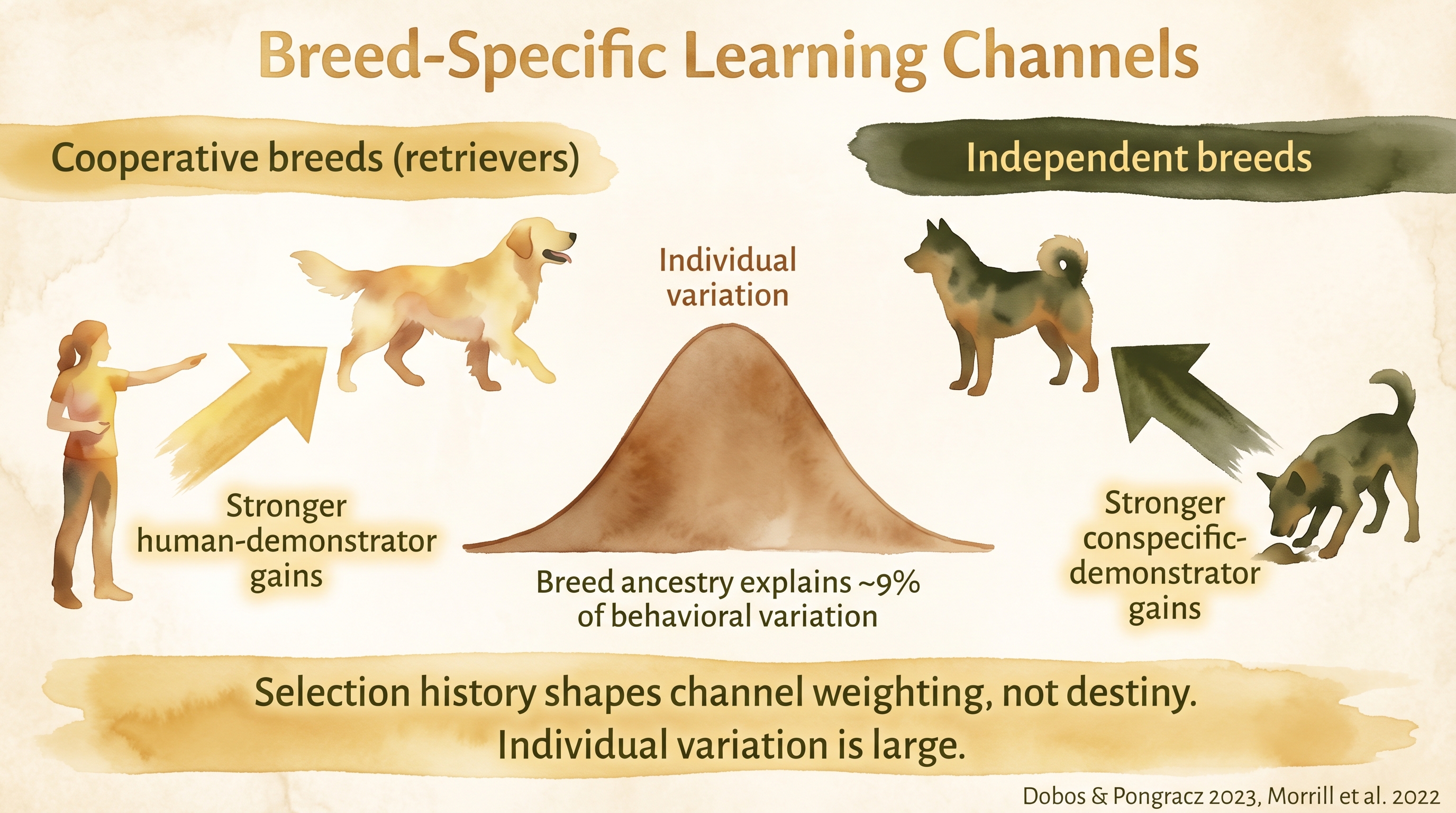
Retrievers are biased toward social learning channels - observation, gesture reading, and cooperative attention.
Key Takeaways
- Breed selection history can shape which demonstrator channel tends to work best, but it does not remove the other channels.
- Cooperative breeds often show stronger human-demonstrator gains, while more independent breeds often show stronger conspecific-demonstrator gains.
- Breed ancestry explains only a modest share of individual behavioral variation, so breed matters probabilistically rather than deterministically.
- The correct framing is channel weighting, not breed destiny.
The Evidence
- Dobos, P., & Pongracz, P. (2023)domestic dogs
Reported stronger human-demonstrator gains in breeds selected for close human cooperation. - Lugosi, C. A. et al. (2024)domestic dogs
Reported stronger conspecific-demonstrator gains in breeds selected for functional independence.
- Morrill, K. et al. (2022)domestic dogs
Found that breed ancestry explains only a modest share of individual behavioral variation, supporting group-level relevance without individual determinism. - Temperament and behavioral-genetics synthesisdomestic dogs
Breed-level differences and individual-level unpredictability are both real, and they operate at different scales of analysis.
- SCR synthesisGolden Retrievers
For Golden Retrievers, the evidence supports a stronger human-channel weighting, but individual dogs still require individual reading and environment still matters heavily.
SCR References
Sources
- Dobos, P., & Pongracz, P. (2023). Would you detour with me? Association between functional breed selection and social learning in dogs sheds light on elements of dog-human cooperation. Animals, 13(12), 2001.
- Lugosi, C. A., Udvarhelyi-Toth, K. M., Dobos, P., & Pongracz, P. (2024). Independent, but still observant: Dog breeds selected for functional independence learn better from a conspecific demonstrator than cooperative breeds in a detour task. BMC Biology, 22(1), 245.
- Morrill, K., Hekman, J., Li, X., et al. (2022). Ancestry-inclusive dog genomics challenges popular breed stereotypes. Science, 376(6592), eabk0639.