Adolescent Attachment Conflict
Compound evidence detail1 SCR / 2 parts
- Documentedcanine welfare evidence on aversive training methods (Vieira de Castro 2020, Ziv 2017, Hiby 2004) and attachment-mediated stress modulation evidence (Schoberl 2015, Asher 2020, Brubaker and Udell 2023)
- HeuristicJB claim that secure attachment context measurably alters how dogs experience mechanically operant-identical correction procedures, RF-flagged in the SCR and formally untested in controlled canine studies
Adolescence can make a bonded dog look less bonded. The dog may ignore familiar cues more often, push harder against routine, and seem more interested in the outside world than in the caregiver. The important scientific point is that this phase is documented as caregiver-specific conflict, not proof that the bond has disappeared. Documented
What It Means
Asher and colleagues gave this phenomenon a much clearer scientific shape. In guide dog populations including Golden Retrievers, dogs were about twice as likely to ignore sit commands from their caregiver at around eight months than they had been before adolescence. The same dogs remained more responsive to an unfamiliar person. That makes the finding more specific than a general obedience dip. The conflict is relationship-facing.
The paper is stronger than a single dramatic result because it is built from three connected sub-studies. Documented One arm tracked pubertal timing in 70 female guide dog candidates. A second arm tested obedience directly in 93 dogs at five and eight months. A third arm followed 285 dogs through trainability questionnaires at five, eight, and twelve months. Put together, those samples let the authors connect puberty timing, live behavioral testing, and later recovery instead of leaving the reader with only one snapshot.
That design is especially useful because guide dog populations reduce some of the background noise that makes ordinary pet-dog research difficult to interpret. Documented The dogs are still individuals, but they are moving through a more standardized developmental pipeline than the average household pet. That improves internal clarity even while it leaves open the question of exactly how the effect looks in every family home. In other words, the paper gains discipline by studying a relatively organized population and loses some breadth by doing so. Both facts matter.
The breed scope matters too. This was a Guide Dogs UK population that included Golden Retrievers, Labrador Retrievers, German Shepherd Dogs, and crosses. That means the study is not automatically generalizable to every pet-dog population. Documented But it also means JB is not borrowing this result from a distant breed ecology. Golden Retrievers are directly represented in the sample, which makes the finding especially relevant to a Golden-focused raising program.
The caregiver-specific nature of the result is the center of gravity. In the obedience arm, performance dipped when the cue came from the primary caregiver, not when it came from an unfamiliar person. If adolescence simply made dogs broadly less trainable, stranger performance should have dropped the same way. It did not. The developmental friction was aimed at the relationship with the established caregiver.
That single comparison does a great deal of interpretive work. It sharply weakens the story that adolescent dogs are just becoming generally impossible, generally inattentive, or uniformly resistant to cues. It also weakens the old status-rivalry story. A dog that responds adequately to a stranger while showing selective friction with the caregiver is not acting like an animal bent on universal defiance. The dog is showing developmental pressure inside the primary relationship.
That detail matters because it fits the attachment lens better than a simple stubbornness story. If the dog were merely becoming globally disobedient, the effect should not be selectively stronger with the caregiver. Instead, adolescence seems to create a period in which the bond is pressured by developmental change. The dog pushes most where the relationship is deepest and most established.
The effect is also not evenly distributed. Dogs showing behavior suggestive of less secure attachment, including higher attention-seeking and more separation-related behavior, had stronger caregiver-directed conflict. In the pubertal-timing arm, less secure attachment indicators were also associated with earlier puberty in the female sample. That does not explain every mechanism. It does show that relationship quality appears to modulate how sharply the phase is expressed.
This is where the page connects naturally to SCR-005 without collapsing into overclaiming. The direct Asher result is not a study of correction. Documented It is a study of relational modulation during development. The same dog behaves differently toward the bonded caregiver than toward a stranger, and that difference becomes sharper when the attachment picture is less secure. That is exactly why the paper matters so much inside the broader JB claim that relationship quality changes how pressure is handled.
This is one place where secure-base language becomes especially useful. A secure bond is not the same thing as uninterrupted compliance. The relationship can remain intact while behavior becomes temporarily more oppositional, inconsistent, or outwardly focused. The secure base holds even while the dog tests its distance from it.
The twelve-month recovery finding is just as important as the eight-month dip. In the larger questionnaire sample, trainability scores returned to or exceeded the five-month level by twelve months. That keeps the whole discussion honest. The paper does not document a bond breaking down. It documents a developmental phase that peaks, strains the caregiver relationship, and then settles.
Just as important is what the paper does not show. It does not show that a secure bond prevents adolescence, that a strong relationship eliminates pushback, or that every adolescent wobble means the family failed. The phase still appears. What changes, on the available evidence, is how sharply the conflict is expressed and how relationship-specific it becomes. JB can therefore say that relational security modulates the storm without promising that good raising abolishes weather.
That is one reason this entry belongs in the bond category rather than under a generic obedience heading. The important question is not only whether the dog complies on cue. It is whether developmental strain is being carried inside a relationship that remains usable. Adolescence becomes less frightening when it is understood as pressure on the bond rather than as proof that the bond was fake.
Families often find the caregiver-specific pattern emotionally hard because it can feel personal. The same dog may look better for a visitor, a class instructor, or a stranger on the street than for the person doing daily life at home. Asher gives a disciplined reason not to overread that sting. The sharper friction may be showing where the primary relationship actually is, not where it has vanished.
The twelve-month rebound is therefore emotionally important as well as scientifically important. It protects families from treating a temporary developmental strain as a permanent verdict on the relationship.
One everyday analogy is human adolescence inside a good family. The teenager who argues most at home is not automatically the least attached. Often the opposite is true. Home is the place sturdy enough to press against. Dogs are not human teenagers, and the analogy must stay limited, but Asher finding makes the comparison useful as a rough picture of what families are living through.
Why It Matters for Your Dog
Families often interpret adolescent conflict as evidence that the dog no longer cares, no longer respects them, or is trying to move up a social ladder. The attachment reading is more accurate and more helpful. The dog is moving through a developmental phase in which the caregiver relationship is being stressed, not erased.
Adolescent conflict is one reason JB insists that leadership through adolescence must stay calm and steady. The bond is under pressure during this phase, which is exactly why the adult has to stay usable.
This changes the practical response. The answer is not to dramatize the phase or to treat it as betrayal. The answer is to keep the relationship legible while difficulty is high: steady rules, calm interruption, low-drama repetition, and adults who do not turn every regression into a referendum on the bond.
That practical stance is one of the clearest places where JB differs from both permissiveness and confrontation. Permissiveness leaves the adolescent dog without enough structure to move through the phase cleanly. Confrontation treats the phase as a political rebellion to crush. The attachment reading supports a third route: keep the bond usable, keep the rules stable, and let development pass through a relationship strong enough to hold it.
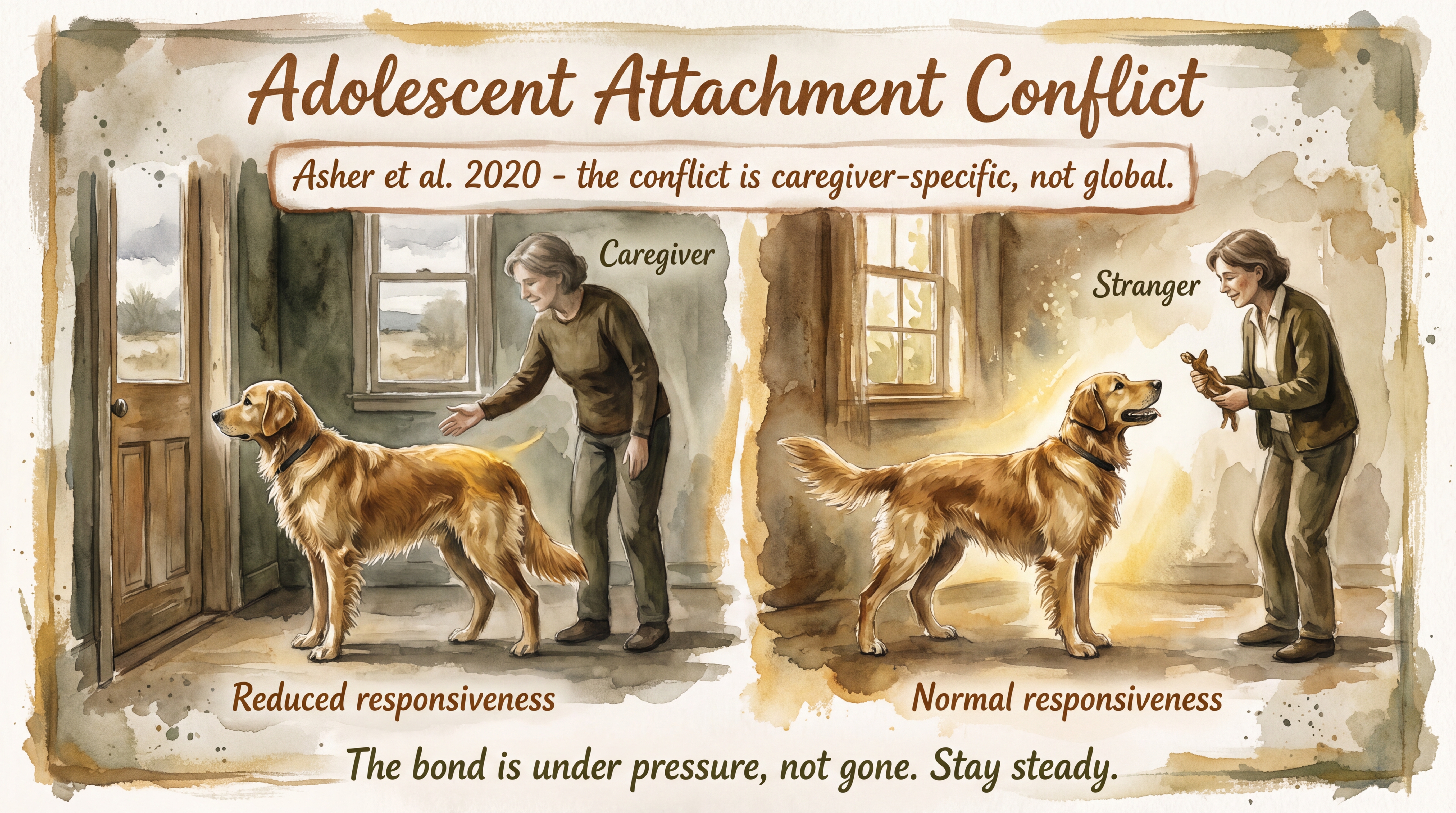
Canine adolescence temporarily loosens attachment behavior, making the dog seem less bonded at exactly the moment families most need reassurance.
Key Takeaways
- A documented adolescent conflict phase exists in dogs, and it is especially directed at the caregiver rather than at strangers.
- The phase does not mean the bond is gone. It means the bond is being pressured by development.
- Dogs with less secure attachment indicators appear to show stronger caregiver-directed conflict during adolescence.
- Families help most by keeping leadership steady rather than treating the phase as disloyalty or dominance.
The Evidence
- Asher, L. et al. (2020)domestic dogs including Golden Retrievers
Used three linked Guide Dogs UK sub-studies, N=70 for pubertal timing, N=93 for direct obedience testing, and N=285 for trainability ratings, and documented an adolescent conflict pattern in which reduced obedience was directed specifically toward the primary caregiver rather than toward unfamiliar people. - Schoberl, I. et al. (2016)domestic dogs and humans
Showed that attachment security changes stress regulation, supporting the broader claim that bond quality alters how pressure is handled. - Brubaker, L., and Udell, M. A. R. (2023)domestic dogs
Found that caregiving style and attachment security covary with persistence and social behavior, reinforcing that relationship quality affects behavioral organization.
- Bowlby, J. (1969/1982)humans
Placed relationship organization at the center of how dependent young handle separation, stress, and developmental challenge.
- SCR-038 boundarydomestic dogs
The adolescent conflict effect is documented, but claims about what the dog subjectively means by the conflict should remain interpretive rather than over-psychologized.
No published study has yet tracked whether specific breeder-to-family transition styles or early caregiving patterns reduce the intensity of adolescent attachment conflict later in development.
SCR References
Sources
- Asher, L., England, G. C. W., Sommerville, R., and Harvey, N. D. (2020). Teenage dogs? Evidence for adolescent-phase conflict behaviour and an association between attachment to humans and pubertal timing in the domestic dog. Biology Letters, 16(5), 20200097. https://doi.org/10.1098/rsbl.2020.0097
- Bowlby, J. (1969/1982). Attachment and Loss, Volume 1: Attachment. Basic Books.
- Brubaker, L., and Udell, M. A. R. (2023). Does pet parenting style predict the social and problem-solving behavior of pet dogs? Animal Cognition, 26(1), 345-356. https://doi.org/10.1007/s10071-022-01694-6
- Schoberl, I., Beetz, A., Solomon, J., Gee, N., Kotrschal, K., and Wedl, M. (2016). Social factors influencing cortisol modulation in dogs during a strange situation procedure. Journal of Veterinary Behavior, 11, 77-85. https://doi.org/10.1016/j.jveb.2015.09.007