Weaning and Transitioning Puppies to Solid Food
Compound evidence detail3 SCRs / 6 parts
- Documentedthe canine weaning timeline from gruel introduction through nutritional independence, with digestive enzyme, microbiome, nutrient-delivery, and dam-puppy social changes treated as coupled transitions
- Documentedthe peer-reviewed association between earlier nursing-to-solid-food transition and subsequent behavior risk, preserved with the confounding boundary that early separation and other stressors are not experimentally isolated
- Documentedcross-mammal evidence that the milk-to-solid-food transition reorganizes early-life gut microbial communities during a major developmental dietary shift
- Observed-JBthe dog-specific application that puppy weaning likely produces analogous microbiome turnover, with canine composition details capped below the broader mammalian evidence
- Documentedthe canonical canine emergency red flags - unproductive retching with abdominal distention (possible GDV), collapse or pale gums (possible internal hemorrhage, hypovolemia, or cardiac disease), repeated vomiting with inability to retain water, suspected toxin ingestion, difficulty breathing or cyanosis, prolonged or cluster seizures, severe trauma, acute limb-use loss, inability to urinate, and heatstroke - each linked in canine emergency-medicine reference texts to a critical underlying problem warranting prompt veterinary evaluation rather than watchful waiting
- Observed-JBthe documented reduction in time-to-care that comes from family preparation in advance - knowing the nearest emergency hospital, a backup hospital, and a poison control number - recognized across emergency-medicine practice but not quantified in a published controlled outcome trial
Weaning is one of the first major developmental transitions a puppy experiences. It is nutritional, gastrointestinal, social, and behavioral all at once. Puppies are not simply switched from milk to kibble on a date. They move through a phased transition in which maternal milk, emerging digestive capacity, texture learning, and social stability all matter together. Documented
What It Means
In practical terms, weaning usually begins with exposure to softened food around 3 to 4 weeks of age, advances through gradual replacement of nursing during weeks 4 through 7, and reaches full weaning around 7 to 8 weeks. Estimated
That timeline is useful because it fits a real biologic transition: maternal milk starts becoming a less complete answer, digestive capacity for solid food is increasing, the microbiome is shifting rapidly, and the litter is becoming more behaviorally active.
That broad timeline is important because it reminds families that full weaning around 7 to 8 weeks is normal. A puppy who first touches solid food at 3 or 4 weeks is not therefore ready for an abrupt, fully independent feeding life at that same age.
That distinction matters because introduction and completion are not the same developmental event. Exposure to softened food is the beginning of the bridge, not the end of nursing. The puppy is still learning texture, still using maternal milk, and still moving through a rapidly changing digestive ecology.
It Is a Process, Not an Event
The cleanest way to think about weaning is as overlap rather than replacement. Puppies benefit when solid food is introduced while maternal access continues. That overlap allows gradual texture adaptation, gradual enzyme and GI adaptation, continued maternal buffering, and less abrupt nutritional disruption.
This is one reason thoughtful breeders typically begin with softened food or a gruel rather than a hard switch to dry solid texture.
Texture progression matters because puppies are learning not just what to eat, but how to eat. Warm softened food or gruel creates a gentler bridge from milk to solid food than hard, dry texture would.
It also gives breeders a chance to monitor tolerance closely. Puppies can show the adults whether the pace is appropriate through stool quality, enthusiasm, messiness, and general comfort. Weaning works better when it is watched and adjusted rather than simply advanced because the calendar says to.
Why Gradual Introduction Matters
The gut is adapting during this period. Lactase activity falls over time, gastric and pancreatic function are maturing, and the microbiome is undergoing a major ecological shift. That makes abrupt diet change a poor fit for the physiology of the moment. Documented
The lactase detail matters enough to name specifically. Canine puppies gradually lose some of their early-life lactase advantage after roughly week 6 to 8, which is one reason the biology of milk reliance is changing right as full weaning approaches.
What works better is progressive transition: warm softened food at first, gradual reduction in moisture, and increasing solid texture as the puppies handle it comfortably.
The same logic applies later if the family eventually changes foods after the puppy comes home. The standard gradual transition pattern usually looks like this: about 75 percent old food and 25 percent new food for the first few days, then 50 and 50 for the middle days, then 25 percent old food and 75 percent new food, and finally full new food by about day 7 to 10. That pattern is not sacred, but it reflects the simple truth that the gut usually handles gradual change better than abrupt replacement.
Some families find it helpful to write the same pattern as a day-by-day protocol:
- days 1 to 3: about 75 percent old food and 25 percent new food
- days 4 to 6: about half old and half new
- days 7 to 9: about 25 percent old food and 75 percent new food
- day 10: fully new food if appetite and stool quality remain stable
This does not mean every puppy must follow the schedule perfectly. It means the gastrointestinal system usually prefers gradualism over abrupt replacement, and adults should be prepared to pause if the puppy's stool or appetite says the pace is too fast.
The Behavioral Boundary
Weaning also intersects with behavior. The literature suggesting earlier weaning may correlate with later behavioral issues deserves careful phrasing, because causality is not simple and management factors overlap. But the broader stewardship lesson is still clear: very early removal and abrupt transition are not neutral developmental choices.
That is why the nutritional transition and the social transition should both stay gradual when possible.
Pierantoni et al. 2011 is one of the studies families often encounter here because it linked earlier weaning timing with later behavioral differences in adulthood. Observed-JB The study does not prove a single simple causal chain, and it should not be overstated. But it does reinforce the broader caution that very early or abrupt transition is not a developmentally neutral choice.
That caution remains useful even if the mechanism is not fully separated from all the surrounding management variables. Earlier weaning can overlap with different maternal access, different breeder practices, different litter experiences, and different stress exposure. Documented The practical lesson still stands: when a developmental transition can be buffered and paced, that is usually preferable to rushing it.
The Breeder-to-Home Bridge
The end of breeder weaning and the start of home feeding should not be treated as two unrelated topics. The puppy that has just completed one major dietary transition is not helped by being pushed immediately into another one.
That is why JB's broader transition philosophy favors continuity: same food, same general meal pattern, same approximate amounts, and same calm routine.
The breeder-to-home handoff is therefore best understood as a continuation of the weaning story rather than a fresh nutritional experiment. The puppy has just finished learning how to eat independently. The gut has just undergone a major microbial and enzymatic transition. The safest next step is usually not another abrupt change.
The Family Mistake to Avoid
Families often come home excited to improve or personalize the diet immediately. Even when the new food is not inherently bad, changing the food right away stacks another variable on top of transport stress, separation stress, and environmental change. The better first move is usually stability.
That is especially important for conscientious families who want to improve the diet immediately. The instinct may be generous, but the timing can still be wrong. The first nutritional task after pickup is not optimization. It is tolerance, continuity, and calm adaptation.
Why It Matters for Your Dog
This page matters because a puppy's digestive system and social system are both in motion during weaning. A gradual weaning process lowers avoidable GI disruption and gives the puppy a calmer developmental bridge from maternal milk to independent feeding.
For Golden families taking a puppy home, it also explains why changing food immediately is usually a worse idea than it feels.
That is an especially useful correction for conscientious families. The urge to improve the food immediately usually comes from care, not neglect. But timing matters. The same choice can be helpful later and disruptive now.
It also helps families respect the breeder's work more accurately. By the time the puppy goes home, a thoughtful breeder has already been managing texture progression, meal frequency, stool quality, and maternal overlap. Preserving that continuity for a short window lets the puppy finish one transition before beginning the next.
The developmental significance of weaning is larger than food texture alone. Puppies are moving from maternal milk toward independent ingestion while still depending heavily on breeder structure, litter rhythm, and a rapidly maturing digestive system. That overlap is why abruptness is so often the wrong fit. The puppy is already doing a great deal of biologic work before the family ever sees the process from the outside.
This makes the breeder's role especially important. A thoughtful breeder is not just putting softened food in a bowl. The breeder is pacing texture change, watching stool quality, letting maternal access taper rather than crash, and protecting continuity during one of the puppy's first major developmental shifts. Families benefit from understanding that because it helps them continue the same logic at home rather than undoing it immediately.
It also explains why this page connects so closely to transition feeding after pickup. Weaning is the first lesson in gradual dietary change. Homecoming should usually extend that lesson, not replace it with a second abrupt experiment. When adults respect that continuity, the puppy's gut has a much better chance of settling into the next stage without unnecessary disruption.
One of the quiet lessons in this page is that overlap is often the gentlest form of change. Puppies do not need every developmental handoff to feel like a clean break. They usually do better when food texture, milk access, social support, and later home feeding taper and overlap enough for the gut and the puppy's behavior to keep up.
That is why the page keeps linking weaning to breeder-to-home transition. The biology is the same in both places. Adults can make change feel like a managed bridge or like a stack of abrupt replacements. The evidence and the observed logic both point toward the bridge.
For families, that means the right response to a newly weaned puppy is rarely more speed. It is usually continuity, observation, and patience. Those are not passive virtues here. They are the practical tools that let the puppy absorb one of its earliest major transitions without unnecessary gastrointestinal and social disruption.
Transition is easier when the adults keep continuity in view. Weaning works best as a managed bridge, and breeder-to-home feeding works best when it honors that same bridge instead of replacing it with another abrupt break.
That is part of what makes gradualism so compelling here. It protects the puppy's gut, supports the social transition, and makes the whole developmental handoff less chaotic than it would be under a hurry-up model.
Continuity is the quiet skill in this whole transition. The more the adults can preserve continuity while the puppy changes, the gentler the developmental handoff usually becomes.
Slower often means gentler here, and gentler is often better tolerated by both the puppy's gut and the puppy's broader developmental system.
That is why overlap, pacing, and continuity remain the central themes from the start of weaning through the first days in a new home.
Gentle continuity is often the most developmentally intelligent choice in this entire window. When adults keep that principle in view, weaning and homecoming start to look like linked stages of one careful transition instead of a series of abrupt replacements. Documented
The gentlest bridge is usually the most biologically coherent one, which is why gradualism carries so much of the page's weight.
Gentle overlap is one of the oldest and best tools in the whole process, which is why the page keeps coming back to it.
The page is really defending managed continuity from start to finish.
The same gentleness keeps paying off later.
That is why the page treats patience as practical rather than sentimental.
And that is the point.
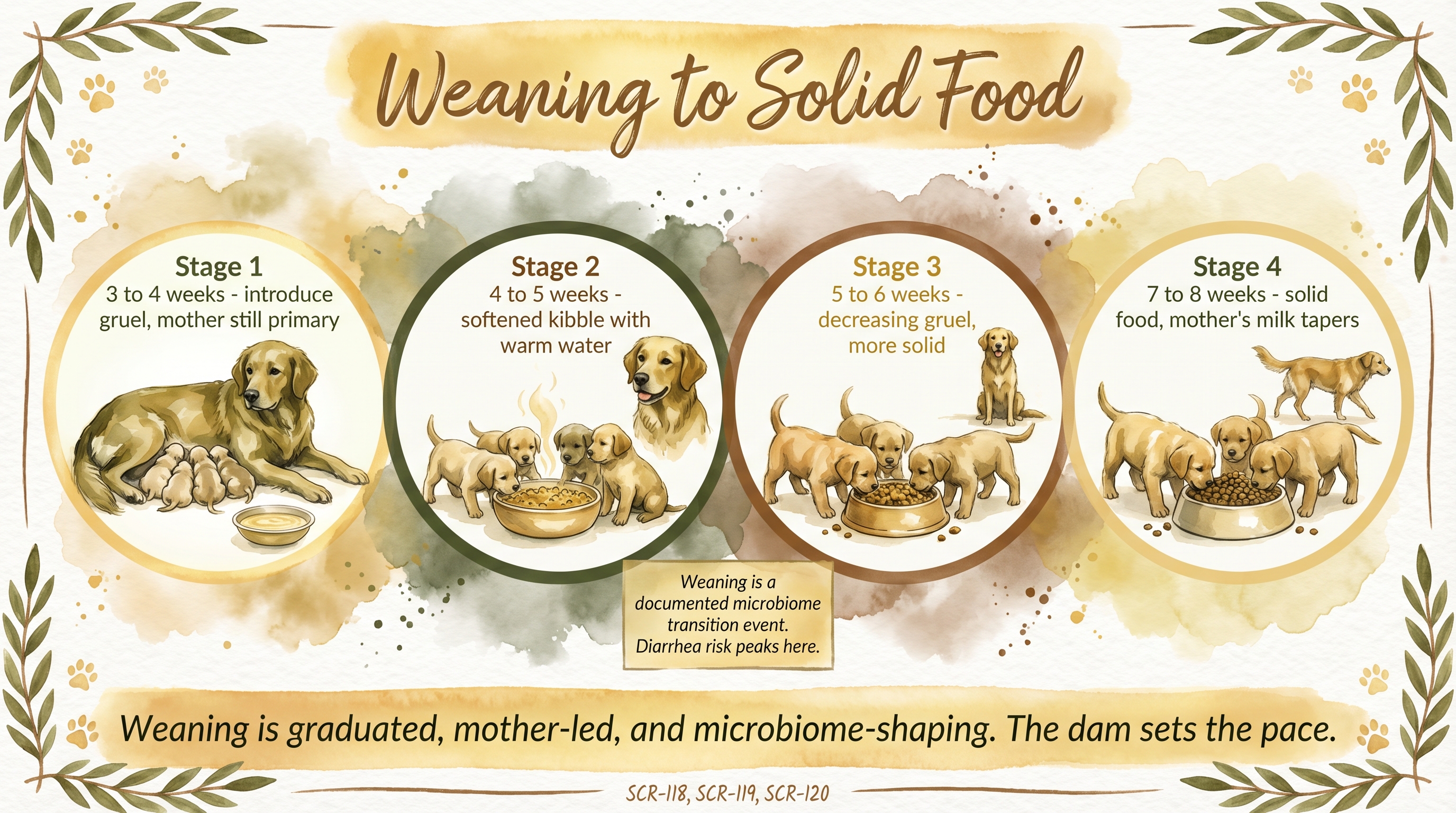
Weaning is graduated, mother-led, and microbiome-shaping - the dam sets the pace.
Key Takeaways
- Weaning works best as a phased overlap between maternal milk and gradually introduced solid food.
- The puppy gut and microbiome are actively changing during weaning, which is why abrupt diet shifts are a poor fit.
- The transition from breeder to home should build on the weaning process rather than restarting nutritional disruption from scratch.
- Stability in food, texture progression, and routine is usually safer than rapid change during the weaning window.
The Evidence
This entry uses estimated claim-level tags beyond the dedicated EvidenceBlocks below. These tags mark approximate ranges or timing claims that should remain bounded by the cited sources.
The evidence in this area converges in a satisfying way. The weaning timeline itself is well described. Puppy microbiome development makes this a period of active physiologic change. Gradual dietary transition reduces gastrointestinal disruption better than abrupt change. Earlier weaning is associated with later behavioral concerns in observational work, though that behavioral link should be framed more cautiously than the GI one. Put together, that makes a strong case for gradualism.
What makes the page useful is that several independent lines of evidence all point in the same direction. Developmental physiology says the gut is changing. Microbiome work says the ecosystem is unstable and responsive during weaning. Transition studies say abrupt food shifts are harder on the gastrointestinal system. Observational behavior work suggests earlier or more abrupt separation may carry later cost. Together they support a slow, buffered, overlap-based approach.
This is also a good example of keeping rhetoric inside the evidence ceiling. We can say gradual weaning is strongly supported. We should be more careful about pretending one exact day is universally correct for every puppy in every setting. The page therefore recommends the biologic pattern with confidence while keeping the calendar edges flexible.
- Puppy nutrition source synthesispuppies
Weaning is normally a phased transition beginning around 3 to 4 weeks and reaching completion around 7 to 8 weeks as digestive and microbial systems mature. - Guard and related puppy microbiome workpuppies
The weaning period is a major microbiome transition window, supporting a gradual rather than abrupt nutritional shift. - Liao et al. diet-transition workpuppies
Gradual dietary transition produces better gastrointestinal outcomes than abrupt change in puppies.
- Weaning-age literature discussed in the source layerdogs
Earlier or more abrupt weaning has been associated with later behavioral concerns in observational literature, though causality and effect size remain less settled than the GI transition story.
No published study directly tests the practical implications of weaning and transitioning puppies to solid food for domestic dog raising programs. The application to household dog raising remains an interpretive synthesis rather than a directly tested intervention finding.
SCR References
Sources
- National Research Council. (2006). Nutrient Requirements of Dogs and Cats. Washington, DC: The National Academies Press.
- AAFCO. (2024). Official Publication. Association of American Feed Control Officials.
- Nap, R. C., & Hazewinkel, H. A. W. (1994). Growth and skeletal development in the dog in relation to nutrition; a review. Veterinary Quarterly, 16(1), 50-59.
- Laflamme, D. P. (1997). Development and validation of a body condition score system for dogs. Canine Practice, 22(4), 10-15.
- WSAVA Global Nutrition Committee. (2011). WSAVA nutritional assessment guidelines. Journal of Small Animal Practice, 52(7), 385-396.