The Place Concept Without a Command
Many families know the shorthand place from training culture: send the dog to a mat or bed, hold the dog there until released, and repeat until the location carries enough meaning to be useful around meals, guests, or daily activity. JB recognizes the utility of that method. It simply aims for something quieter. In the JB household, the dog usually has a natural resting place in each main room and moves to it voluntarily during the calmer parts of the day. The bed in the office, the rug in the kitchen corner, the mat by the sofa, the cool tile near the back door. These places become meaningful through repetition and household rhythm rather than through a repeatedly prompted assignment. That is a strongly observed household pattern, not a directly tested formal method. Observed-JB
What It Means
The place concept in JB is really a map.
The dog learns where calm happens in each room, where bodies settle, where it can be near the family without being underfoot, and where it tends to rest when life is ordinary. Observed-JB
These locations become part of the dogs understanding of the house. The dog does not need to be sent there each time because the home itself has already made the answer clear.
Why Multiple Places Matter
One reason the concept works so naturally is that dogs do not live in only one room. Families often imagine a single designated bed should solve the entire household. In reality, dogs benefit from having sensible resting options wherever daily life actually occurs.
That may mean a bed in the living room, a mat in the kitchen, a rug by the desk, or a soft spot in the bedroom.
Once the dog has these anchors, quiet movement through the house becomes easier. The dog follows life without needing to hover in the center of traffic.
How the Place Gets Built
The place gathers meaning by repeated use. The family sits down, the dog lies on the nearby mat. Observed-JB Dinner is made, the dog curls up on the kitchen rug. Work begins, the dog moves to the office bed. No special ceremony is required. The place becomes a conditioned resting signal through ordinary life.
This is part of what JB means by relationship replacing excessive technique. The family is not absent from the process. The family is arranging the whole environment by choosing where the beds go, by making those spots comfortable, by protecting rest there, and by not constantly calling the dog out of them.
The dog learns the meaning of place because the house keeps confirming it.
What This Is Not
The JB place concept is not a criticism of trained mat work. That work can be useful, especially for dogs who already have restless habits or for families who need an immediate management tool while building a calmer life. Heuristic
The distinction is that trained mat work often remains a requested behavior.
The JB version aims for a chosen resting place.
This page is also not saying the family never guides the dog toward a bed. Of course families sometimes do. A puppy may be gently led to a soft spot. A young dog may be blocked away from the kitchen traffic and toward the mat. The point is simply that the final household goal is voluntary use, not lifelong dependence on a repeated instruction.
Why It Matters for Your Dog
The place concept matters because homes are physical spaces, not just emotional ones. A dog who understands the geography of rest tends to move through the home more calmly. The dog has somewhere to be that is socially connected but not centrally chaotic.
One quiet sign of adult leadership is that the house already has shape. The dog does not need to invent where to land in each room because the family has already made calm places available and meaningful.
This helps with many daily issues at once: cooking, guests, children moving through the house, work calls, and evening downtime.
The dog is still part of the family scene, but in a settled way. That is why the place concept belongs beside the settle. One describes the internal state. The other describes where that state often lands.
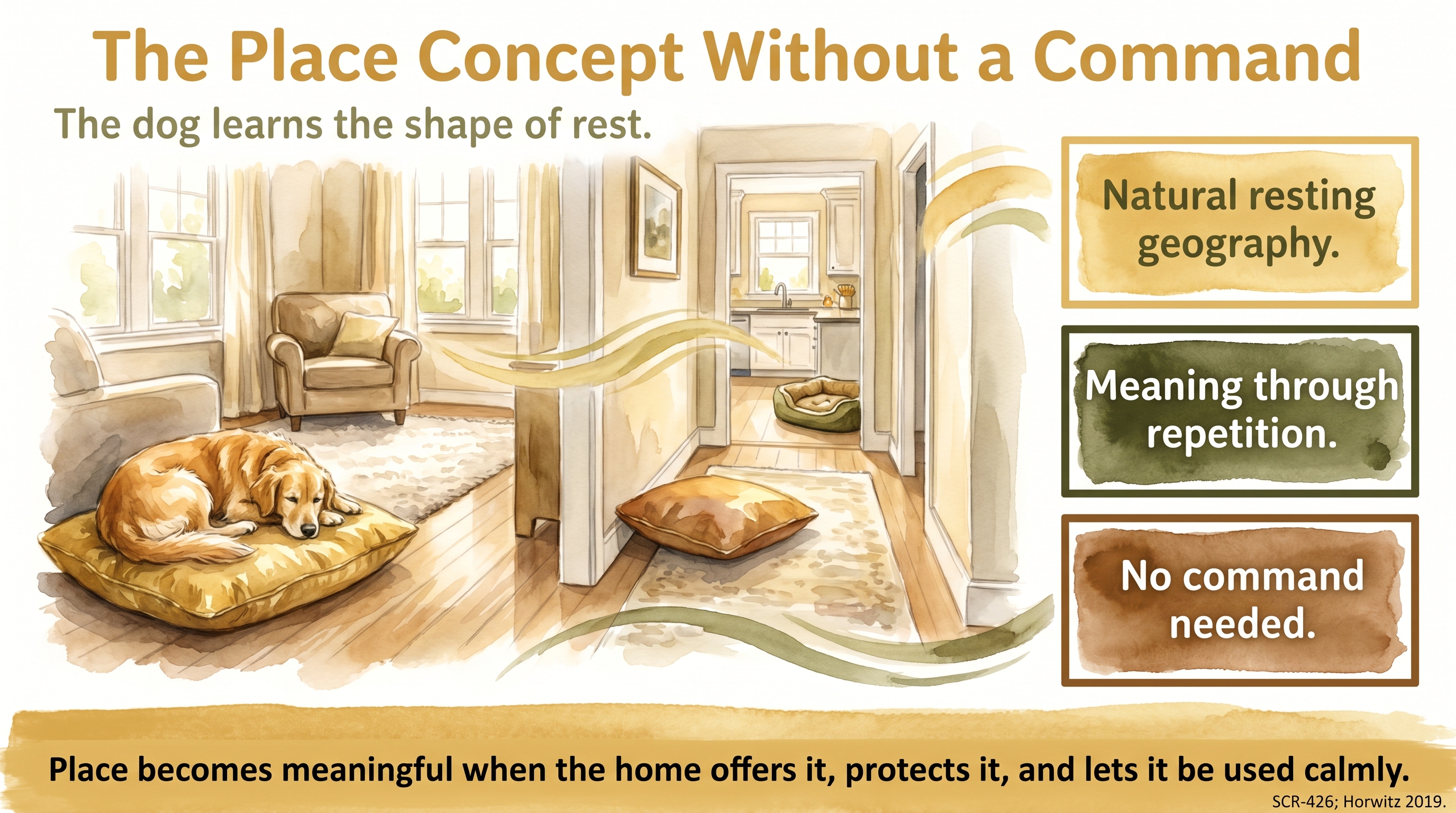
Place becomes meaningful when the home offers it, protects it, and lets it be used calmly.
Key Takeaways
- The JB place concept gives the dog natural resting locations in each main room instead of relying on one repeatedly prompted bed routine.
- These places gain meaning through repetition, comfort, and protected rest rather than through constant command-and-release cycles.
- A dog who understands the geography of rest moves through family life more calmly and with less need to hover in traffic zones.
- The JB claim is observational and environmentally grounded, not a direct experimental comparison with trained mat work.
The Evidence
- JB breeder and family observationGolden Retrievers and family dogs
Dogs with dedicated quiet spots in main household rooms often begin using those locations voluntarily as part of daily settling without needing repeated prompted placement. - JB observationfamily homes
When beds and mats are positioned where life actually happens, dogs more readily rest near the family without obstructing or escalating daily movement.
- Environmental-management literaturedogs
Behavior is shaped by physical arrangement, access, and repeated context, supporting the claim that resting locations can acquire stable meaning through routine. - Arousal-regulation literaturedogs
Low-conflict, predictable environments make settling easier and reduce unnecessary activation during ordinary household movement.
- JB synthesisfamily homes
The claim that voluntary room-by-room resting places are more durable than prompted mat routines is an applied household philosophy rather than a direct comparative canine trial.
No published study directly tests the practical implications of the place concept without a command for domestic dog raising programs. The application to household dog raising remains an interpretive synthesis rather than a directly tested intervention finding.
SCR References
Sources
- Wells, D. L. (2004). A review of environmental enrichment for kennelled dogs, Canis familiaris. Applied Animal Behaviour Science, 85(3-4), 307-317. https://doi.org/10.1016/j.applanim.2003.11.005
- Schork, I. G., Manzo, I. A., De Oliveira, M. R. B., da Costa, F. V., Palme, R., Young, R. J., & de Azevedo, C. S. (2022). How environmental conditions affect sleep? An investigation in domestic dogs (Canis lupus familiaris). Behavioural Processes, 199, Article 104662. https://doi.org/10.1016/j.beproc.2022.104662
- Moyer, B. J., Zulch, H., Ventura, B. A., & Burman, O. (2025). A qualitative exploration of owner experiences following dog adoption. Animal Welfare, 34, e9. https://doi.org/10.1017/awf.2025.4
- Just Behaving program observation disclosure. (2026). Boundary: this internal observation is limited to JB-raised Golden Retrievers whose families continued the JB framework after placement; cohort size, time window, and counting rule are deferred in this revision. Treat as program observation supporting voluntary room-by-room resting-place use, not as published external evidence.