Travel and Lodging with a Dog
Travel with a dog is not mainly about whether the location allows dogs. It is about whether the family can reproduce enough of the dog's normal rhythm in a new place for the dog to rest, eat, recover, and remain easy to live with. JB treats travel as exported household life, not as a suspended state where all the ordinary architecture disappears. Observed-JB
That framing simplifies a lot. Families often think the travel question is logistical. In practice it is relational and physiological. Can the dog settle there? Can the family protect the dog's rhythm there? Can the trip hold the dog as a participant rather than as luggage with emotions?
What It Means
The Goal Is Not Adventure Density
The most common travel mistake is trying to give the dog everything at once: new drive, new lodging, new smells, new people, new walking routes, and new sounds at night. Then on top of that, the family expects the dog to keep pace with a human itinerary that would already be tiring for a person.
JB pushes the other way. The point of taking the dog is not to maximize novelty. It is to let the dog remain part of family life in a new place without losing regulation.
Arrival Matters Most
If there is one moment that shapes the whole trip, it is arrival.
A calm dog entering a lodging needs the same things a puppy needed in the first week: a readable entry, a defined resting place, a chance to observe before being pulled into activity, and enough quiet time that the nervous system can downshift. Observed-JB
Families help themselves enormously when they bring the dog's known bed, crate, water setup, food, and a familiar feeding pattern. These are not sentimental props. They are continuity cues. A dog who recognizes part of home inside a new place often settles faster because the transition is less total. Observed-JB
The Lodging Has to Fit the Dog
Some environments are much easier on dogs than others.
A quiet family home where the dog is welcome may be simple and workable.
A thoughtfully chosen rental with easy outdoor access may be simple and workable.
A hotel can be workable too, but only if the family is realistic about hallways, elevators, other guests, unfamiliar noises, and the fact that the dog may need more decompression than the humans expected. Observed-JB
JB does not have one morally correct lodging type. It has one governing question: can the dog maintain a calm floor here?
If the answer is no, then the lodging may not fit even if the reservation does.
Rhythm Has to Travel Too
Families sometimes bring the dog but leave the dog's rhythm behind. Meals get late, walks become random, and rest disappears. The dog is asked to accompany breakfast out, sightseeing, shopping, dinner out, and an evening gathering without a real reset window.
Then the dog begins the second day already compromised.
JB recommends the opposite. Carry as much of the home rhythm as the trip reasonably allows: keep meals close to their usual timing, walk at normal anchors rather than only when convenient, preserve nap and quiet periods, and build in return-to-room recovery rather than chaining outing to outing.
This is not about being rigid. It is about preventing the dog from becoming less and less itself over the course of the trip.
When the Dog Should Stay Home
One of the healthiest travel decisions is sometimes not bringing the dog.
That is not exclusion. It is stewardship.
If the trip would involve long periods alone in a strange room, highly stimulating public environments, extreme weather, schedule density, or many transitions with no meaningful rest, the dog may be better served by good care at home. A dog is not loved less because the family can tell the difference between inclusion and overextension.
This is where Structured Leadership matters. The adults decide based on the dog's welfare, not on whether they personally want the dog in every photograph.
What This Is Not
JB is not saying the adult dog cannot travel well. It is not saying every new place is a problem. It is not saying the family must run vacations around the dog to the point of absurdity.
It is saying that travel quality depends on whether the dog can still live inside a recognizable version of family life.
The sentimental error is assuming presence equals participation. A dog dragged through an itinerary it cannot regulate inside is present but not well included. A dog on a shorter, calmer, more realistic trip is more truly part of the experience.
Why It Matters for Your Dog
Travel is where many adult dogs either reveal the strength of their foundation or show where the foundation thins under novelty. A dog who can sleep in a new room, eat in a new place, walk quietly through a new town, and return to bed without emotional residue is showing something very deep about how it was raised.
The dog does not need freedom from structure during travel. The dog needs the adults to carry enough structure into the new environment that novelty does not become the dog's emotional government.
That is why good travel with a dog often looks quieter than people expect. Fewer activities. Better recovery. A more legible day. The reward is not just a manageable trip. The reward is a dog who remains itself in a place that is not home.
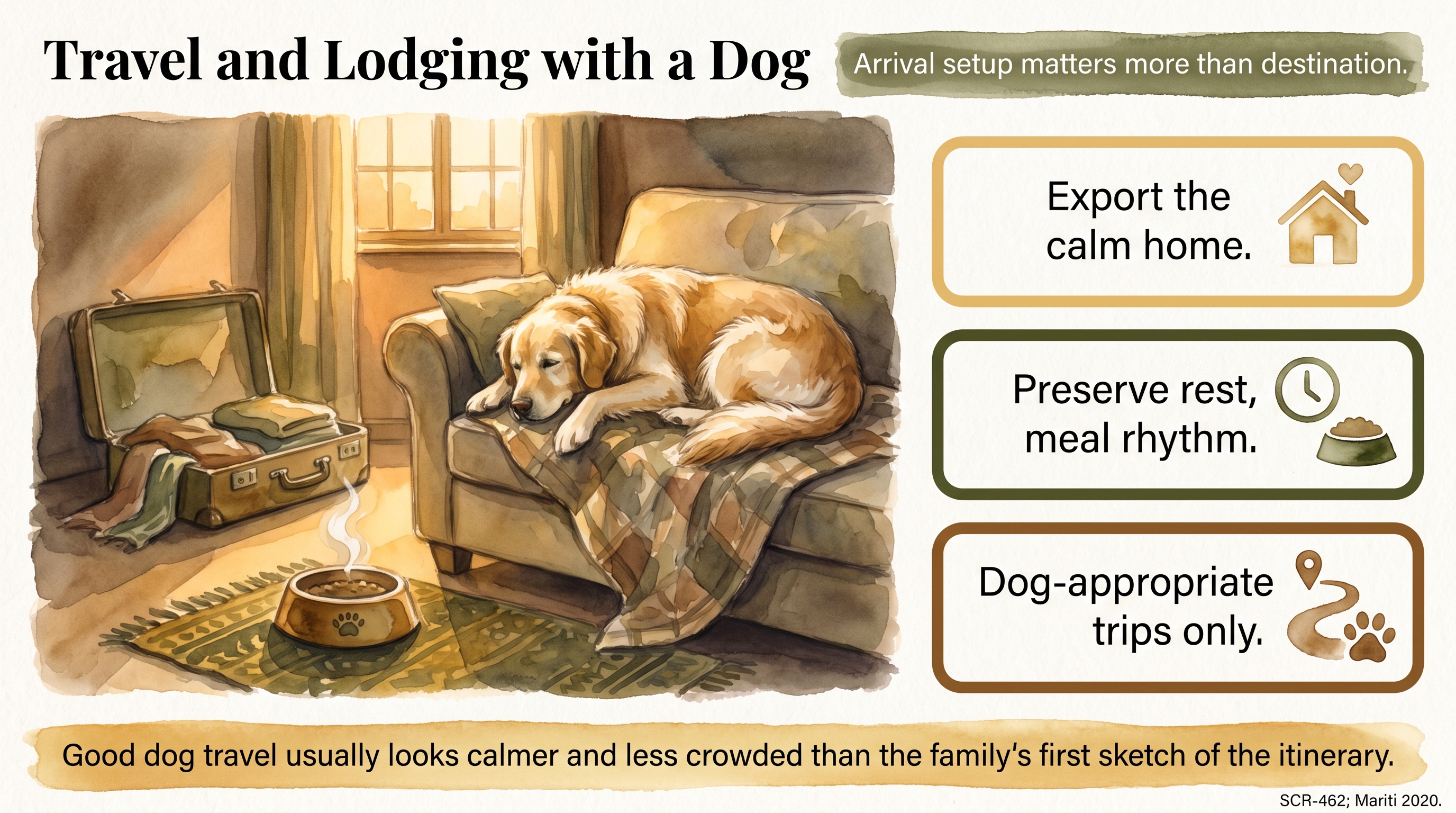
Good dog travel usually looks calmer and less crowded than the family's first sketch of the itinerary.
Key Takeaways
- Travel with a dog works best when the family exports the calm household rather than suspending it.
- Arrival, rest setup, and preserved meal and walk rhythm often matter more than the destination itself.
- A trip that cannot accommodate the dog's calm floor may be better taken without the dog.
- Good dog travel usually looks calmer and less crowded than human travel plans first imagined.
The Evidence
- arousal-regulation literaturedomestic dogs
Novelty, accumulated stimulation, and inadequate recovery can raise baseline arousal and reduce coping quality across subsequent contexts. - owner-behavior literaturedomestic dogs
Human predictability and handling style affect how dogs navigate environmental change and unfamiliar situations.
- JB breeder observationGolden Retrievers
Dogs usually travel best when the family reproduces enough of the home rhythm in the new place for the dog to settle rather than merely endure the trip. - JB family practicetraveling family dogs
The calmest travel outcomes often come from shorter, more realistic itineraries with protected arrival and recovery periods.
No published study directly tests the practical implications of travel and lodging with a dog for domestic dog raising programs. The application to household dog raising remains an interpretive synthesis rather than a directly tested intervention finding.
SCR References
Sources
- Sundman, A.-S., Van Poucke, E., Svensson Holm, A.-C., Faresjo, A., Theodorsson, E., Jensen, P., & Roth, L. S. V. (2019). Long-term stress levels are synchronized in dogs and their owners. Scientific Reports, 9, 7391. https://doi.org/10.1038/s41598-019-43851-x
- Schork, I. G., Manzo, I. A., De Oliveira, M. R. B., da Costa, F. V., Palme, R., Young, R. J., & de Azevedo, C. S. (2022). How environmental conditions affect sleep? An investigation in domestic dogs (Canis lupus familiaris). Behavioural Processes, 199, Article 104662. https://doi.org/10.1016/j.beproc.2022.104662
- Moyer, B. J., Zulch, H., Ventura, B. A., & Burman, O. (2025). A qualitative exploration of owner experiences following dog adoption. Animal Welfare, 34, e9. https://doi.org/10.1017/awf.2025.4
- Just Behaving program observation disclosure. (2026). Boundary: this internal observation is limited to JB-raised Golden Retrievers whose families continued the JB framework after placement; cohort size, time window, and counting rule are deferred in this revision. Treat as program observation supporting travel and lodging adaptation patterns, not as published external evidence.