Car Travel as Calm Practice
The car is one of the most repeated environments in a family dog's life. It is not just a way to get somewhere else. For many dogs, it becomes a place where anticipation, restraint, motion, novelty, and human emotional tone all stack together in a very small space. That is why JB treats the car as part of the raising architecture rather than as a neutral container. The car should feel like a moving extension of the calm floor, not like a rolling exception to it. Observed-JB
Families usually notice this early. Some dogs ride quietly from the beginning. Some vibrate, whine, pant, pace, bark, or throw themselves forward with every turn. The common modern mistake is to treat those outcomes as personality alone. JB sees them as relational and environmental outcomes too. A dog's car life is shaped by what the family repeatedly makes the car mean.
What It Means
The Car Is Part of the dog's World
When people think about raising, they often think only about the home, the yard, and the walk. But many adult dogs spend years moving through cars to get to veterinary visits, family gatherings, trailheads, vacations, school pickups, and ordinary errands. Observed-JB If the dog becomes dysregulated every time the engine starts, that dysregulation leaks into the rest of life.
That is why JB prefers a calmer question than "does your dog like the car?"
The better question is "what state does the car reliably produce?"
For a well-carried adult dog, the answer is usually simple. The dog loads, settles into a crate or restraint, rides quietly, unloads without emotional explosion, and understands that some rides lead to activity while others lead right back home. The meaning of the ride is not constant excitement. It is ordinary participation in family life.
Practical Architecture
The calm car does not happen through speeches. It happens through repeated structure. That usually includes safe restraint through a crate or well-fitted travel restraint, calm loading rather than dramatic invitation, minimal vocal stimulation once the dog is in the vehicle, predictable entry and exit rhythm, and enough routine rides that the car does not stay rare and overcharged. Observed-JB
The restraint question matters because safety and state often travel together. Dogs that are loose in the vehicle often rehearse pacing, front-seat scrambling, window charging, and hypervigilant scanning. None of that is neutral. It is a repeated nervous-system pattern.
JB prefers that the dog have a clear place in the car. That place does not need fanfare. It needs consistency.
Ordinary Rides Matter More Than Special Ones
One reason some dogs become so intense in the car is that every ride predicts a peak event. The dog only rides to the beach, the park, the grandparents' house, or the exciting store. The engine starts and the dog has every reason to assume the day is about to escalate.
A healthier car life often includes many uneventful rides.
Short rides.
Calm rides.
Rides that end in a quiet walk.
Rides that end in coming back home.
Rides where the dog simply participates in ordinary life without the trip itself becoming the main emotional event.
This is one reason adult dogs often ride better than adolescent dogs. They have enough repetition behind them that the car has stopped meaning promise and started meaning process.
Long Trips and Day Trips
Adult life introduces more travel complexity than the first year did. Families start taking longer drives, vacation drives, and day trips with the dog. These are reasonable parts of life, but the dog still needs a readable start, physical security, breaks that are actually calming, recovery time after arrival, and permission not to accompany every possible outing.
Many families inadvertently run the dog too hard during travel days. The dog rides for hours, unloads into novelty, meets people, explores a new place, eats late, skips rest, and then rides again. By the end of the day the family says the dog was "so good but wired." That wiring is not a mystery. The day asked too much.
JB would rather see fewer stops, quieter arrivals, and a dog that still has nervous-system margin left by evening. Observed-JB
The Dog Does Not Need to Join Everything
Another adult-life question matters here: should the dog come on every outing just because it can?
Usually not.
A mature dog should be able to ride calmly in the car. That does not mean constant inclusion is the best version of adulthood. Some outings are worth the dog's participation. Some are better handled as rest-at-home time. A dog who can ride well and stay home well has a more stable life than a dog who is either carted everywhere or left out of life entirely.
JB is cautious about making the dog a default passenger on human errands all day long. Hours of waiting, repeated loading and unloading, parking-lot stimulation, and novelty density can quietly degrade the same regulation the family appreciates at home.
What This Is Not
JB is not anti-travel, it is not saying the dog should never go anywhere, it is not saying a quiet dog must love every car ride, and it is not saying one difficult ride means the dog was raised badly. It is saying the car is a real environment, and real environments either strengthen rhythm or erode it.
The common cultural split is unhelpful. Some families under-expose the dog so severely that every ride stays novel and charged. Other families over-use the car so heavily that the dog spends too much of life suspended in motion and anticipation. JB tries to hold the middle. The car is normal. The car is calm. The car is not the whole world.
Why It Matters for Your Dog
Car behavior is one of the clearest places where the soft landing either continued through life or quietly disappeared. A dog who rides with composure is usually a dog whose family has kept the larger pattern legible. The loading routine is calm because greetings are calm. The exit is calm because novelty is not treated like spectacle. The ride is calm because the human is calm.
The car does not need its own philosophy. It needs the same one. The adult dog travels best when the vehicle feels like a moving room in the same calm house, not like a machine that turns family life into an event.
That is why the car matters so much. It is not just about transportation. It is a repeated test of whether the relationship can stay organized while the environment changes around it.
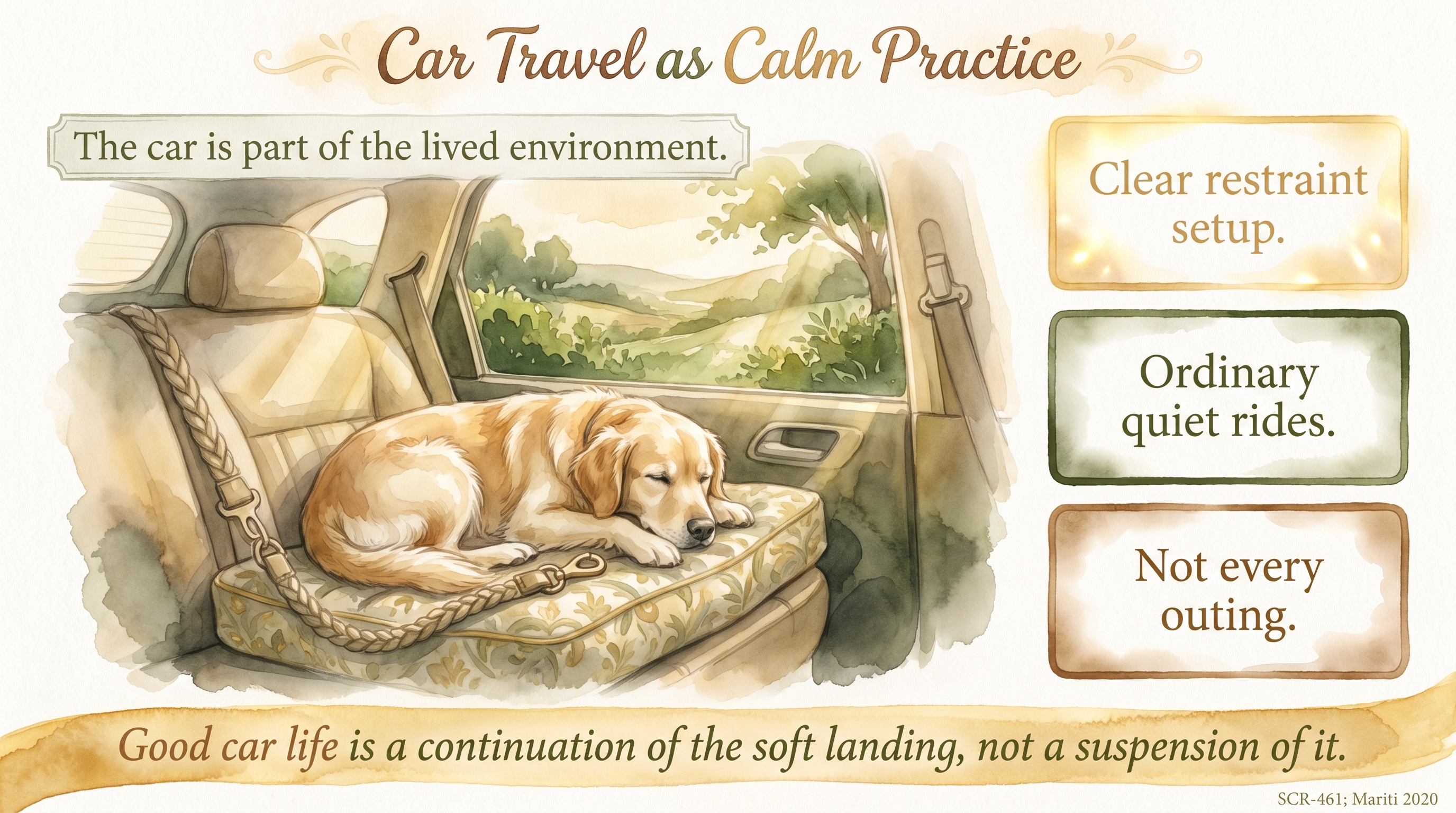
Good car life is a continuation of the soft landing, not a suspension of it.
Key Takeaways
- The car is part of the dog's lived environment, not just a tool for human transport.
- A clear restraint setup, calm loading, and enough ordinary rides help keep car travel readable and low-drama.
- Adult dogs do not need to accompany every outing simply because they can ride well.
- The best adult car life is a continuation of the soft landing, not a suspension of it.
The Evidence
- owner-behavior and handler-effect literaturedomestic dogs
Human tone, predictability, and interaction style reliably shape canine arousal and coping in repeated shared environments. - arousal-regulation literaturedomestic dogs
Repeated high-arousal exposure without sufficient recovery can shift baseline regulation and increase behavioral spillover into later contexts.
- JB breeder observationGolden Retrievers
Dogs who experience the car as an ordinary calm setting from early life onward usually continue to ride more quietly through adulthood than dogs whose rides always predict excitement or stress. - JB family practicefamily dogs
The most stable adult car riders are often those whose families normalize both calm outings and normal rest at home rather than making every ride the highlight of the week.
No published study directly tests the practical implications of car travel as calm practice for domestic dog raising programs. The application to household dog raising remains an interpretive synthesis rather than a directly tested intervention finding.
SCR References
Sources
- Sundman, A.-S., Van Poucke, E., Svensson Holm, A.-C., Faresjo, A., Theodorsson, E., Jensen, P., & Roth, L. S. V. (2019). Long-term stress levels are synchronized in dogs and their owners. Scientific Reports, 9, 7391. https://doi.org/10.1038/s41598-019-43851-x
- Schork, I. G., Manzo, I. A., De Oliveira, M. R. B., da Costa, F. V., Palme, R., Young, R. J., & de Azevedo, C. S. (2022). How environmental conditions affect sleep? An investigation in domestic dogs (Canis lupus familiaris). Behavioural Processes, 199, Article 104662. https://doi.org/10.1016/j.beproc.2022.104662
- Moyer, B. J., Zulch, H., Ventura, B. A., & Burman, O. (2025). A qualitative exploration of owner experiences following dog adoption. Animal Welfare, 34, e9. https://doi.org/10.1017/awf.2025.4
- Just Behaving program observation disclosure. (2026). Boundary: this internal observation is limited to JB-raised Golden Retrievers whose families continued the JB framework after placement; cohort size, time window, and counting rule are deferred in this revision. Treat as program observation supporting car travel as calm practice, not as published external evidence.