The Adult Household Rhythm
The adult household rhythm is the version of routine families stop noticing because it works so well. The dog rises, rests, walks, eats, settles, and moves through the home with so little friction that the structure can begin to feel natural rather than constructed. Observed-JB That is exactly what families hoped for. It is also the moment when they can accidentally forget how much the rhythm is still carrying.
What It Means
What Changes in Adulthood
The adult dog usually self-regulates better than the adolescent. Observed-JB The family does not have to actively scaffold every part of the day. The dog knows the morning, knows the mealtime flow, knows the evening downshift, and often knows where to be without being told. This is one of the great pleasures of living with a settled Golden Retriever. The dog becomes part of the house rather than a project moving through the house.
But the rhythm has not become unnecessary. It has become absorbed.
That distinction matters. A dog that looks easy may still be depending on the quiet consistency of the home in ways the family no longer registers consciously.
How Drift Happens
Adulthood is when rhythm usually loosens by inches rather than by dramatic decisions. Meal times move around, evenings get louder, walks become more erratic, and guests are handled with less thought. The dog comes on too many outings or not enough. Rest remains available, but the household no longer actively protects it.
None of this usually creates an immediate problem. Over months, it can create a different dog. The changes are often small enough that families do not connect them to the return of minor friction. The dog starts greeting with more charge, pacing more in the evening, hovering more in the kitchen, or losing some of the effortless settle that once felt automatic.
The Adult Rhythm Should Feel Ordinary
JB does not want the adult rhythm to feel like management forever. That would miss the whole point. The goal is that it becomes background. But background is not the same as gone.
The most mature adult households often look deceptively simple: predictable mornings, readable feeding flow, one or two strong daily movement anchors, easy rest during work hours, quiet evenings, and no constant pressure for the dog to be participating in everything. Observed-JB
The rhythm is not rigid. It is legible.
In adulthood, the rhythm succeeds when the family barely notices it. The dog has learned the shape of the house so well that calmness becomes the homes default setting instead of an active intervention.
Why the Adult Dog Can Become the Calm Gravity
A well-raised adult Golden often becomes the calm gravity at the center of the home. Families notice this most clearly when life is busy. Children are moving, people are coming and going, work is happening, and the dog is simply there without needing to be the emotional center of the room.
This is one of the deepest JB outcomes. The dog is not invisible. The dog is integrated. That is very different from the stimulation-dependent household where the dog requires constant management, entertainment, or negotiation in order to coexist comfortably.
The Mistake of Total Relaxation
There is a kind of false compliment families give adult dogs: he is so easy now, he can handle anything.
Sometimes he cannot, at least not as well as the family thinks.
The dog may still need protected down time after guests, sensible limits on long busy days, consistent walk patterns, portion discipline, and thoughtful handling during travel or schedule disruption. Observed-JB
These are not puppy accommodations. They are adult stewardship. The dog has earned more ease, not total environmental randomness.
Why It Matters for Your Dog
The adult rhythm is the life most families wanted when they first took the puppy home. It is the life where the dog and the home fit each other. That is why it deserves its own page. The risk in adulthood is no longer panic. It is forgetting what made the fit possible.
The family does not need to manage the dog the way it did at twelve weeks. It does need to continue living in a way the adult dog can read easily. When it does, the rhythm keeps holding, and the dog keeps becoming what the first years were building toward.
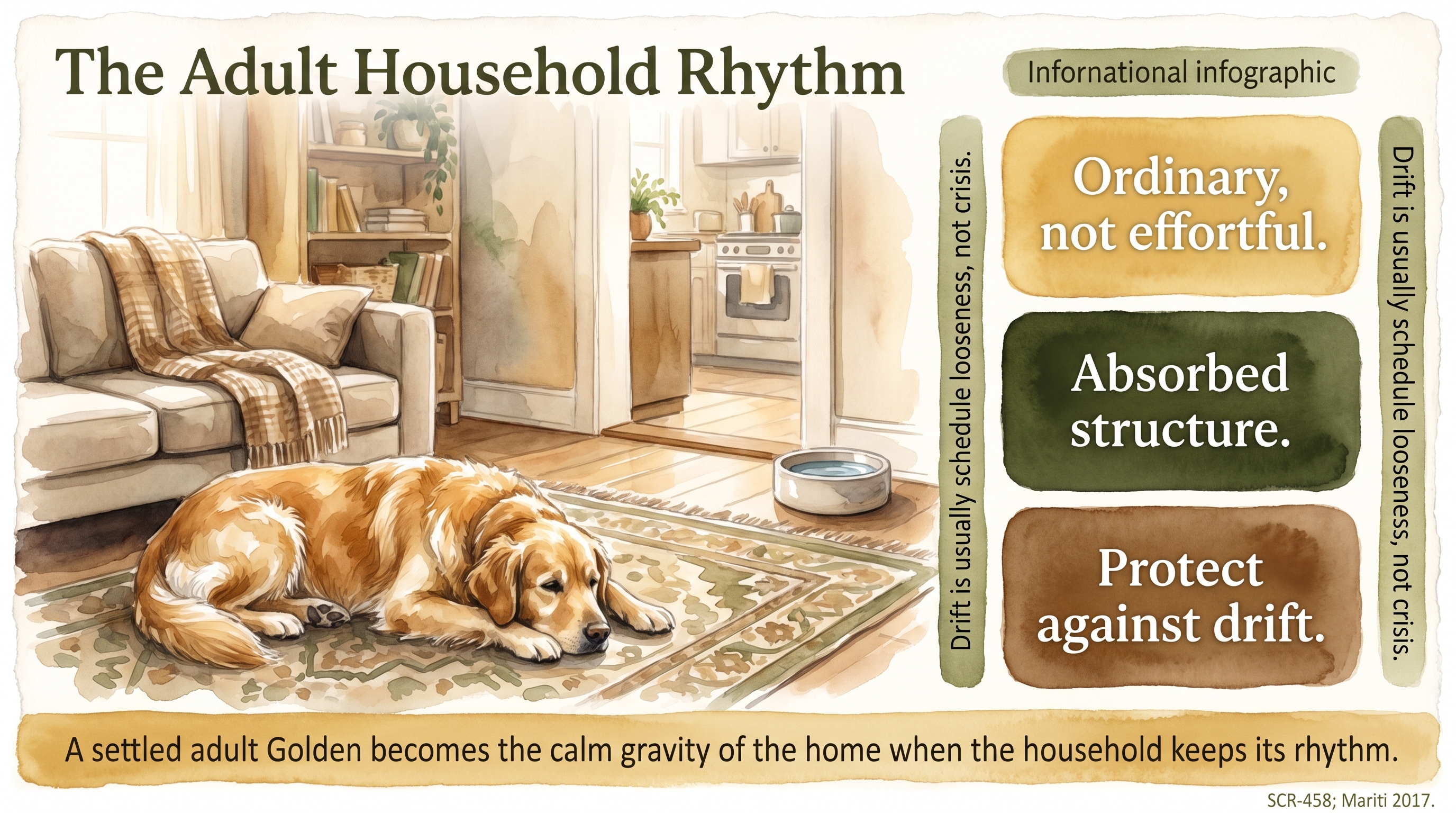
A settled adult Golden becomes the calm gravity of the home when the household keeps its rhythm.
Key Takeaways
- The adult household rhythm should feel ordinary, not effortful, but it is still doing real work.
- Adult dogs often depend on absorbed structure in ways families stop consciously noticing.
- Most adult-life drift happens gradually through schedule looseness, not through one dramatic mistake.
- A settled adult Golden becomes the calm gravity of the home when the household keeps the rhythm legible.
The Evidence
- JB breeder observationGolden Retrievers
Adult dogs raised through a soft landing and calm adolescence often run household rhythm so reliably that families stop noticing the structure itself. - JB household practicefamily-raised dogs
Minor behavioral friction in adult dogs often follows slow rhythm drift rather than a sudden change in the dog.
- developmental and regulation literaturemammals and domestic dogs
Predictable external structure supports regulation and lowers the cost of coping, even when the individual appears behaviorally mature.
No published study directly tests the practical implications of the adult household rhythm for domestic dog raising programs. The application to household dog raising remains an interpretive synthesis rather than a directly tested intervention finding.
SCR References
Sources
- Creevy, K. E., Grady, J., Little, S. E., Moore, G. E., Strickler, B. G., Thompson, S., & Webb, J. A. (2019). 2019 AAHA canine life stage guidelines. Journal of the American Animal Hospital Association, 55(6), 267-290. https://doi.org/10.5326/JAAHA-MS-6999
- Bouton, M. E., & Todd, T. P. (2014). A fundamental role for context in instrumental learning and extinction. Behavioural Processes, 104, 13-19. https://doi.org/10.1016/j.beproc.2014.02.012
- Schork, I. G., Manzo, I. A., De Oliveira, M. R. B., da Costa, F. V., Palme, R., Young, R. J., & de Azevedo, C. S. (2022). How environmental conditions affect sleep? An investigation in domestic dogs (Canis lupus familiaris). Behavioural Processes, 199, Article 104662. https://doi.org/10.1016/j.beproc.2022.104662
- Just Behaving program observation disclosure. (2026). Boundary: this internal observation is limited to JB-raised Golden Retrievers whose families continued the JB framework after placement; cohort size, time window, and counting rule are deferred in this revision. Treat as program observation supporting adult household-rhythm outcomes, not as published external evidence.