Toys and Their Role in the Calm Home
JB is not anti-toy. It is anti-confusion about what toys are for. In the calm home, toys are present but secondary. A few good chew options, a retrieve item for outdoor activity, perhaps a soft carry toy for the dog who likes to hold something in its mouth. That is enough for many family Goldens. What JB pushes against is the modern idea that a dog needs a large rotating inventory of products and novelty objects in order to remain emotionally fulfilled. A dog can absolutely enjoy toys. The question is whether toys are supporting the relationship or quietly replacing it. JB argues for the first. That is an observed household philosophy rather than a directly tested toy-rotation experiment. Observed-JB
What It Means
Toys are tools, not the center of the dogs emotional life.
In a calm household, the primary forms of fulfillment are often calm proximity to the family, walks, rest, natural chewing, brief play windows, and occasional retrieving or swimming.
Toys fit into that life, but they do not have to carry the full burden of engagement.
The Consumer Model of Canine Fulfillment
The modern pet market has built a powerful message around toys and enrichment products. Families are encouraged to rotate objects constantly, layer novelty into every week, and assume that a dog without a basket of stimulating products is an understimulated dog.
There is some truth buried inside that message. A genuinely under-exercised, under-socialized, or under-engaged dog may indeed benefit from more outlets and more thoughtfully offered objects. Observed-JB
But JB draws a distinction between product engagement and relational engagement. Observed-JB Those are not interchangeable.
A dog may spend a long time with a toy and still be living in a thin relational life. Observed-JB Another dog may own only a few durable items yet feel deeply woven into the family because the family itself is the center of the day.
What Most Goldens Actually Need
Most family Goldens do not need a toy catalogue. They need a few good categories of objects: safe chew options, one or two retrieve items, and perhaps a soft item for carrying.
Beyond that, what matters more is when and how those items appear. A retrieve toy used in a short calm session can be deeply satisfying. A chew offered during a quiet rest window can support regulation. A toy used to whip the dog into frantic activation is serving a different function entirely.
The goal is not more stuff. The goal is cleaner use.
Why It Matters for Your Dog
When toys are kept in proportion, the dog does not begin to experience constant novelty and object-seeking as the core of daily life. The dog can enjoy things without needing things to feel complete.
Toys belong in the calm home, but they should support the relationship rather than become a substitute for it. The deepest daily fulfillment still comes from a readable life shared with the family.
This matters because many families are trying to solve relational thinness with products. If the real issue is that the dog lacks good movement, good rest, calm companionship, or meaningful integration into family life, then adding more objects may soften the edges without changing the center.
JB would rather strengthen the center.
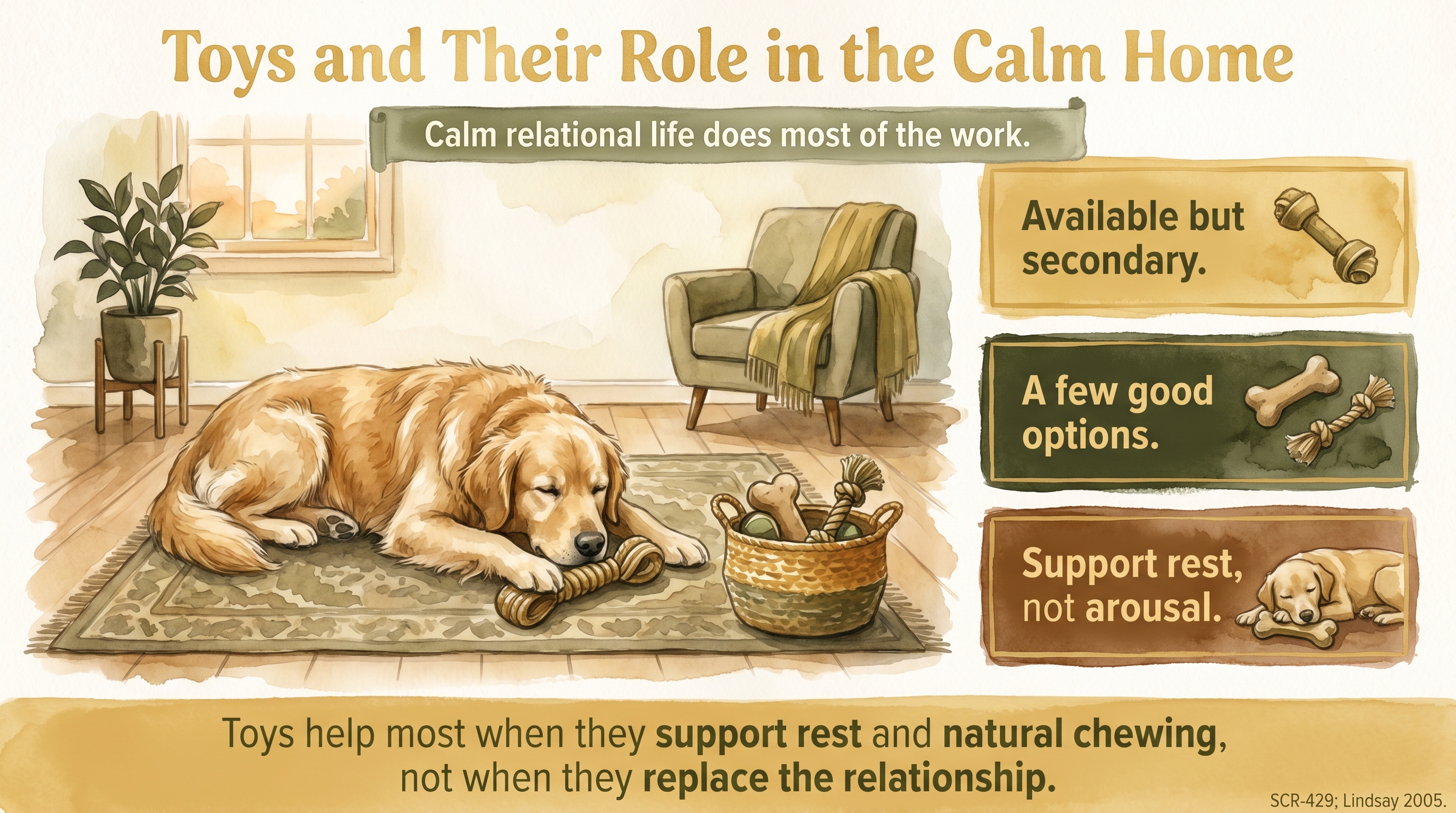
Toys help most when they support rest and natural chewing, not when they replace the relationship.
Key Takeaways
- JB keeps toys available but secondary, with calm relational life doing more of the fulfillment work than constant object novelty.
- Most family Goldens need a few good chew and retrieve options, not an ever-expanding toy catalogue.
- Toys help most when they support rest, natural chewing, or short clean play windows rather than nonstop activation.
- The strongest JB toy claim is observational and philosophical, supported by play and arousal science rather than by a direct toy-rotation trial.
The Evidence
- Canine play literaturedogs
Play and object interaction can be valuable parts of canine life, but their effects depend on context, social meaning, and the dogs overall regulatory state. - Arousal-regulation literaturedogs
Not all stimulation is equally helpful; stimulation that repeatedly escalates arousal may undermine rather than improve regulation in some dogs.
- JB breeder and family observationGolden Retrievers and family dogs
Many family dogs thrive with a small number of durable toys when the surrounding relational life is strong and calm. - JB observationfamily homes
Adding more toy novelty often does less for long-term ease than improving rest rhythm, walking quality, and household integration.
- JB synthesisfamily-dog enrichment culture
The claim that consumer enrichment culture often overestimates the emotional importance of toy variety is a practical critique built from observation, not a direct randomized trial of toy abundance.
No published study directly tests the practical implications of toys and their role in the calm home for domestic dog raising programs. The application to household dog raising remains an interpretive synthesis rather than a directly tested intervention finding.
SCR References
Sources
- Wells, D. L. (2004). A review of environmental enrichment for kennelled dogs, Canis familiaris. Applied Animal Behaviour Science, 85(3-4), 307-317. https://doi.org/10.1016/j.applanim.2003.11.005
- Schork, I. G., Manzo, I. A., De Oliveira, M. R. B., da Costa, F. V., Palme, R., Young, R. J., & de Azevedo, C. S. (2022). How environmental conditions affect sleep? An investigation in domestic dogs (Canis lupus familiaris). Behavioural Processes, 199, Article 104662. https://doi.org/10.1016/j.beproc.2022.104662
- Bradshaw, J. W. S., Pullen, A. J., & Rooney, N. J. (2015). Why do adult dogs play? Behavioural Processes, 110, 82-87. https://doi.org/10.1016/j.beproc.2014.09.023
- Rooney, N. J., Bradshaw, J. W. S., & Robinson, I. H. (2000). A comparison of dog-dog and dog-human play behaviour. Applied Animal Behaviour Science, 66(3), 235-248. https://doi.org/10.1016/S0168-1591(99)00078-7
- Just Behaving program observation disclosure. (2026). Boundary: this internal observation is limited to JB-raised Golden Retrievers whose families continued the JB framework after placement; cohort size, time window, and counting rule are deferred in this revision. Treat as program observation supporting toy-use patterns in calm homes, not as published external evidence.