Chewing Outlets and Choice Architecture
Chewing is not a problem behavior waiting to happen. It is a normal canine need. Puppies chew because teething and oral exploration are developmentally real. Adolescents chew because development is still underway. Many adults continue to chew because it remains satisfying, regulating, and species-appropriate. The question, then, is not whether a family can eliminate chewing. It is whether the family will arrange the home so the need has good outlets before the dog discovers bad ones. JB answers that question through prevention and choice architecture. The dog is given appropriate options in the exact places where chewing naturally happens, and the inappropriate options are removed from easy access. That is a strongly observed household practice grounded in developmental common sense. Observed-JB
What It Means
Choice architecture means the environment does some of the work before conflict begins.
Instead of asking:
- how do I teach my puppy not to chew the rug
JB asks:
- why can the puppy get to the rug when no better option is present
That reframing is one of the clearest expressions of the Prevention pillar. The family is not waiting for repeated unwanted chewing and then trying to correct it out later. The family is setting up the resting space so that the dog keeps choosing legal outlets because the legal outlets are the easiest and most satisfying things available.
What Good Setup Looks Like
A dog usually chews where it rests, where it waits, or where it has a little unstructured time. Observed-JB That is where the good options belong.
Depending on the dog's age and household, those options may include supervised raw recreational bones where appropriate, durable rubber chew items, bully sticks in moderation, and sturdy natural chews that match the dog's size and chewing style. Observed-JB
Families should also know what not to trust casually: cooked bones, small brittle items that splinter, pieces that can be swallowed whole, and rawhide products of uncertain quality. Observed-JB
The chewing need is not solved by saying no louder. It is solved by supplying better yeses before the dog builds a relationship with the wrong object.
Why Correction Alone Usually Fails
When families correct chewing without providing a real alternative, the need does not disappear. The dog still wants oral activity, relief, occupation, or decompression. If the good option is missing or less available than the bad one, the dog simply keeps searching.
That is why prevention feels almost unfairly effective compared with repair. Once the baseboard, shoe, rug fringe, or chair leg has become part of the dogs chewing map, the family is already behind. Better to keep the map clean.
Why It Matters for Your Dog
Chewing handled well does three good things at once: it protects the home, it meets a real canine need, and it reduces conflict between dog and family.
Choice architecture is Prevention made practical. The family does not wait for the dog to make the wrong choice repeatedly. It arranges the room so the right choice is the easiest one to make.
This matters especially in puppyhood and adolescence, when oral needs can be intense and families are most tempted to interpret normal developmental behavior as defiance. A puppy with a good chew in the right spot is not "being distracted from mischief." The puppy is often simply being allowed to be a puppy in a more lawful way.
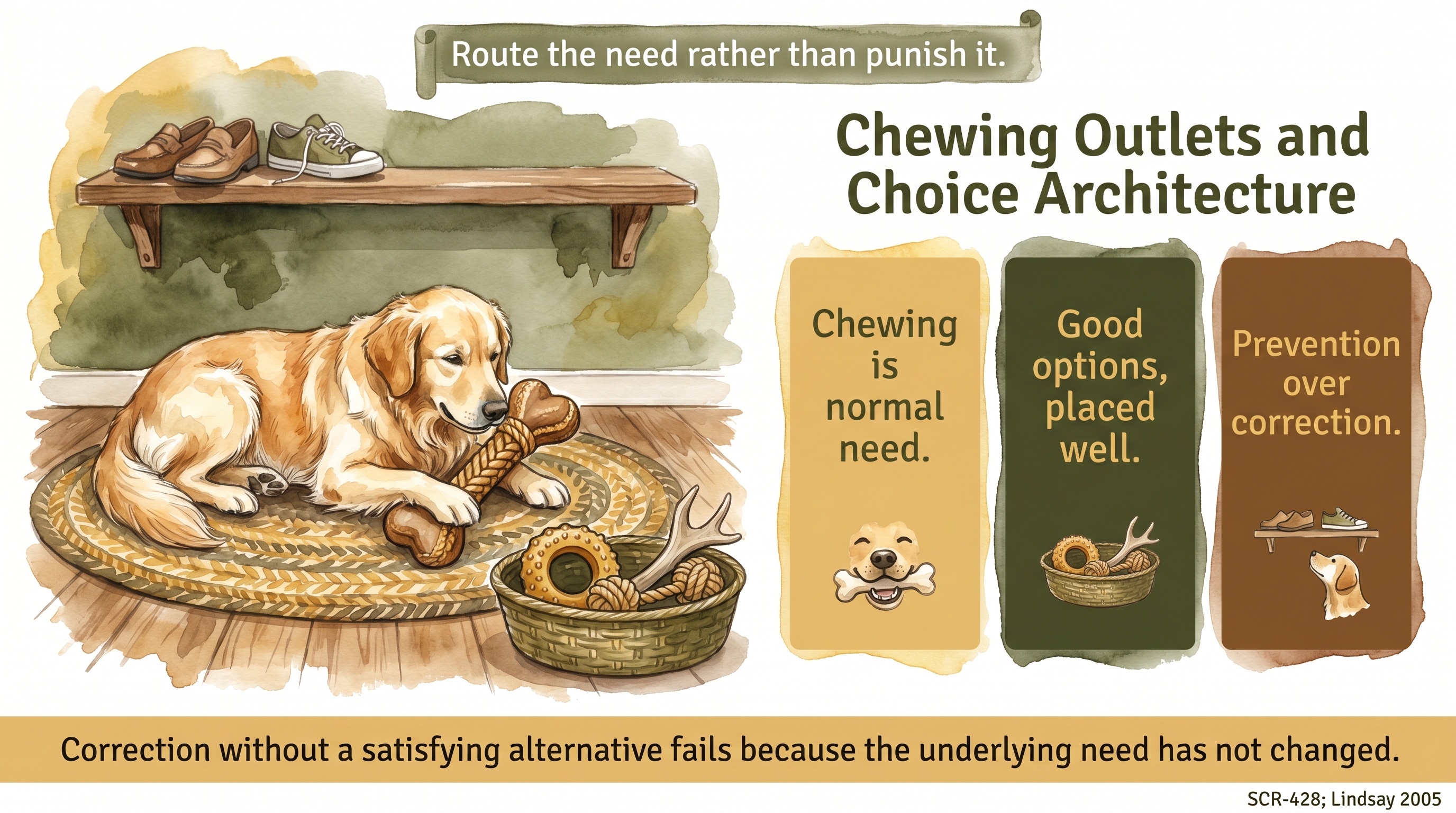
Correction without a satisfying alternative fails because the underlying need has not changed.
Key Takeaways
- Chewing is a normal canine need, especially in puppyhood and adolescence, not simply a problem behavior.
- JB handles chewing through prevention and choice architecture by placing good options where chewing naturally happens and removing bad options from easy reach.
- Correction without a satisfying alternative usually fails because the underlying oral need is still present.
- The strongest JB claim is observational, supported by developmental logic and veterinary safety guidance rather than by a direct intervention trial.
The Evidence
- Developmental literaturedogs
Puppies engage in extensive oral exploration during development, and mouthing and chewing are normal components of early behavioral maturation. - Veterinary safety guidancedogs
Chew-item suitability depends on size, durability, and supervision because some options carry obstruction, choking, or fracture risk.
- JB breeder and family observationGolden Retrievers and family dogs
When good chew options are placed in the exact spaces where dogs naturally settle, destructive chewing is often dramatically reduced without repeated correction. - JB household observationfamily homes
Dogs corrected for chewing without being given a comparable outlet tend to keep searching for oral satisfaction elsewhere.
- JB synthesisfamily-dog management
The claim that environmental choice architecture is the best primary response to normal chewing is an applied prevention philosophy rather than a direct comparative trial against traditional correction methods.
No published study directly tests the practical implications of chewing outlets and choice architecture for domestic dog raising programs. The application to household dog raising remains an interpretive synthesis rather than a directly tested intervention finding.
SCR References
Sources
- Wells, D. L. (2004). A review of environmental enrichment for kennelled dogs, Canis familiaris. Applied Animal Behaviour Science, 85(3-4), 307-317. https://doi.org/10.1016/j.applanim.2003.11.005
- Creevy, K. E., Grady, J., Little, S. E., Moore, G. E., Strickler, B. G., Thompson, S., & Webb, J. A. (2019). 2019 AAHA canine life stage guidelines. Journal of the American Animal Hospital Association, 55(6), 267-290. https://doi.org/10.5326/JAAHA-MS-6999
- Re-sharpened by Queue1-DecisionTree: Iinuma, M., Yoshida, S., & Funakoshi, M. (1991). Development of masticatory muscles and oral behavior from suckling to chewing in dogs. Comparative Biochemistry and Physiology A, 100(4), 789-794. https://doi.org/10.1016/0300-9629(91)90293-l. This documents early canine oral and masticatory development, but does not verify JB household chewing-outlet choice architecture. SCR-428 remains an [Observed] JB-practice claim.