Natural Retrieving vs Drilled Fetch
This dispatch opens with a regular Tuesday and closes with one of the most Golden Retriever things in the world: a dog bringing something back. That is not an accident. Retrieving lets Living With Your Dog come full circle to the breed itself. In JB, natural retrieving is the version families should learn to recognize and protect. The dog wants to chase, pick up, carry, and return because the drive is genuinely there. A few throws in the yard, a short water retrieve at the pond, a toy carried proudly through the house. Drilled fetch is different. It is the heavily structured building of retrieval for precision, endurance, or competitive goals. JB does not condemn that world. It simply says the family-dog context does not need it. A well-bred Golden usually offers enough retrieve drive naturally for ordinary life, and short clean sessions preserve both the drive and the calm baseline better than long drilled routines often do. That is an observed breed-and-household claim rather than a formal competition-versus-family trial. Observed-JB
What It Means
Natural retrieving is retrieve behavior offered from breed heritage and relationship.
It often includes eager orientation to the object, a joyful pickup, a proud carry, a return toward the human, and a clean end before arousal peaks too high. Observed-JB
The session is brief because it does not need to be a training campaign. The point is not to manufacture more and more repetitions until the dog is exhausted. The point is to enjoy the natural behavior while it is still clean and satisfying.
What Drilled Fetch Is Actually For
Drilled retrieving exists for good reasons in working and competitive contexts. Hunt-test dogs, field dogs, and dogs asked for precision under pressure need a different level of structure. Observed-JB There is nothing inherently immoral about that. It simply serves a different goal.
Family dogs usually do not need dozens of repetitions, precision delivery drills, escalating pressure for clean fronts or holds, or highly formalized retrieve mechanics.
They need enough retrieving to satisfy the breed and share pleasure with the family.
Why Short Sessions Matter
Retrieving can become highly arousing very quickly. That is true even in dogs who love it. One of the easiest mistakes families make is assuming more throws always equal more fulfillment. Often the opposite is true. Once arousal climbs too high, the retrieve gets sloppier, the return gets less relational, and the dog leaves the session more activated than satisfied. Observed-JB
JB prefers a few throws, a clean stopping point, and walking away while the dog's body is still coherent.
This preserves the experience as shared and breed-congruent rather than letting it drift into compulsion.
What This Is Not
This page is not arguing that formal retrieve work has no place in the world.
It does.
Working retriever people are pursuing goals ordinary family life does not require, and their methods should be judged within those goals. JB is simply drawing a boundary around what a companion Golden needs to live well in a home.
It is also not saying every Golden retrieves naturally with identical enthusiasm. Genetics vary. Temperament varies. Maturity varies. Some dogs love the water retrieve but ignore a tennis ball in the yard. Some retrieve happily only in short bursts. Some never show much interest at all.
The family should work with the dog in front of them.
Why It Matters for Your Dog
Natural retrieving matters because it lets the family honor the breed without converting the breed into a project. The retrieve becomes one more place where the dogs inheritance and the relationship meet.
JB prefers to build on what the Golden already is. Natural retrieving is one of the clearest examples. The family does not need to manufacture the whole behavior from scratch when the breed has already brought so much of it to the relationship.
This also brings the dispatch to its warmest point. Living with a JB dog is not about doing less with your dog. It is about doing different things with your dog. A quiet evening brush while the family talks. A walk that stays soft on the leash. A dog settling at your feet while you work. A few retrieves at the pond before dinner. That is not a lesser life. It is a coherent one.
And that, in the end, is what this whole dispatch has been trying to show. The Five Pillars do not disappear once the transition is over. They become Tuesday.
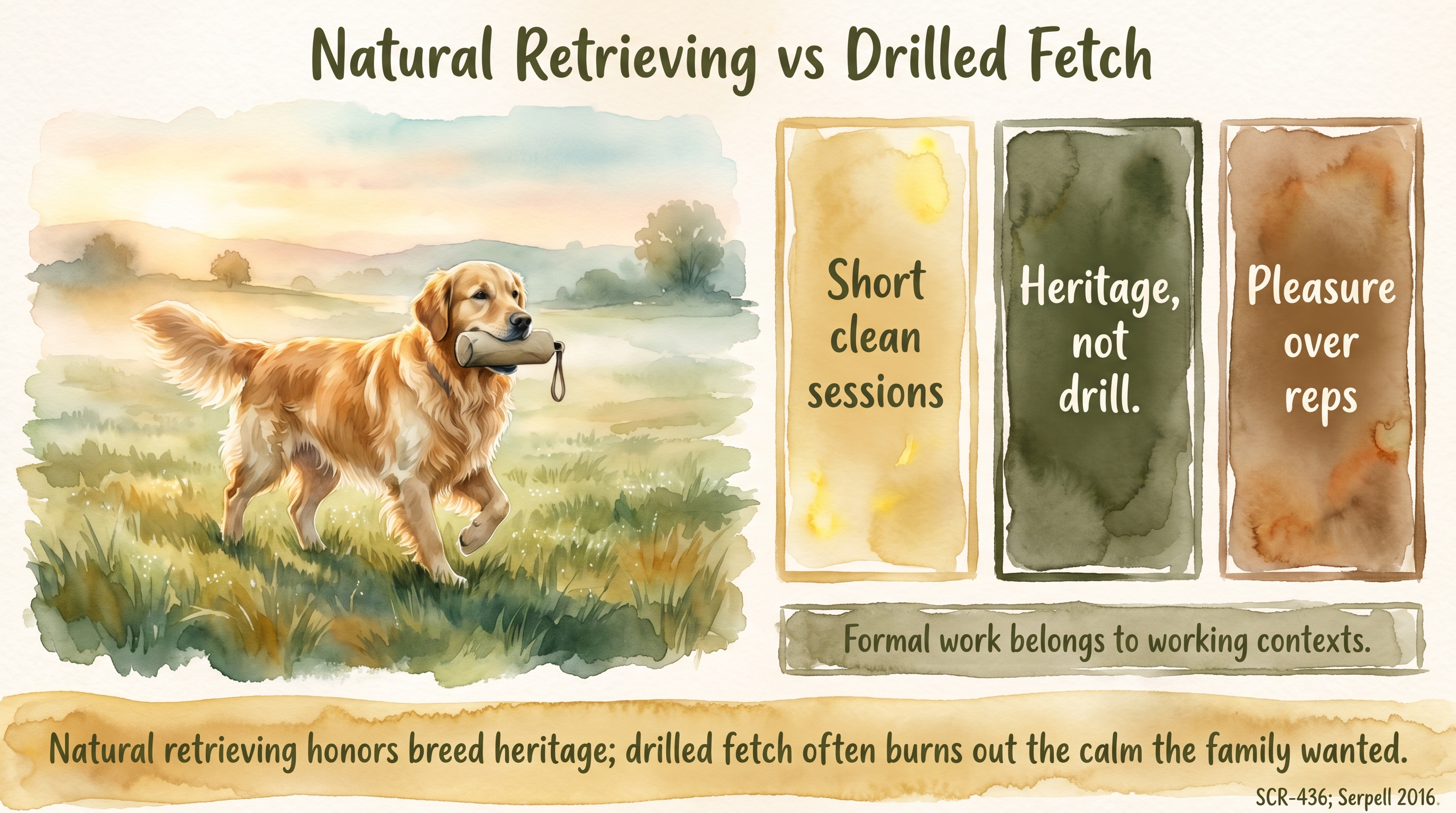
Natural retrieving honors breed heritage; drilled fetch often burns out the calm the family wanted.
Key Takeaways
- Natural retrieving builds on real Golden Retriever heritage and often gives families all the fetch they need without turning the behavior into a drilling project.
- Short clean retrieve sessions usually preserve both the pleasure of the activity and the dogs calm baseline better than long repetitive sequences.
- Formal retrieve work belongs to legitimate working and competitive contexts, but most family dogs do not need that level of structure or intensity.
- The strongest JB claim is observational and breed-informed, supported by heritability and arousal science rather than by a direct trial of family fetch styles.
The Evidence
- Retriever breed literatureGolden Retrievers and related retrievers
Retrieving motivation is partly heritable and tied to selection for human-directed cooperation and object return. - Arousal-regulation literaturedogs
Highly repetitive exciting activity can drive arousal upward and reduce behavioral coherence once the dog passes its cleaner regulatory window.
- JB breeder and family observationGolden Retrievers
Many well-bred Goldens offer enough natural retrieve drive for satisfying family play without needing heavily drilled fetch routines. - JB observationfamily dogs
Short sessions ended before arousal spikes too high tend to preserve both retrieve enthusiasm and post-activity settling better than long repetitive fetch sequences.
- JB synthesisfamily-dog retrieving practice
The claim that natural retrieving serves companion Goldens better than drilled fetch for most households is a practical breed-and-lifestyle judgment rather than a formal comparative trial.
No published study directly tests the practical implications of natural retrieving vs drilled fetch for domestic dog raising programs. The application to household dog raising remains an interpretive synthesis rather than a directly tested intervention finding.
SCR References
Sources
- Schork, I. G., Manzo, I. A., De Oliveira, M. R. B., da Costa, F. V., Palme, R., Young, R. J., & de Azevedo, C. S. (2022). How environmental conditions affect sleep? An investigation in domestic dogs (Canis lupus familiaris). Behavioural Processes, 199, Article 104662. https://doi.org/10.1016/j.beproc.2022.104662
- Hiby, E. F., Rooney, N. J., & Bradshaw, J. W. S. (2004). Dog training methods: Their use, effectiveness and interaction with behaviour and welfare. Animal Welfare, 13(1), 63-69. https://doi.org/10.1017/S0962728600026683
- Boundary approved by Queue1-DecisionTree: existing canine play, arousal, and training-method sources support the low-arousal handling boundary. No retriever-breed primary source was located for the natural-retrieving-versus-drilled-fetch claim. The row remains breed-history interpretation plus JB observed practice, not primary-source-backed breed science.
- Just Behaving program observation disclosure. (2026). Boundary: this internal observation is limited to JB-raised Golden Retrievers whose families continued the JB framework after placement; cohort size, time window, and counting rule are deferred in this revision. Treat as program observation supporting natural retrieving outcomes, not as published external evidence.