The Settle as a Default State
Perhaps no daily-life difference between JB and ordinary dog culture is more visible than this one: in JB, settle is not mainly a thing the dog does when told. It is the state the dog keeps returning to on its own. A dog lying quietly in the kitchen while dinner is cooked, at the feet of the desk while work gets done, or beside the sofa during the evening is not performing a choreographed trick. The dog is living inside a calm household rhythm. That claim is deeply observational. It is the accumulated breeder and family experience that the settle emerges when calmness, rest protection, and attachment have been built early enough and held long enough. Observed-JB
What It Means
The settle is the shape a well-raised dog's body takes when nothing urgent is happening.
That definition matters because it removes the behavior from a narrow training frame. Observed-JB The family is not pulling a behavior out of the dog on command. The family is creating a life in which resting near the humans becomes natural.
The settle often looks very plain: the dog lies down nearby, the dog sighs, the hips roll to one side, the eyes stay soft, and the dog dozes, watches, or lightly shifts position.
This is not dead time. It is regulated social life.
Where the Settle Starts
The settle usually begins long before adulthood. A puppy who learns to sleep in a quiet bedroom, rest through the family's morning routine, nap after walks, and recover from stimulation without being kept perpetually "on" is already learning the settle. Observed-JB The posture may become more mature later, but the nervous-system habit is being built early.
That is why Dispatch 6 keeps reaching backward into the transition category. What looks like a mature adult-dog virtue often began as a very ordinary first-week protection of rest.
Why Many Families Miss It
Many people think they want a settled dog, but they have accidentally built a house where settling is hard to choose. The dog is talked to every time it enters the room. Wake windows are treated as entertainment windows. Movement from the dog immediately pulls movement from the human. The dog learns that being awake means being socially active.
Then the humans wonder why the dog will not simply lie down.
The issue is often not that the dog was never taught to settle. It is that the house never stopped asking the dog not to.
The Trained Version and the JB Version
Many families do reach the visible outcome through formal teaching. They ask the dog to lie on a mat, pay the behavior, and expand duration until the dog can remain quiet for long stretches. Observed-JB That can produce a genuinely helpful household skill.
JB is naming a different endpoint. The trained version is a requested behavior. The JB version is a default state.
The family can still guide, shape the environment, or interrupt restlessness when needed, but the dog is not waiting for a special prompt to remember that calm exists.
Why It Matters for Your Dog
The settle matters because most of real life is not peak activity. Most of life is the middle. It is errands, work calls, children reading, dinner being made, guests talking, weather changing outside, and people moving quietly through rooms. A dog that cannot inhabit the middle of life without escalating will struggle even if the dog is perfectly charming in bursts of deliberate activity.
The settle is one of the clearest signs that calmness has become the households real baseline. It is not about stopping the dog from living. It is about making everyday life soft enough that the dog can rest inside it.
A true settle also protects the bond. The dog does not need to beg for constant engagement because connection remains available in quiet form. The family does not feel pressured to perform companionship every waking hour. Both sides can simply be together.
That ordinary togetherness is one of the deepest goods in family dog life.
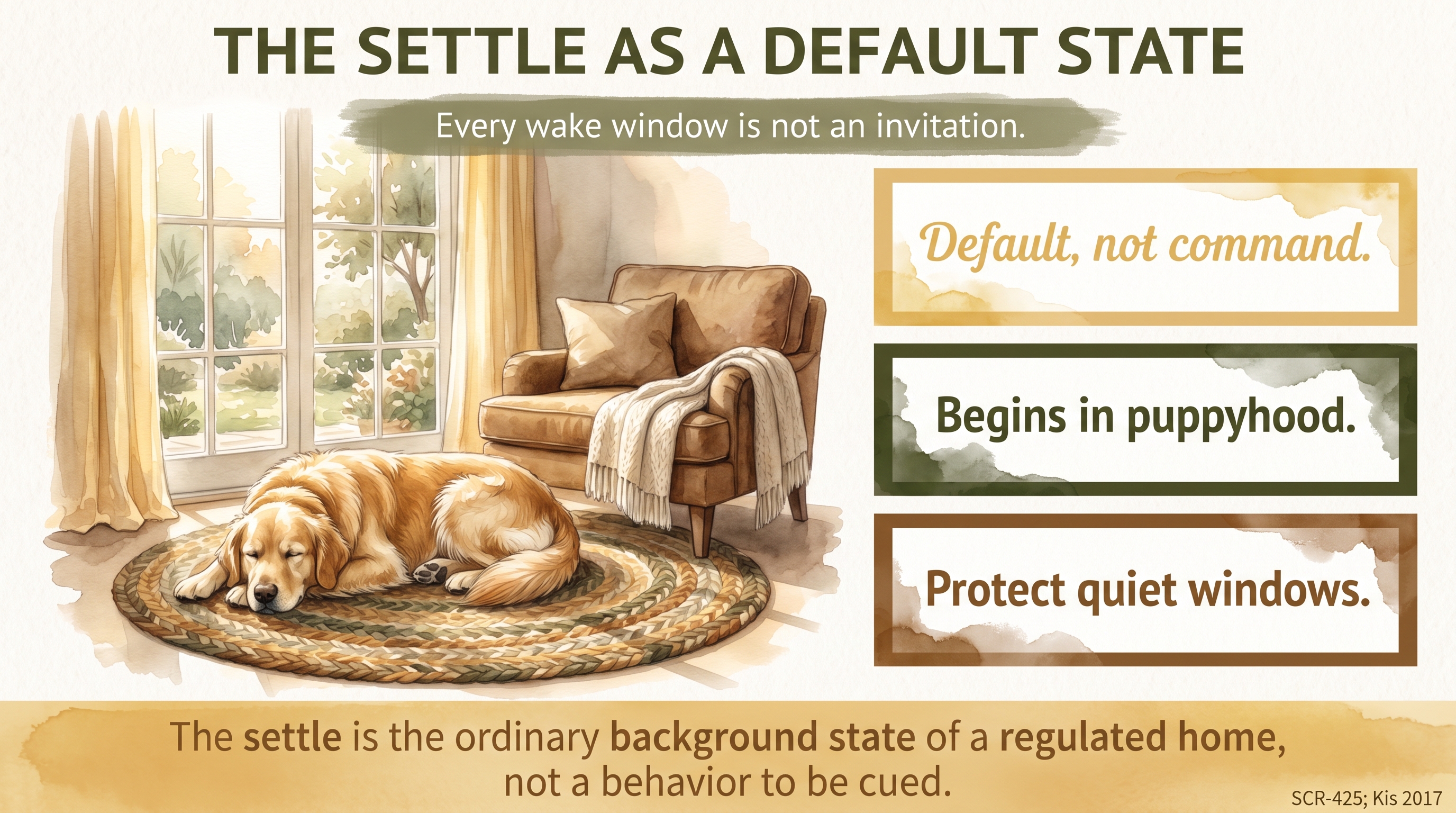
The settle is the ordinary background state of a regulated home, not a behavior to be cued.
Key Takeaways
- In JB, the settle is primarily a default state of regulated daily life, not just a behavior performed on request.
- The adult settle usually begins in puppyhood through protected rest, calm routine, and repeated return to a low-arousal baseline.
- Many households accidentally make settling difficult by treating every wake window as a social or entertainment window.
- The strongest JB claim is observational, supported by arousal and sleep science rather than by a direct settle-protocol trial.
The Evidence
- JB breeder and family observationGolden Retrievers and family dogs
Dogs raised with protected rest and calm household rhythm often develop spontaneous settling as a default state without needing continual prompting. - JB longitudinal observationfamily dogs
The easier adult settle is usually traceable to early-life rest protection rather than to a later isolated behavior lesson.
- Canine arousal-regulation literaturedogs
Lower chronic arousal and stronger recovery support more flexible behavior and easier return to rest after stimulation. - Sleep and recovery literaturedogs
Protected rest is biologically important for development and behavioral regulation, supporting the claim that spontaneous settling is built on earlier opportunities to rest well.
- JB synthesisfamily-dog daily life
The claim that the settle is best understood as a lifestyle outcome rather than as a taught behavior is an interpretive framework built from observation, sleep science, and calm-household practice rather than a direct comparative trial.
No published study directly tests the practical implications of the settle as a default state for domestic dog raising programs. The application to household dog raising remains an interpretive synthesis rather than a directly tested intervention finding.
SCR References
Sources
- Kinsman, R., Owczarczak-Garstecka, S., Casey, R., Knowles, T., Tasker, S., Woodward, J., Da Costa, R., & Murray, J. (2020). Sleep duration and behaviours: A descriptive analysis of a cohort of dogs up to 12 months of age. Animals, 10(7), 1172. https://doi.org/10.3390/ani10071172
- Kis, A., Szakadat, S., Gacsi, M., Kovacs, E., Simor, P., Torok, C., Gombos, F., Bodizs, R., & Topal, J. (2017). The interrelated effect of sleep and learning in dogs (Canis familiaris): An EEG and behavioural study. Scientific Reports, 7, 41873. https://doi.org/10.1038/srep41873
- Tooley, C., & Heath, S. E. (2022). Sleep characteristics in dogs: Effect on caregiver-reported problem behaviours. Animals, 12(14), 1753. https://doi.org/10.3390/ani12141753
- Schork, I. G., Manzo, I. A., De Oliveira, M. R. B., da Costa, F. V., Palme, R., Young, R. J., & de Azevedo, C. S. (2022). How environmental conditions affect sleep? An investigation in domestic dogs (Canis lupus familiaris). Behavioural Processes, 199, Article 104662. https://doi.org/10.1016/j.beproc.2022.104662
- Just Behaving program observation disclosure. (2026). Boundary: this internal observation is limited to JB-raised Golden Retrievers whose families continued the JB framework after placement; cohort size, time window, and counting rule are deferred in this revision. Treat as program observation supporting the spontaneous-settle outcome claim, not as published external evidence.