The Dog Aging Process
Aging in a dog rarely begins with one dramatic moment. More often it arrives as a collection of small shifts that are easy to explain away when seen one at a time. The walk takes a little longer to get going. Recovery after activity is a little slower. Sleep stretches longer. Gray appears around the muzzle. The dog still feels like itself, which is why families can underestimate how much has changed until they compare this year with last year. Documented
JB wants families to hold two truths at once. The senior dog is still the same dog. Aging is also real biology, not an emotional illusion. Loving the dog well means refusing both denial and premature fragility.
What It Means
Physical Aging Is Usually Gradual First
In Golden Retrievers, the earliest aging signs often show up in ordinary life rather than in crisis: more stiffness when rising, longer warm-up before the body looks fluid, more reluctance around slippery footing or jumping, subtle changes in stamina or recovery, coat thinning or increased whitening, and more sleep and quieter evenings. Observed-JB
None of these signs automatically means disease. Many reflect normal aging. The point is not to medicalize every change. It is to notice them honestly and use them to guide the next stage of care.
Sleep and Recovery Change Too
Older dogs often spend more time resting and may show different sleep-wake patterns than they did in mid-adulthood. Observed-JB Some of that is ordinary aging. Some of it can also be a clue that discomfort, anxiety, sensory change, or cognitive change is entering the picture.
That is one reason JB pays attention to sleep in older dogs. The dog who naps more but still wakes comfortably and joins life may simply be aging. The dog who paces at night, seems disoriented after dark, or sleeps poorly while looking tired all day may be telling the family something more specific.
Cognitive Aging Has a Veterinary Name
Families should also know that canine cognitive dysfunction is a documented later-life syndrome. It is not the same thing as ordinary mild slowing. It describes a pattern of aging-related cognitive decline that can include disorientation in familiar spaces, altered sleep-wake cycling, changes in social engagement, house-training lapses, and activity-pattern changes.
Not every older dog develops it. Not every behavior change in an older dog is cognitive dysfunction. But the syndrome is real, and it becomes more relevant as dogs move into advanced age.
Why Families Underestimate the Process
Aging is easier to miss than sudden illness because it is cumulative rather than dramatic. The family sees the dog every day. Each day feels close to the one before it. That is why people often say a sentence like "he got old all at once" when what really happened is that the family finally noticed a year of small changes at the same moment.
JB does not treat that as failure. Heuristic It treats it as a predictable feature of living closely with someone you love.
The Senior Dog Is Not a Broken Adult
One of the most important emotional corrections JB offers is this: aging is not a deviation from the dog's life. It is part of the dog's life.
That matters because families often react in one of two unhelpful ways: they deny change and keep pushing the dog into the old baseline, or they interpret every change as fragility and quietly withdraw normal inclusion. Observed-JB
The better stance is adaptive inclusion. The dog is still in family life. The family simply adjusts the rhythm, expectations, and physical supports to match the body and brain the dog has now.
What This Is Not
This page is not saying every older dog with gray hair has a disorder.
It is not saying slower always means pain.
It is not saying every sleep change means cognitive dysfunction.
It is saying that aging has recognizable physical and cognitive signatures, and families serve the dog best when they notice the signs early enough to respond proportionately.
Why It Matters for Your Dog
The aging process matters because it sets the tone for the entire senior period. A family that notices honestly can make better decisions about bedding, traction, exercise, checkups, body condition, and the pace of daily life before the dog is forced to ask more loudly.
The senior dog does not need to be treated as though life is over. The dog needs the family to keep the calm floor intact while adjusting it to an older body and an older nervous system.
When that happens, the dog usually experiences aging not as exclusion but as a gentler form of the same belonging it has always known.
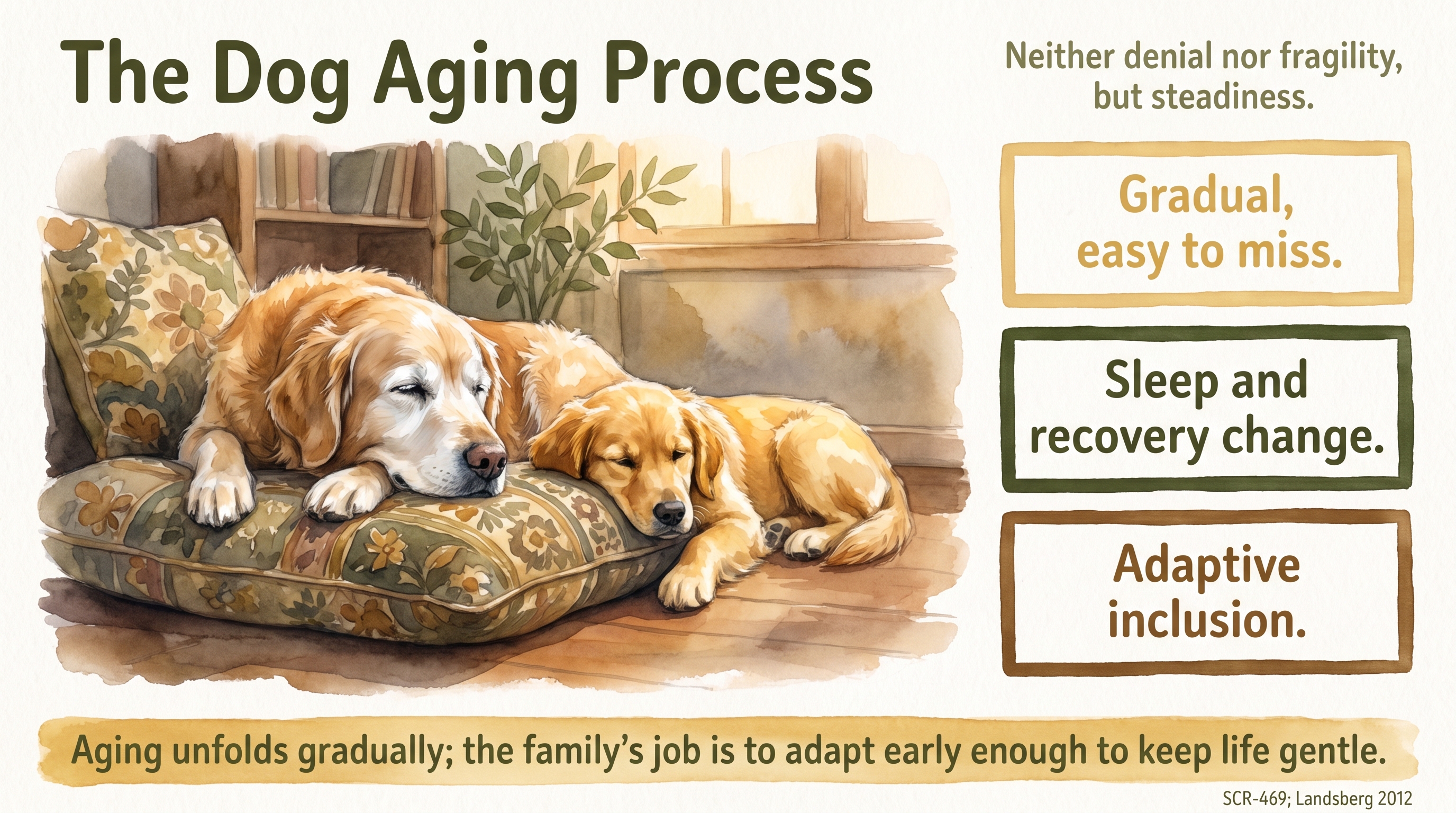
Aging unfolds gradually; the family's job is to adapt early enough to keep life gentle.
Key Takeaways
- Aging in dogs is usually gradual enough that families can miss it until many small changes have accumulated.
- Physical slowing, sleep change, and altered recovery are common parts of aging and deserve honest observation.
- Canine cognitive dysfunction is a real documented syndrome and should be distinguished from ordinary mild aging.
- The healthiest family posture is neither denial nor fragility, but adaptive inclusion.
The Evidence
This entry uses heuristic claim-level tags beyond the dedicated EvidenceBlocks below. These tags mark JB interpretive application rather than direct study findings.
- senior-dog medical literaturedogs
Aging commonly brings reduced exercise tolerance, sleep-wake changes, mobility decline, and growing relevance of age-associated disease. - canine cognitive dysfunction literaturedogs
Canine cognitive dysfunction is a documented age-associated syndrome characterized by disorientation, altered sleep, social change, house-soiling, and activity-pattern change. - sleep-aging physiologydogs
Older dogs show measurable changes in sleep architecture and sleep-wake rhythm compared with younger adults.
- JB breeder and family observationGolden Retrievers
Families often underestimate how much a dog has aged until they compare current life with the previous year rather than with the previous week.
No published study directly tests the practical implications of the dog aging process for domestic dog raising programs. The application to household dog raising remains an interpretive synthesis rather than a directly tested intervention finding.
SCR References
Sources
- American Animal Hospital Association. (2023). 2023 AAHA senior care guidelines for dogs and cats. Journal of the American Animal Hospital Association, 59(1), 1-21. https://doi.org/10.5326/JAAHA-MS-7343
- Creevy, K. E., Grady, J., Little, S. E., Moore, G. E., Strickler, B. G., Thompson, S., & Webb, J. A. (2019). 2019 AAHA canine life stage guidelines. Journal of the American Animal Hospital Association, 55(6), 267-290. https://doi.org/10.5326/JAAHA-MS-6999
- Takeuchi, T., & Harada, E. (2002). Age-related changes in sleep-wake rhythm in dog. Behavioural Brain Research, 136(1), 193-199. https://doi.org/10.1016/S0166-4328(02)00123-7
- Osella, M. C., Re, G., Odore, R., Girardi, C., Badino, P., Barbero, R., Bergamasco, L., & Schiavone, A. (2007). Canine cognitive dysfunction syndrome: Prevalence, clinical signs and treatment with a neuroprotective nutraceutical. Applied Animal Behaviour Science, 105(4), 297-310. https://doi.org/10.1016/j.applanim.2006.11.007
- Epstein, M., Kuehn, N. F., Landsberg, G., Lascelles, B. D. X., Marks, S. L., Schaedler, J. M., & Tuzio, H. (2023). 2023 AAHA senior care guidelines for dogs and cats. Journal of the American Animal Hospital Association, 59(1), 1-21. https://doi.org/10.5326/JAAHA-MS-7343