Loose-Leash Walking Without Training
Loose-leash walking is one of the most practical questions in family life because it shows up almost immediately. The ordinary assumption is that a dog walks nicely on lead because someone has systematically taught the dog to do so through a reward routine. JB does not dispute that such programs can work. It claims something narrower and more relational: many family dogs, especially Golden Retrievers raised from puppyhood in a calm, structured home, can come to walk loosely because pulling never becomes the profitable default and because the handler's pace becomes the dog's anchor. That claim is not drawn from a formal controlled trial. It is an observed JB outcome repeated across breeder-raised dogs and maintained households. Observed-JB
What It Means
The phrase without training can create confusion if it is heard carelessly.
JB is not claiming the dog learns nothing.
The dog learns constantly.
What JB rejects is the idea that loose-leash walking must be built primarily as a reward-maintained performance. In the JB frame, walking emerges from relationship, rhythm, and prevention.
The dog learns the walk begins from calm, the human sets the pace, the end of the leash is not where good things happen, moving with the handler is easier than dragging against the handler, and brief drift is answered quietly, not dramatically. Observed-JB That is still learning. It is simply a different kind of learning.
The Walk Starts Before the Door Opens
Most leash problems begin long before the leash tightens.
They begin in the hallway, the mudroom, or the front step where the dog is already elevated because the entire departure ritual has been taught as exciting. Observed-JB The human reaches for shoes, keys, harness, and leash. The dog spins, vocalizes, leaps, and surges toward the exit. By the time the walk begins, the nervous system is already above the line.
JB changes the front end of the sequence.
The dog is not wound up for the walk. The walk begins as an ordinary event. The leash is put on with the same tone used for any other daily transition. The dog moves through the doorway at the handler's pace. This matters because a dog that starts from calm has a chance to continue from calm. Observed-JB
The Handler Becomes the Metronome
One of the most important JB ideas is almost disappointingly simple. The handler walks at their own pace.
Not in a rigid, punitive way.
Not in a theatrical "you will submit to my tempo" way.
Simply in the ordinary way a stable adult moves through space.
The dog learns that the walk has a center and that the center is the human body, not the far end of the leash. The dog can investigate, look around, sniff, and move with interest, but the fundamental rhythm still belongs to the pair.
This is why loose-leash walking in JB is less about micromanaging inches of position and more about preventing a pulling economy from forming at all.
What Happens When the Dog Drifts Ahead
Dogs drift. Puppies especially drift. Adolescents drift with enthusiasm. JB does not interpret every moment of forward interest as a disciplinary crisis. What matters is how the handler answers it. The answer is usually subtle: a quiet stop, a calm change of direction, a slight body turn, or a moment of spatial pressure. The point is not to punish pulling. The point is to make pulling unproductive without making the walk emotionally loud.
This is where indirect correction matters. The handler is communicating that the shared line has been broken and then calmly restoring it. No anger is required. No drama is needed. No food negotiation is inserted into the middle of the relationship.
Why Prevention Carries So Much of the Work
Once families have spent months or years letting the dog tow them toward every smell, dog, child, or patch of grass, loose-leash walking becomes a bigger repair project. That is exactly why JB places so much weight on prevention. The young dog is not repeatedly taught that tension gets forward motion, activation opens access, or lunging earns arrival. If those circuits are never built deeply, the walking life stays much simpler.
This is also why breed matters. A well-bred Golden Retriever typically wants to stay socially connected to the human in a way that many families underuse. If the dog is raised as though that relational tendency matters, walking can remain a shared activity rather than becoming a daily contest of competing intentions.
What This Is Not
This page is not saying conventional loose-leash programs do not work. They do work, and plenty of good trainers have taught many dogs to walk politely on lead using food, repetition, and clear contingency. JB is not claiming incompetence on the part of everyone else. It is making a philosophical and practical distinction.
The distinction is this:
- a reward-maintained walking routine asks the dog to perform for a known currency
- a relational walking routine asks the dog to synchronize with a known human
Those two things can look similar from twenty feet away.
Up close, they are not the same. The first often requires active maintenance from the human. The second is more likely to scale into ordinary life because it is built into the walking rhythm itself.
That does not make JB morally superior. It makes JB different.
Why It Matters for Your Dog
Walking happens too often to treat it as a small issue. If the dog pulls on every outing, the family rehearses tension every day. If the dog walks loosely because the walk itself has a calm relational center, the family rehearses something else every day. This difference affects more than arm strain. It affects how often the dog scans for outside rewards, whether the dog orients to the handler spontaneously, how escalated the dog becomes at the sight of other dogs, and whether the walk feels cooperative or adversarial.
Loose-leash walking in JB is largely the product of what never gets reinforced and what gets quietly interrupted early. Prevention keeps the pulling economy shallow, and indirect correction restores rhythm without making the leash a battleground.
It also changes how the human feels. Many people quietly dread walks because they have come to expect conflict, embarrassment, or shoulder strain. Once the walk returns to being a shared rhythm rather than a daily campaign, the whole activity becomes lighter.
That matters because families should be able to enjoy living with their dogs.
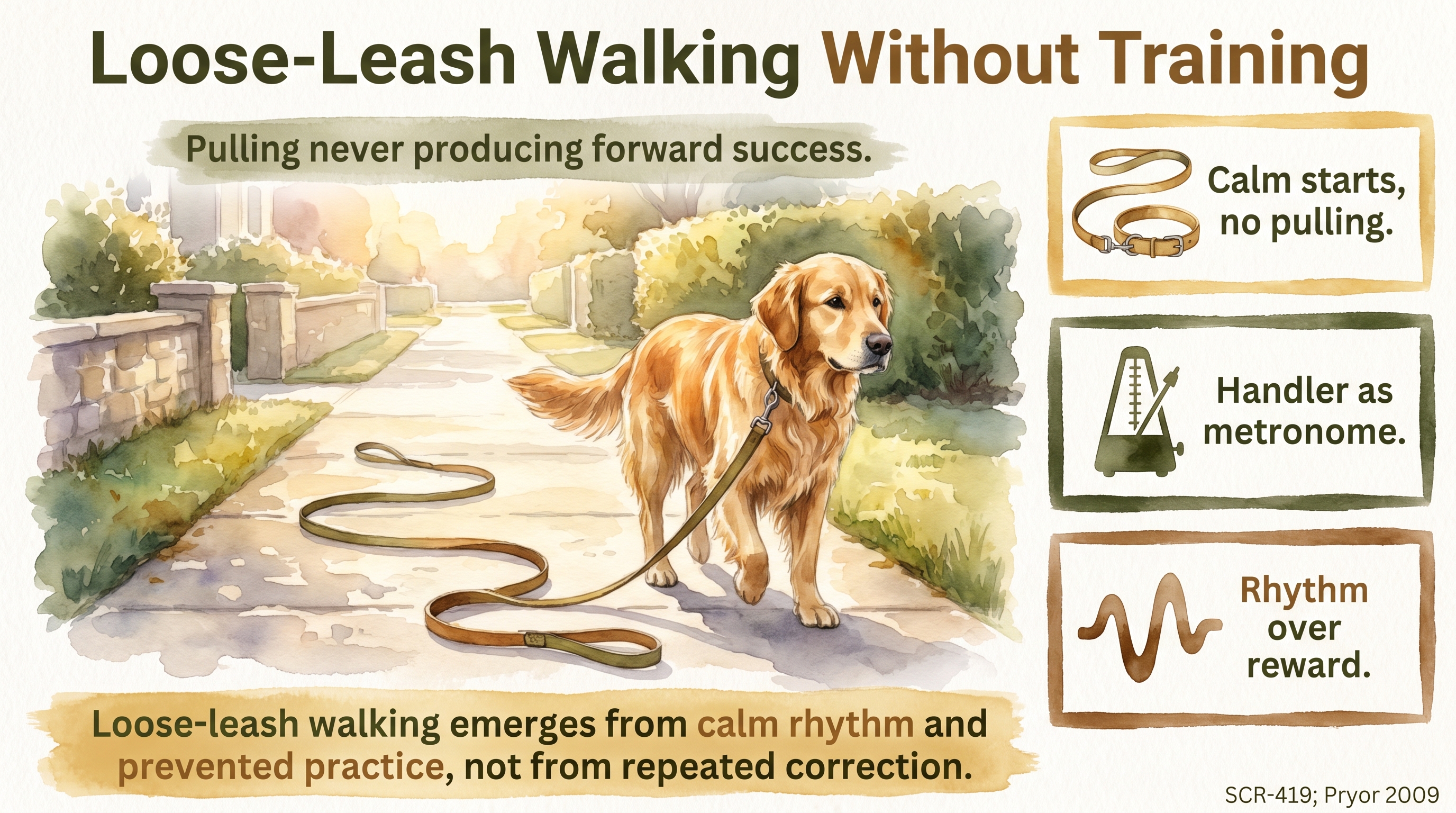
Loose-leash walking emerges from calm rhythm and prevented practice, not from repeated correction.
Key Takeaways
- JB loose-leash walking is built through calm starts, prevented pulling success, and quiet interruption rather than through constant treat maintenance.
- The handler becomes the walking metronome, which gives the dog a social rhythm to synchronize with instead of a daily contest at the end of the leash.
- Conventional reward-based loose-leash routines can work, but JB distinguishes them from a relational walking pattern that often scales more naturally to ordinary life.
- The strongest part of the JB claim is observational, supported by basic behavioral and arousal science rather than by a direct protocol trial.
The Evidence
- JB breeder and family observationGolden Retriever family dogs
Dogs whose walks begin calmly, do not profit from leash tension, and are guided through quiet directional or spatial interruption often maintain loose-leash patterns without treat-based upkeep. - JB practice observationfamily-dog walking routines
Pulling is easier to prevent than to unwind later because forward success at the end of the leash quickly becomes a self-maintaining circuit.
- Learning and habit literaturedogs
Behaviors that repeatedly produce the desired outcome tend to strengthen, which supports the prevention claim that forward success on a tight leash will deepen pulling over time. - Arousal and self-regulation literaturedogs
Higher arousal impairs flexibility and makes sustained coordinated movement harder, which helps explain why calm walk starts matter.
- JB synthesisfamily dogs
The claim that loose-leash walking scales better when it is built as a relational rhythm than when it is built as a reward performance is an applied interpretation of breeder practice rather than a directly compared experimental result.
No published study directly tests the practical implications of loose-leash walking without training for domestic dog raising programs. The application to household dog raising remains an interpretive synthesis rather than a directly tested intervention finding.
SCR References
Sources
- Wormald, D., Lawrence, A. J., Carter, G., & Fisher, A. D. (2017). Reduced heart rate variability in pet dogs affected by anxiety-related behaviour problems. Physiology & Behavior, 168, 122-127. https://doi.org/10.1016/j.physbeh.2016.11.003
- Bouton, M. E., & Todd, T. P. (2014). A fundamental role for context in instrumental learning and extinction. Behavioural Processes, 104, 13-19. https://doi.org/10.1016/j.beproc.2014.02.012
- Hiby, E. F., Rooney, N. J., & Bradshaw, J. W. S. (2004). Dog training methods: Their use, effectiveness and interaction with behaviour and welfare. Animal Welfare, 13(1), 63-69. https://doi.org/10.1017/S0962728600026683
- Just Behaving program observation disclosure. (2026). Boundary: this internal observation is limited to JB-raised Golden Retrievers whose families continued the JB framework after placement; cohort size, time window, and counting rule are deferred in this revision. Treat as program observation supporting loose-leash walking without formal command training, not as published external evidence.