The Lifelong Breeder Relationship
In JB, the breeder relationship is not supposed to end when the puppy leaves. The dog has moved from breeder to family, but the connection remains useful for the whole life of the dog. That does not mean the breeder replaces the veterinarian, the behavior professional, or the family's own judgment. It means the family continues to have access to someone who knows the line, knows the philosophy, and cares how the life unfolds over time. Observed-JB
This matters more than many people realize. A lot of modern dog culture treats breeder contact as either customer service or awkward nostalgia. JB treats it as continuity.
What It Means
What the Relationship Offers
Across the life of the dog, the breeder can provide several kinds of value: perspective during the first weeks and months, pattern recognition during adolescence, line knowledge when health questions arise, emotional steadiness during stressful decisions, and longitudinal interest in how the litter actually turned out.
The family does not need to use the breeder for every question. But it should feel welcome to reach back when something matters.
Why It Matters Beyond the Puppy Period
The relationship often changes form after the first year. Early on, families ask about sleep, feeding, transitions, and everyday puppy questions. Later the questions become subtler: Is this adolescent shift within the range you usually see? Does this health issue occur elsewhere in the line? Is this the stage when people often consider a second dog? What should we be watching as our dog begins to age?
The breeder may not hold the final answer to all of those questions. But the breeder often holds context that no one else does.
The Breeder Is Not the Veterinarian
That boundary matters and should stay clear.
The breeder is not diagnosing disease.
The breeder is not replacing annual care.
The breeder is not making the euthanasia decision for the family.
The breeder is not providing a legalistic compliance relationship after the puppy goes home.
JB sees the breeder more as a long-form mentor and witness than as an authority over the household. Observed-JB The family should be able to ask for perspective without feeling managed from outside.
Why Health Updates Matter
For a serious breeder, litter updates are not only sentimental. They are part of how future breeding decisions improve. Over years, information about longevity, cancer, orthopedic outcome, temperament, cognition, and quality of life becomes the difference between folklore and actual line knowledge. Observed-JB
That is one reason good families should not assume the breeder is only interested in good news. Honest updates matter even when the news is hard. A diagnosis in one dog may change how a breeder interprets a line, a pairing, or a recurring pattern across relatives. Observed-JB
This is not the same thing as a formal research study, and JB should not pretend otherwise. It is still valuable stewardship.
The Emotional Use of the Relationship
There is also a quieter reason the breeder relationship matters. The breeder knew the dog before the family did. In some cases the breeder knew the parents, grandparents, and siblings too. When a family is in the middle of a hard stretch, that continuity can feel less like information and more like companionship.
Families often reach back when adolescence feels unexpectedly hard, when a medical decision is frightening, when the dog enters the senior years, or when end-of-life questions begin to appear. They do this not because the breeder owns the decision, but because the breeder is part of the dog's human circle.
The breeder-family relationship is mentorship in a later form. The puppy left, but the door did not close. The same philosophy that helped start the life can still help hold the life years later.
What This Is Not
This page is not claiming every family wants ongoing contact at the same level. It is not claiming every breeder earns that trust equally. It is not obligating the family to report every detail of daily life.
It is saying the relationship should remain open, warm, and useful if the family wants it to be.
Why It Matters for Your Dog
Dogs benefit when the humans around them share information rather than hoard it. The veterinarian sees medicine. The family sees daily life. The breeder sees lineage and long pattern. Those are different windows onto the same dog.
For the dog, that can mean better support. For the breeder, it can mean better future decisions. For the family, it can mean not feeling alone with questions that no generic advice source can answer well.
The relationship is part of the philosophy because JB never intended to be a transaction. It intended to be a way of raising and living with dogs that remains relational all the way through.
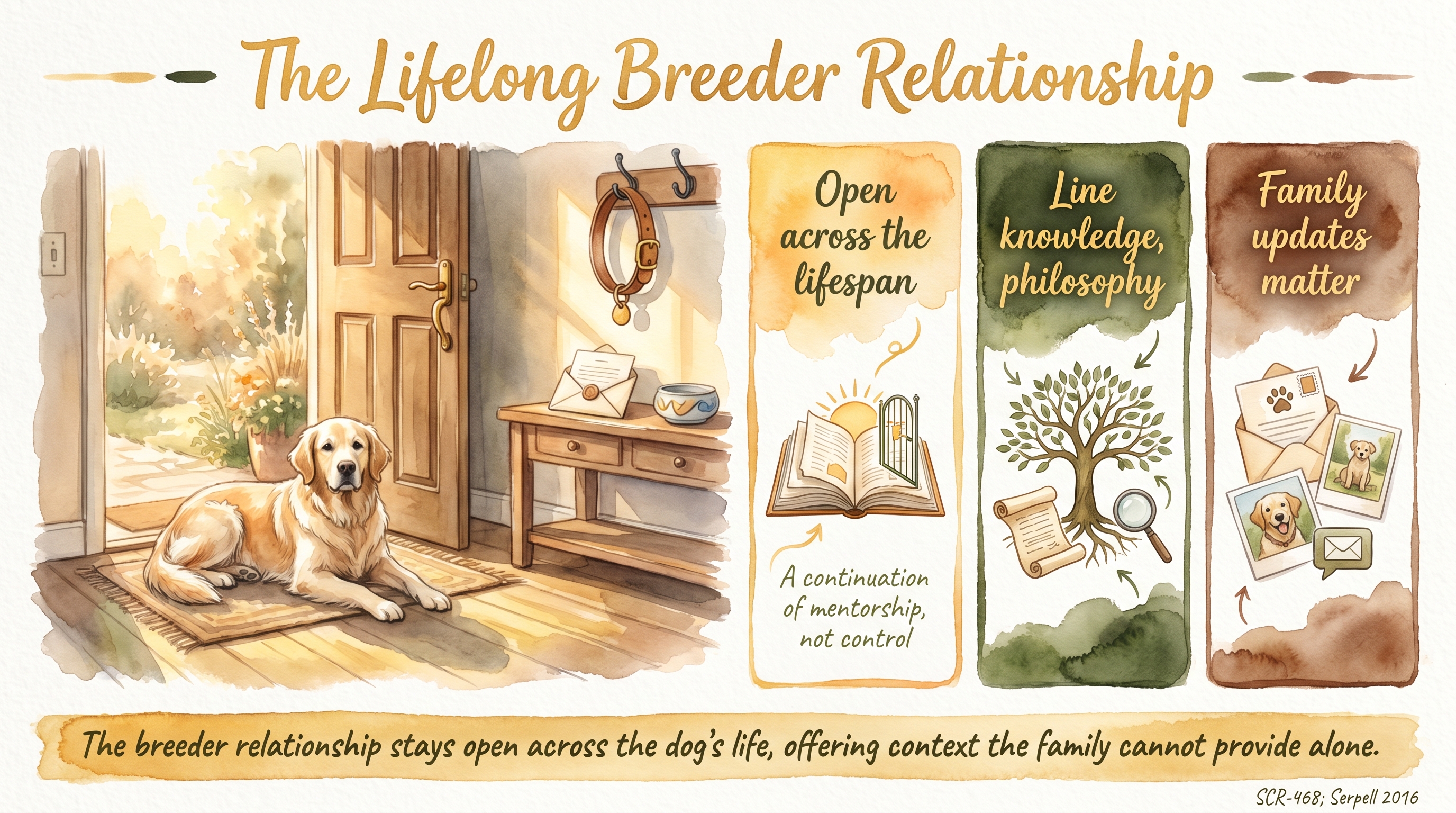
The breeder relationship stays open across the dog's life, offering context the family cannot provide alone.
Key Takeaways
- In JB, the breeder relationship is meant to remain open across the dog's whole life rather than ending at pickup day.
- The breeder offers line knowledge, philosophical continuity, and human support, but does not replace the veterinarian or other professionals.
- Honest family updates help both the current dog and the future breeding program.
- The lifelong breeder relationship is a continuation of mentorship, not a continuation of control.
The Evidence
- JB breeder observationGolden Retrievers
Families often use the breeder most productively not only during the first month but at later turning points such as adolescence, health changes, second-dog decisions, and the senior years. - JB breeding-program practiceGolden Retriever litters
Longitudinal family updates help the breeder track line outcome, refine future decisions, and support current families with context that general advice does not provide.
- Golden lifetime-study frameworkGolden Retrievers
Longitudinal collection of health and lifestyle information is central to understanding breed outcome over time, even though breeder follow-up is not equivalent to a formal prospective cohort.
No published study directly tests the practical implications of the lifelong breeder relationship for domestic dog raising programs. The application to household dog raising remains an interpretive synthesis rather than a directly tested intervention finding.
SCR References
Sources
- Guy, M. K., Page, R. L., Jensen, W. A., et al. (2015). The Golden Retriever Lifetime Study: Establishing an observational cohort study with translational relevance for human health. Philosophical Transactions of the Royal Society B, 370(1673), 20140230. https://doi.org/10.1098/rstb.2014.0230
- Morris Animal Foundation. (n.d.). Golden Retriever Lifetime Study. https://www.morrisanimalfoundation.org/golden-retriever-lifetime-study
- Just Behaving program-practice disclosure. (2026). Boundary: this internal observation is limited to the JB breeder-family support structure and operator practice, not to a measured dog outcome claim; cohort size, time window, and counting rule are deferred in this revision. Treat as program observation supporting the lifelong breeder relationship claim, not as published external evidence.