Senior Cognitive Changes and Family Adaptation
Not every older dog who changes is cognitively impaired. Some are sleeping more, hearing less well, moving more slowly, or coping with pain. But canine cognitive dysfunction is also a real documented condition, and families deserve language for it because the symptoms can be emotionally disorienting when they first appear. Documented
What makes this hard is that the dog still looks like the same dog. The coat is familiar. The face is familiar. Then the dog begins doing unfamiliar things in familiar places. Families often feel grief before they have a name for why.
What It Means
What Cognitive Change Can Look Like
Clinicians often group later-life cognitive signs into a recognizable pattern that can include disorientation in familiar rooms or routines, changes in day-night rhythm (especially nighttime wakefulness), reduced or altered greeting behavior, house-soiling in a previously reliable dog, pacing or aimless wandering, and changed interaction with people or other dogs. Observed-JB
No single sign proves cognitive dysfunction. The value of the list is cumulative. When several of these changes appear together, especially in an older dog, the family should bring them to the veterinarian clearly and early.
Why Sleep Changes Matter So Much
Families often notice sleep disruption before they notice anything else. The dog who used to sleep through the night now wakes, paces, seems uncertain, or cannot settle. This matters practically because night disruption affects the whole household. It also matters diagnostically because sleep-wake changes are part of the syndrome itself.
That is why JB wants families to treat night behavior as information, not as misbehavior.
An older dog pacing at 2 a.m. is not asking for correction. The dog may be confused, uncomfortable, anxious, or unable to organize its own rest in the same way it once could.
Ordinary Aging Versus Medical Change
This is the point where families most need proportion.
Normal aging can bring a little more sleep, a little less interest in busy activity, and slower transitions between rest and action. Concerning cognitive change more often brings apparent confusion, significant nighttime disruption, loss of known habits, and altered recognition of familiar household patterns. Observed-JB
The distinction is not always obvious at home, which is why the veterinarian belongs in the conversation. Sensory loss, pain, endocrine disease, neurologic disease, and cognitive dysfunction can overlap in ways families cannot safely sort out alone.
How Families Usually Make It Harder Without Meaning To
When behavior changes are upsetting, families often respond by pushing for the old dog to reappear. They call more, cue more, correct night activity, and become emotionally loud because the loss of predictability scares them.
That usually makes the dog less comfortable, not more. The dog who is already struggling to organize itself internally does not benefit from a more emotionally charged environment on top of that.
What Adaptation Usually Looks Like
JB's guidance here is simple and humane: keep daily rhythm as stable as possible, protect the dog's familiar rest spaces, use lighting, access, and furniture arrangement to reduce confusion, keep expectations realistic, maintain affection and inclusion, and work with the veterinarian on medical management options.
That last part matters. Families should know that veterinary management for cognitive dysfunction can include environmental strategies, diet approaches, supplements or medications when indicated, and broader senior-health review. JB does not replace that plan. JB helps the family hold the dog gently inside it.
The dog with cognitive change does not need sharper correction. The dog needs a household that remains legible enough to act as an external scaffold when the internal one is weakening.
What This Is Not
This page is not saying every old dog has canine cognitive dysfunction.
It is not saying the family should diagnose the condition on its own.
It is not saying no medical help exists.
It is not saying the dog has become someone else.
That last one matters most. Families often speak as though the dog has disappeared. JB resists that language. The dog is still here. The family is meeting a medical condition in the dog it already loves.
Why It Matters for Your Dog
The way a family responds to cognitive change shapes the emotional quality of the senior period. A house that becomes impatient, loud, or correction-heavy because the dog is now harder to read adds suffering to confusion. A house that adapts, simplifies, and keeps affection steady gives the dog a better chance to remain held even as some functions change. Documented
That is not a cure. It is still meaningful.
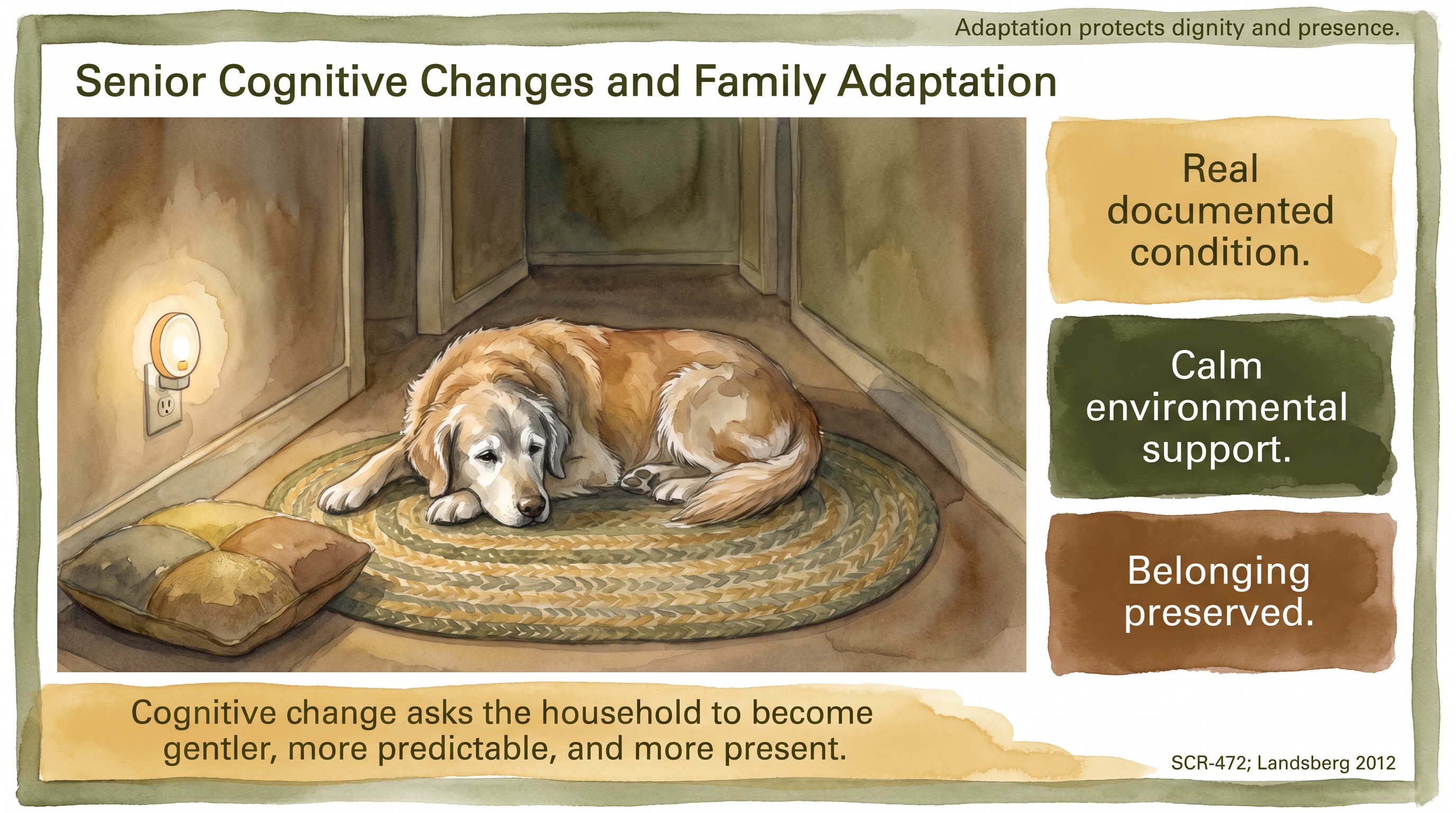
Cognitive change asks the household to become gentler, more predictable, and more present.
Key Takeaways
- Canine cognitive dysfunction is a real documented condition and should be distinguished from ordinary mild aging.
- Nighttime pacing, disorientation, altered greeting, and house-training lapses are meaningful patterns to bring to the veterinarian.
- The dog with cognitive change needs calmer environmental support and medical evaluation, not sharper correction.
- Family adaptation can preserve dignity and belonging even when cognitive decline cannot be reversed.
The Evidence
- veterinary cognitive-dysfunction literaturedogs
Canine cognitive dysfunction is a documented age-associated syndrome involving disorientation, sleep-wake change, altered interaction, house-soiling, and activity-pattern change. - senior-care guidancedogs
Assessment of cognitive change in older dogs is part of contemporary senior veterinary care and should be considered alongside sensory, pain, endocrine, and neurologic differentials. - sleep and aging literaturedogs
Aging-related alterations in sleep and sleep-wake organization are real and can interact with later-life behavioral presentation.
- JB breeder and family observationolder family dogs
Families handle cognitive change best when they lower emotional intensity, simplify the environment, and stop interpreting confusion as disobedience.
No published study directly tests the practical implications of senior cognitive changes and family adaptation for domestic dog raising programs. The application to household dog raising remains an interpretive synthesis rather than a directly tested intervention finding.
SCR References
Sources
- American Animal Hospital Association. (2023). 2023 AAHA senior care guidelines for dogs and cats. Journal of the American Animal Hospital Association, 59(1), 1-21. https://doi.org/10.5326/JAAHA-MS-7343
- Takeuchi, T., & Harada, E. (2002). Age-related changes in sleep-wake rhythm in dog. Behavioural Brain Research, 136(1), 193-199. https://doi.org/10.1016/S0166-4328(02)00123-7
- Osella, M. C., Re, G., Odore, R., Girardi, C., Badino, P., Barbero, R., Bergamasco, L., & Schiavone, A. (2007). Canine cognitive dysfunction syndrome: Prevalence, clinical signs and treatment with a neuroprotective nutraceutical. Applied Animal Behaviour Science, 105(4), 297-310. https://doi.org/10.1016/j.applanim.2006.11.007
- Epstein, M., Kuehn, N. F., Landsberg, G., Lascelles, B. D. X., Marks, S. L., Schaedler, J. M., & Tuzio, H. (2023). 2023 AAHA senior care guidelines for dogs and cats. Journal of the American Animal Hospital Association, 59(1), 1-21. https://doi.org/10.5326/JAAHA-MS-7343
- Just Behaving program observation disclosure. (2026). Boundary: this internal observation is limited to JB-raised Golden Retrievers whose families continued the JB framework after placement; cohort size, time window, and counting rule are deferred in this revision. Treat as program observation supporting senior cognitive adaptation patterns, not as published external evidence.