Recall as a Relationship, Not a Cue
Compound evidence detail1 SCR / 2 parts
- Documentedbehavioral research on recall behavior, attentional binding, and dog-handler relationship factors
- HeuristicJB framing of recall as a relational outcome of mentorship and continuous engagement rather than a trained cue
Few topics create more immediate friction between JB and the wider dog-training culture than recall. The industry standard is clear: choose a word, pair it with high-value food, and build a return response through repetition until the dog treats the prompt as a contract it has learned to cash in. JB does not deny that this can work. It argues for something more foundational. In the JB frame, the deepest form of recall is not produced by the prompt alone. It is produced by the relationship. The dog comes because the handler is the secure base, because the dog's orientation has been built around staying socially connected, and because distance from the handler has never become more rewarding than returning to the handler. The secure-base and attachment literature gives a documented foundation for that logic. The stronger claim, that a JB-raised Golden Retriever can often live from attachment-based recall without needing heavy food conditioning, remains an observed breeder-level outcome rather than a guaranteed universal result. Mixed Evidence
What It Means
This page is not claiming that dogs magically know to come back.
It is claiming that return behavior has more than one possible foundation.
In one model, recall is mainly a trained response to a prompt.
In the JB model, recall begins much earlier. It begins in the puppy who already checks in with the human, already experiences the human as the center of safety, and already finds proximity intrinsically valuable.
That difference matters because the dog is not only hearing a signal. The dog is answering a relationship.
The Attachment Floor
Attachment research in dogs matters here because it shows that dogs do not relate to familiar humans as interchangeable providers of food. Documented Dogs show proximity seeking, secure-base effects, reunion behavior, and stress-buffering patterns with trusted people. That is the scientific floor for saying that a dog can orient to a person for reasons deeper than simple transaction.
In everyday life, that orientation shows up as looking back for the handler, moving with the handler without being micromanaged, choosing to stay within social orbit, and returning after brief exploration.
Those are the early building blocks of recall.
JB is not waiting until the dog is older and then trying to install return behavior from scratch. It is treating the whole relationship as the foundation of return from the beginning.
Why the Dog Comes
In an attachment-based model, the dog comes because the human matters more than the environment, proximity feels safe and normal, the handler's movement organizes the dog's movement, and the dog has practiced staying socially connected since puppyhood. Documented
That does not make the dog robotic. It makes the dog bonded.
A well-raised Golden can still range, sniff, retrieve, swim, or explore, but the dog's movement has a center. The center is the person.
The Prompt Still Exists, but It Is Not the Whole Story
The title of this page names the distinction sharply on purpose, but the practical reality is not mystical. Families still call their dog. They still use a word, a whistle, or a known vocal tone. The difference is that the vocal signal is not doing all the work by itself.
If the relationship underneath it is thin, the prompt must carry nearly the entire burden.
If the relationship underneath it is deep, the prompt functions more like a familiar invitation into an already-existing return pattern.
That is why two dogs can hear the same word and respond very differently. The sound may be identical. The relationship is not.
Goldens, Genetics, and Limits
This page also needs honest boundaries. Golden Retrievers are unusually well suited to this claim because the breed has been selected for cooperative orientation to humans. Even so, not every Golden has the same attachment profile, the same impulse control, or the same environmental history. Adolescents can still make bad decisions. Novel wildlife, social distraction, or weak early relationship work can all erode the reliability families hoped for.
JB should never promise families that love alone produces perfect off-leash return.
The stronger and more defensible claim is this:
When a dog is bred for human cooperation, raised inside a calm relational framework, and kept socially anchored to the handler in daily life, recall often emerges as a relationship outcome rather than only as a food-maintained behavior.
What This Is Not
This page is not a dismissal of conventional recall training.
Reward-based recall work is useful, humane, and for many families entirely appropriate. JB is not saying those families are doing harm. It is saying they may be building return on a different foundation than the one JB prioritizes.
JB is also not saying that every dog should immediately be trusted off lead because the bond feels strong.
That would be careless.
Attachment-based recall does not erase developmental immaturity, environmental hazard, wildlife temptation, breed differences, or legal leash requirements. Documented
The philosophy of recall and the management of recall are not the same topic.
Why It Matters for Your Dog
If recall is treated only as a command response, the family may end up focusing narrowly on whether the dog obeys in the moment. If recall is treated as a relationship outcome, the family starts asking a better upstream question: does my dog live as though I am the secure base?
That question changes daily life. It changes walks, greetings, retrieving sessions, transitions, and ordinary household movement. The dog is not just being drilled on a return. The dog is being raised to stay socially connected.
The strongest JB version of recall grows out of the dog living in orientation to the human. The prompt matters, but the bond is doing the heavier work.
This is also one reason JB families often report that their dogs feel "easy" off lead once maturity arrives. The dog is not constantly calculating whether the outside world is more rewarding than the person. The outside world is being enjoyed from within the relationship.
That is a very different mental structure than one in which the dog is always deciding whether the next offered reward outweighs the environment.
It is also why recall belongs in a daily-rhythm dispatch instead of a narrow training dispatch. The foundation of recall is built in the life, not only in the practice session.
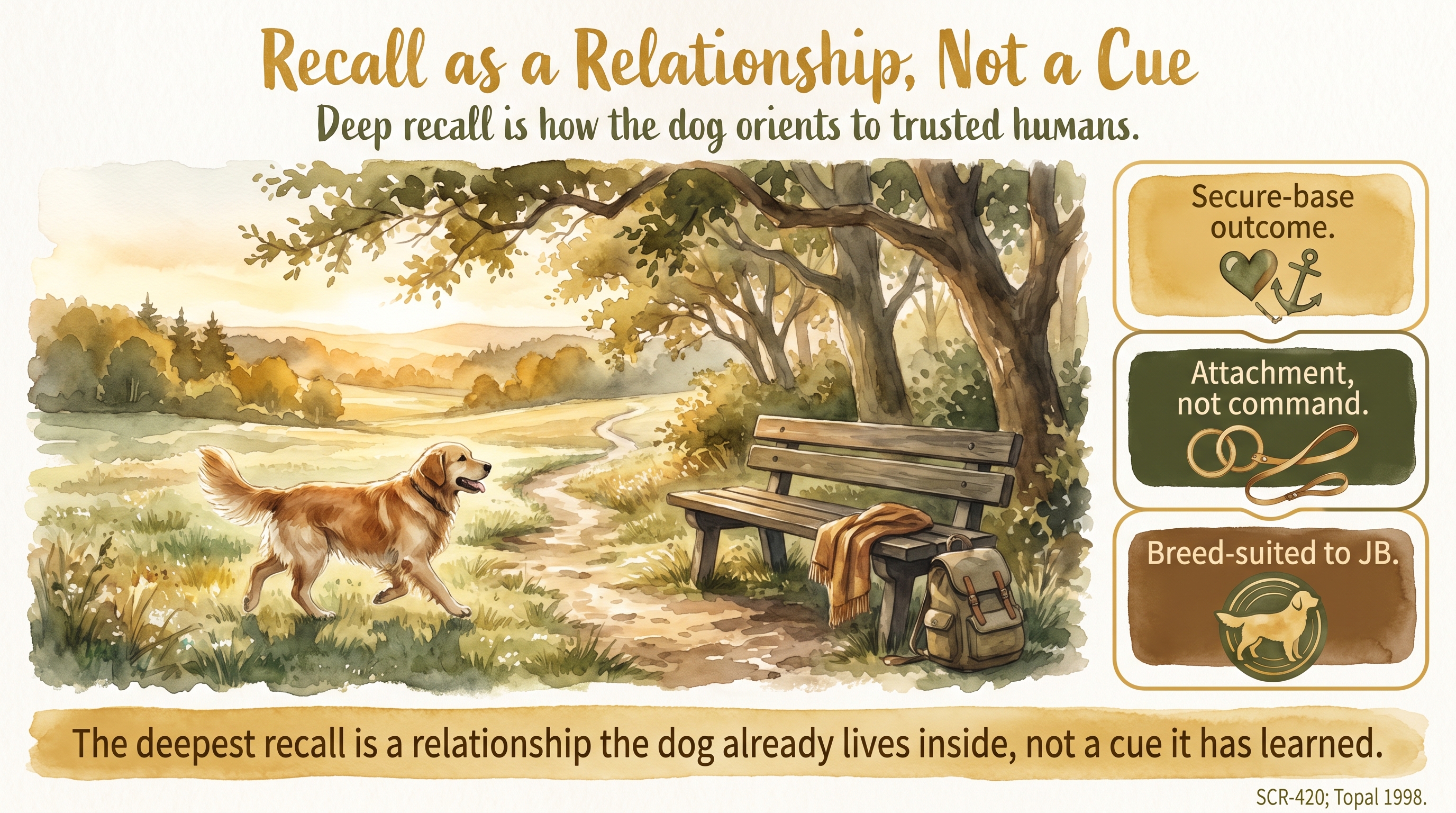
The deepest recall is a relationship the dog already lives inside, not a cue it has learned.
Key Takeaways
- JB treats the deepest form of recall as an attachment outcome rooted in secure-base orientation, not only as a prompted return for food.
- Canine attachment research supports the idea that dogs orient to trusted humans for reasons deeper than transaction, even though that does not guarantee universal off-leash reliability.
- Goldens are especially well suited to attachment-based recall because of breed-level cooperative orientation, but genetics and relationship quality still vary.
- The JB recall claim is strongest as an observed breeder outcome built on a documented attachment floor rather than as a universal promise.
The Evidence
This entry uses mixed-evidence claim-level tags beyond the dedicated EvidenceBlocks below. These tags mark claims that combine documented findings with observed practice, heuristic application, or unresolved gaps.
- Topal and later canine attachment literaturedogs
Dogs show attachment-relevant proximity seeking and secure-base effects with familiar humans, supporting the claim that return to the handler can be grounded in bond rather than in food alone. - Attachment and cortisol-buffering studiesdogs
Secure attachment is associated with lower stress reactivity and stronger orientation to the familiar caregiver under challenge.
- Bowlby and Ainsworth traditionhumans and social mammals
Young social mammals use trusted caregivers as secure bases for exploration and safe havens for return, which provides the conceptual frame for attachment-based return behavior.
- JB breeder observationGolden Retrievers
Dogs raised in a strong relational framework often return to the handler as a default social behavior without depending heavily on food-conditioned recall routines. - JB family observationfamily-raised dogs
The more the dogs daily life is organized around orientation to the handler, the less recall feels like a separate task and the more it feels like continuation of the bond.
No published study directly tests the practical implications of recall as a relationship, not a cue for domestic dog raising programs. The application to household dog raising remains an interpretive synthesis rather than a directly tested intervention finding.
SCR References
Sources
- Ainsworth, M. D. S., et al. (1978). Patterns of Attachment. Erlbaum.
- Bowlby, J. (1969). Attachment and Loss. Vol. 1: Attachment. Basic Books.
- Horn, L., Huber, L., & Range, F. (2013). The importance of the secure base effect for domestic dogs. PLoS ONE, 8(1), e65296.
- Topal, J., Miklosi, A., Csanyi, V., & Doka, A. (1998). Attachment behavior in dogs (Canis familiaris): A new application of Ainsworth's Strange Situation Test. Journal of Comparative Psychology, 112(3), 219-229. https://doi.org/10.1037/0735-7036.112.3.219