Quality of Life Assessment in the Senior Years
Quality of life is one of the hardest later-life subjects because it asks for honesty at the same moment families most want hope. That tension is normal. It does not mean the family is failing. It means they are approaching one of the deepest responsibilities of living with an aging dog. Documented
JB does not treat quality of life as a mystical feeling and it does not treat it as a score that makes the decision by itself. It is a structured conversation between the dog's daily lived experience, the family's observation, and the veterinarian's medical judgment.
What It Means
Why Families Need a Framework
Decline is often easier to see in retrospect than in real time. A hard day is followed by a decent day. A weak morning is followed by a better evening. Families adapt quietly and generously, and sometimes they do that so well that they no longer notice how much of the dog's day is now organized around preventing discomfort. Documented
That is why quality-of-life frameworks help. They slow the moment down enough for the family to ask better questions.
What Quality of Life Actually Means
At its simplest, quality of life asks whether the dog's days still contain more comfort, engagement, and dignity than suffering. Documented
That broad question is often made more usable through structured prompts. One widely used hospice framework is the HHHHHMM scale: Hurt, Hunger, Hydration, Hygiene, Happiness, Mobility, and More good days than bad.
Similar veterinary hospice tools aim at the same thing. They help the family step back from one emotional hour and look at the actual shape of the dog's life across days and weeks. Documented
What These Tools Can and Cannot Do
These tools are useful because they introduce discipline.
They are limited because they cannot remove judgment.
No number captures the whole dog. A score may help the family see a pattern they were minimizing. It cannot tell them exactly what day to choose or how much suffering is too much for this individual dog with this diagnosis and this trajectory. That is where the veterinarian, the family, and the dog's real daily life matter more than any form.
JB is very careful here. It does not issue thresholds. It does not tell families what score equals what decision. That would be false authority.
The Calm Floor as a Helpful Lens
JB adds one interpretive lens of its own, and it stays at the level of philosophy rather than medical command.
When a dog can still live inside the calm floor, there is often still meaningful life available. The dog can rest, settle, take pleasure, engage, and recover within the family's ordinary care. When the dog is consistently beyond the reach of that floor, when discomfort, confusion, respiratory distress, pain, panic, profound weakness, or relentless instability dominate the day, the family is in a different part of the conversation.
That is not a formula. It is a way of naming the difference between supported life and merely prolonged suffering.
Quality of life is not mainly about how much the family wishes to keep the dog. It is about whether the dog still has a day that feels livable from the dog's side of the relationship.
Common Distortions
Families often struggle with a few predictable distortions: comparing today only with yesterday rather than with six months ago, giving special weight to one good hour after many difficult ones, counting their own readiness more heavily than the dog's comfort, and fearing that honest assessment equals betrayal.
The last one is especially painful. It is also untrue. Honest assessment is part of care, not a departure from it.
The Veterinarian Belongs in This Conversation
The veterinarian can help interpret pain control, breathing effort, mobility decline, appetite loss, cognition, prognosis, treatment burden, and what likely comes next. Families should not feel they need to do this in isolation or guess from internet lists alone.
That support matters even when the answer is not immediate. Some dogs still have good time ahead with better symptom management. Some do not. The role of quality-of-life assessment is to help the family see where they are more clearly.
Family Note
If you are reading this page because you think you may need it soon, you are already carrying a heavy part of loving your dog well. Most families do not feel ready for this conversation when it first becomes necessary. That is normal. You do not have to be emotionally finished with the bond in order to look honestly at the dog's comfort. In fact, the willingness to look is part of the bond.
What This Is Not
This page is not telling you when.
It is not saying every senior slowdown is an end-of-life crisis.
It is not saying a quality-of-life form replaces a veterinarian.
It is not pretending that one tool can remove grief from judgment.
Why It Matters for Your Dog
Quality-of-life assessment matters because older dogs usually depend on the family's honesty long before they lose the family's love. The family cannot stop loving. It can stop pretending not to see.
That is one of the final acts of stewardship. Not a number. Not a performance of toughness. A willingness to ask whether the dog's days are still truly the dog's days.
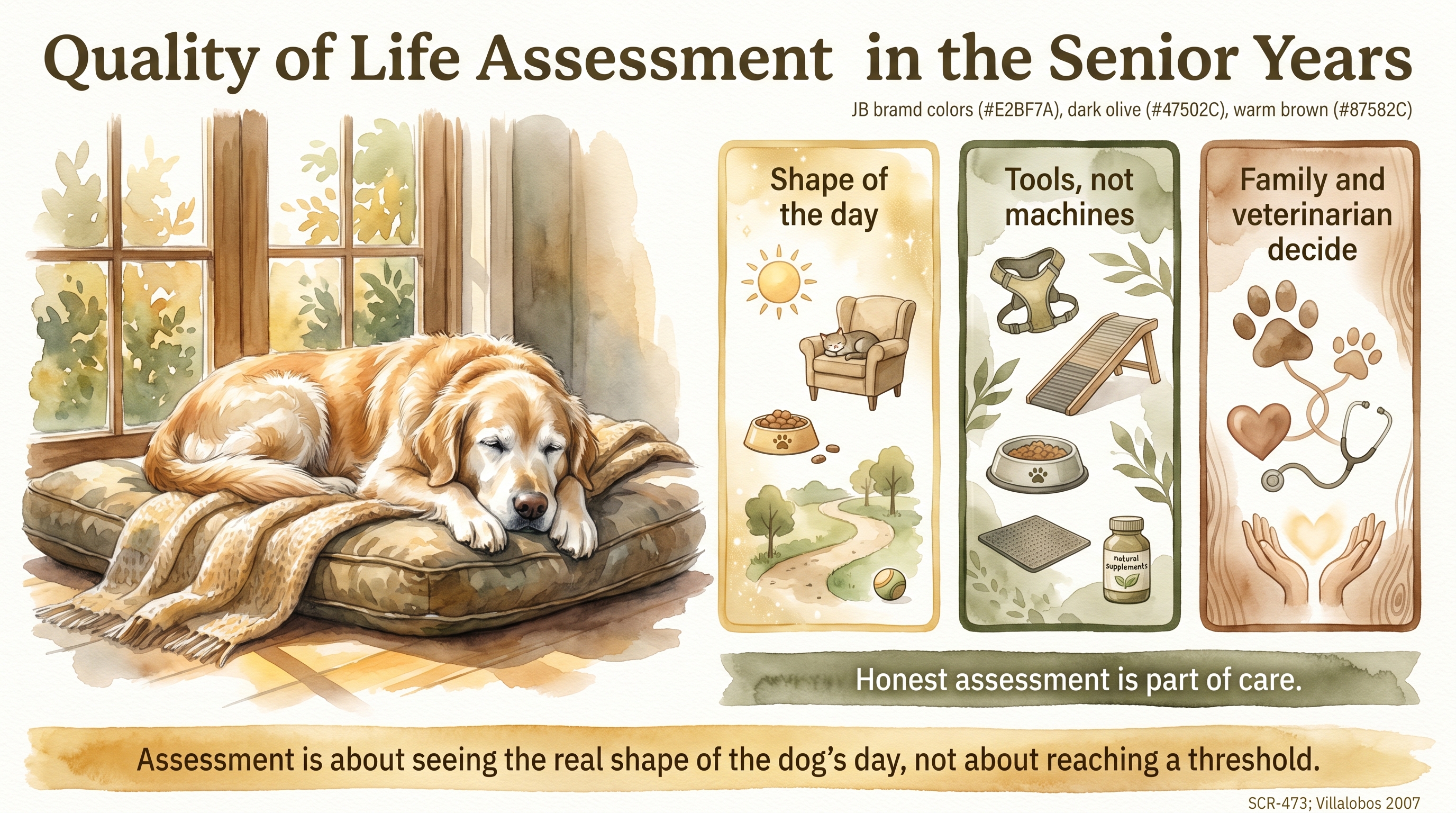
Assessment is about seeing the real shape of the dog's day, not about reaching a threshold.
Key Takeaways
- Quality-of-life assessment helps families see the real shape of an older dogs days when gradual decline is hard to judge in the moment.
- Tools like HHHHHMM are useful conversation supports, not machines that make the decision by themselves.
- JB does not set decision thresholds; those belong to the family and veterinarian together.
- Honest quality-of-life assessment is part of care, not a betrayal of the bond.
The Evidence
- veterinary hospice and senior-care guidancedogs
Structured quality-of-life tools such as the HHHHHMM framework are used to support clinical and family discussion of comfort, function, and suffering in aging or terminally ill dogs. - senior-care guidancedogs
Quality-of-life review is part of contemporary senior and palliative veterinary care and is intended to guide conversation rather than replace clinical judgment.
- JB family and breeder observationolder family dogs
Families often see decline more clearly once they step back from day-to-day adaptation and ask whether the dog's life still contains more comfort and engagement than strain.
No published study directly tests the practical implications of quality of life assessment in the senior years for domestic dog raising programs. The application to household dog raising remains an interpretive synthesis rather than a directly tested intervention finding.
SCR References
Sources
- Villalobos, A. E. (2004). Quality-of-life assessment techniques for veterinarians. Veterinary Clinics of North America: Small Animal Practice, 34(2), 247-267.
- Brown, C. R., et al. (2017). Wellness recommendations for dogs and cats. AAHA Press.
- Goldmeier, A. M., et al. (2015). Health assessment and recommendations for senior dogs. Veterinary Record, 177(18), 467-475.