End-of-Life Decisions
End-of-life decisions are among the hardest decisions a family ever makes for a dog because love does not solve timing. Love is the reason timing hurts. That is why this page stays careful. JB does not tell families when to choose euthanasia. It does not claim authority over the final medical threshold. It does try to tell the truth about the shape of the decision, because honest framing helps more than avoidance does. Documented
In practice, many families will face euthanasia rather than a peaceful natural death at home. Observed-JB That reality is painful, but it is not a sign that the bond failed. It is often how suffering is prevented when quality of life can no longer be maintained.
What It Means
What the Decision Actually Is
Veterinary euthanasia is a medical intervention intended to prevent or end suffering when disease, injury, frailty, pain, respiratory distress, cognitive decline, or combined burdens have moved the dog beyond what can be sustained with acceptable comfort. Documented That sentence matters because it protects the family from two opposite distortions: treating euthanasia as abandonment and treating euthanasia as a casual logistical convenience. It is neither. It is a serious medical and ethical act of care.
The Decision Is Shared
Families do not need to make this decision in a vacuum. The veterinarian's role is to help the family understand the prognosis, symptom burden, likely near-term trajectory, what treatment can still reasonably improve, and what treatment now mostly prolongs difficulty. The family's role is different. The family knows the dog's day, the dog's joy, the dog's effort, and the dog's ordinary self better than anyone. Those two forms of knowledge belong together.
Questions Families Often Face
Even when the general direction is becoming clear, families still face painful practical questions: whether the euthanasia will be in-home or in-clinic, who should be present, whether children should participate and how, what level of preparation would make the moment less chaotic, and how to think about the day itself. JB does not prescribe one universally right answer to those questions. The right answer is usually the one that most reduces stress for the dog while allowing the family to move through the moment with as much calm as the situation permits.
Guilt Is Common and Usually Misleading
Families often carry the burden of having to decide. They ask whether they are too early, too late, too weak, too emotional, too attached, too afraid. This guilt is common because the family feels causally involved in the end of the dog's life.
JB wants to say something very plain here: choosing euthanasia to spare a dog prolonged suffering is not a collapse of courage. Documented It is often the final expression of courage. The dog benefits from the family's willingness to hold a decision the dog cannot make alone.
That does not make the decision easy. It does place it back inside the relationship rather than outside it.
Preparation Helps More Than People Expect
When the time is near, simple practical preparation can lower distress: discussing the process with the veterinarian ahead of time, thinking about transport if the dog has mobility limitations, deciding who should be present before the day is emotionally urgent, keeping the dog's environment calm and familiar, and avoiding turning the day into a frantic or crowded event. Preparation does not make the loss smaller. It often makes the experience gentler.
Family Note
If you are reading this because the decision is close, the most important thing JB can say is this: the years before this day matter. Families often stare so hard at the final moment that they lose sight of the life that led to it. If you have loved the dog well through puppyhood, adulthood, and aging, this decision is not canceling that life. It is part of carrying the dog through the final part of it with the same responsibility you carried every part before.
What This Is Not
This page is not telling you a date, it is not replacing your veterinarian, it is not saying families should wait for absolute certainty before acting, and it is not saying every difficult senior period should end quickly. It is saying the decision belongs in an honest conversation about suffering, comfort, prognosis, and what the dog is now actually living through.
Why It Matters for Your Dog
End-of-life decisions matter because dogs cannot narrate their own threshold in human language. They rely on families and veterinarians to notice when treatment still serves life and when it mostly serves delay. That is a painful responsibility. It is still a real form of love.
The family has guided the dog through every stage of life. At the end, guidance may mean doing the hardest thing calmly enough that the dog is protected from unnecessary fear and prolonged suffering.
That is not failure. It is stewardship under the worst emotional conditions a family faces.
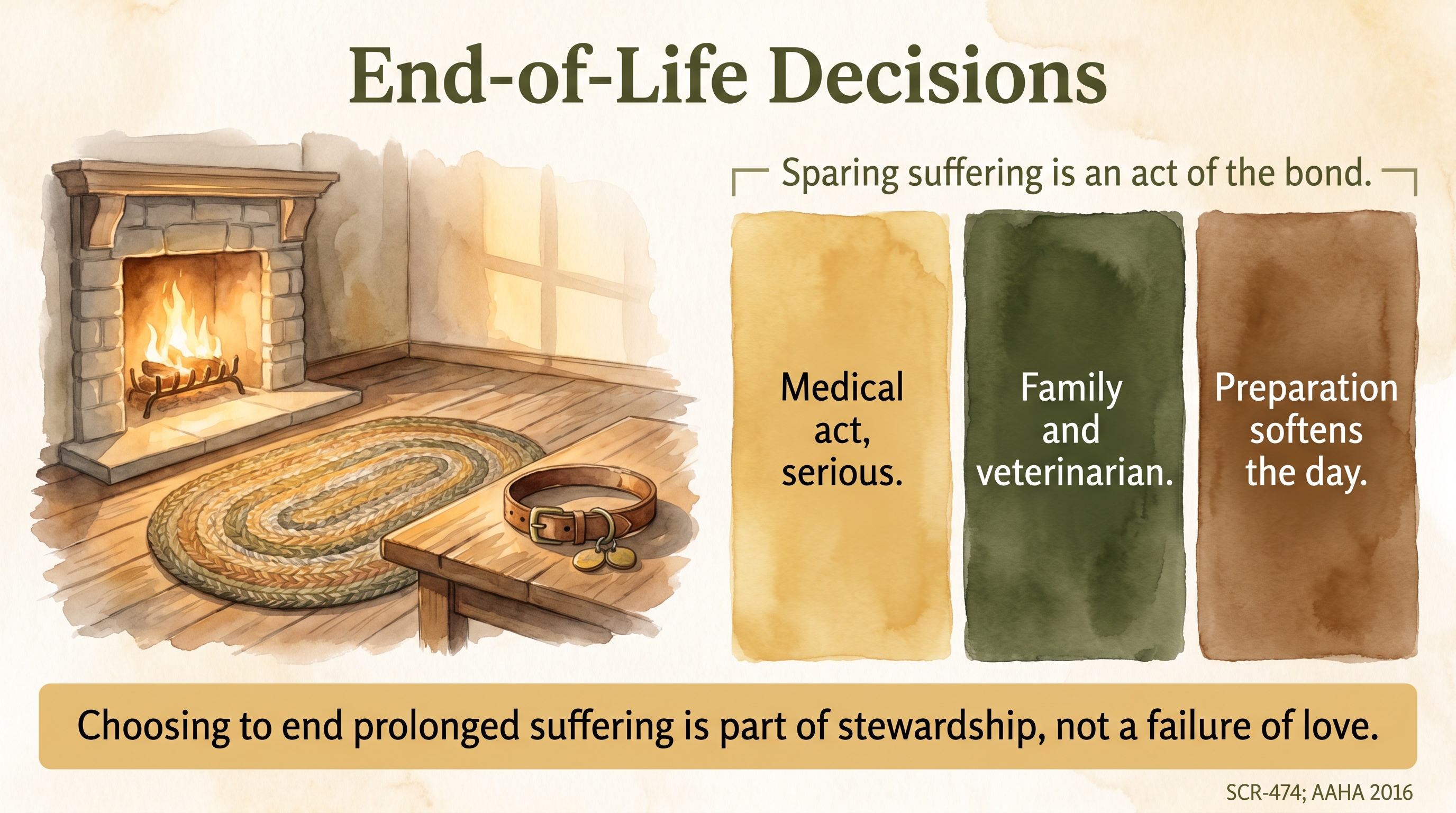
Choosing to end prolonged suffering is part of stewardship, not a failure of love.
Key Takeaways
- Veterinary euthanasia is a serious medical act intended to prevent or end suffering when quality of life can no longer be maintained acceptably.
- The decision is best made by the family and veterinarian together, because they hold different essential parts of the truth.
- Preparation can make the day gentler even when it cannot make the loss easier.
- Choosing to spare a dog prolonged suffering is not a failure of the bond but often one of its last expressions.
The Evidence
- veterinary euthanasia guidanceanimals and companion dogs
Euthanasia is an accepted medical intervention used to end suffering when quality of life has deteriorated beyond what can be maintained humanely. - senior and palliative-care guidancedogs
End-of-life decisions should be informed by prognosis, symptom burden, quality-of-life assessment, and family-veterinarian discussion rather than by crisis alone.
- JB breeder and family observationfamily dogs
The heaviest burden many families carry is the feeling of having to choose, and they are often helped most by being reminded that sparing suffering can be part of the relationship rather than a betrayal of it.
No published study directly tests the practical implications of end-of-life decisions for domestic dog raising programs. The application to household dog raising remains an interpretive synthesis rather than a directly tested intervention finding.
SCR References
Sources
- Villalobos, A. E. (2004). Quality-of-life assessment techniques for veterinarians. Veterinary Clinics of North America: Small Animal Practice, 34(2), 247-267.
- Brown, C. R., et al. (2017). Wellness recommendations for dogs and cats. AAHA Press.
- Goldmeier, A. M., et al. (2015). End-of-life perspectives: Oncology patients, families, and veterinarians. Veterinary Oncology, 3(2), 109-118.