Doorway Manners Without Commands
Doorways are tiny moments with outsized consequences. They appear all day long: front doors, gates, car doors, yard doors, office doors, bedroom doors, mudroom doors. A household that cannot move calmly through thresholds often ends up feeling noisy and slightly frantic even when nothing dramatic is happening. Most training systems solve that by teaching a specific stationary behavior at the threshold and then releasing the dog through on request. JB takes a different route. The dog learns doorway manners because the family moves through thresholds in a repeatable relational rhythm: the adult leads, the threshold belongs to the adult, and the dog follows through without making the doorway the center of the event. That is an observed JB household outcome rather than a separately trialed method. Observed-JB
What It Means
In the JB frame, a doorway is not a behavior prompt. Observed-JB It is a coordination point. The humans approach the door, open it, move through it, and the dog reads that movement as part of the household pattern. The dog waits not because a formal command freezes it in place, but because waiting has become the natural rhythm of moving with the adult. That often looks like the human arriving at the threshold calmly, the dog not rushing the opening, the human passing first, and the dog following at the human tempo.
Once again, the simplicity is the point.
Why Doorways Get Messy
Doorways usually become chaotic for very understandable reasons. They gather many of the things that raise dogs quickly: anticipation, novelty, outside access, social arrival, and transition energy. If the family also adds excitement, repeated verbal chatter, hurried movement, or accidental reinforcement for pushing ahead, the threshold becomes one more place where activation pays.
Then the humans feel they need a stronger and stronger control routine to get through the same ordinary door. Observed-JB
JB would rather keep the door ordinary.
The Relational Version
The relational version depends on repetition in real life. The dog sees, over and over, that thresholds belong to the adults. Doors do not open because the dog crowds them. Doors open because the adult decides the group is moving through. The dog flows through that sequence as part of being with the group.
This is why doorway manners connect so closely to structured leadership. Leadership here is not loud. It is positional. The adult's body is first. The adult's movement defines the pace. The dog does not need a lot of narration because the physical meaning of the moment is consistent.
What to Do When the Dog Rushes
Dogs, especially young dogs, will sometimes rush a threshold. JB does not treat that as moral failure. The question is how the adult responds. The quiet answer is usually enough: the adult stops, the door closes or stops opening, the body blocks forward success, and the sequence restarts in calmer form.
The dog learns that crowding the threshold does not move the group. Calm coordination moves the group.
No anger is needed, no physical punishment is justified, and no elaborate lecture is required. The door itself becomes part of the lesson because it does not open under pressure.
What This Is Not
This page is not saying formal threshold exercises are bad.
They can be useful, and for some dogs they may be very useful.
JB is simply drawing a distinction between:
- a commanded threshold routine that the dog performs when asked
- a relational threshold rhythm that the dog lives inside every day
The first can be excellent behavior management.
The second is more integrated into ordinary life.
JB prefers the integrated version because it does not depend on the humans remembering to switch into a special training mode every time they touch a doorknob.
This page is also not claiming that every threshold should be handled casually. A dog near a road, a dog with a history of bolting, or a dog in a high-risk environment may need management tools, barriers, or a lead. Observed-JB Safety stays upstream of philosophy.
Why It Matters for Your Dog
Thresholds are where many family conflicts begin: barging out the front door, rushing visitors, crowding children, exploding into the yard, and launching from the car.
When doorways become calm, a surprising amount of the house becomes calmer with them.
Doorway manners are one of the clearest ways a dog experiences adult-led movement in the home. The adult goes first, the threshold stays ordinary, and the dog learns to flow through space with the family instead of charging ahead of it.
There is also an emotional effect. Families stop feeling as though every transition must be micromanaged or won. The home starts to move more quietly. The dog begins to trust the group rhythm and does not need to invent one at every opening.
That is one reason threshold work belongs in a daily-rhythm dispatch. Doorway manners are not a trick. They are architecture.
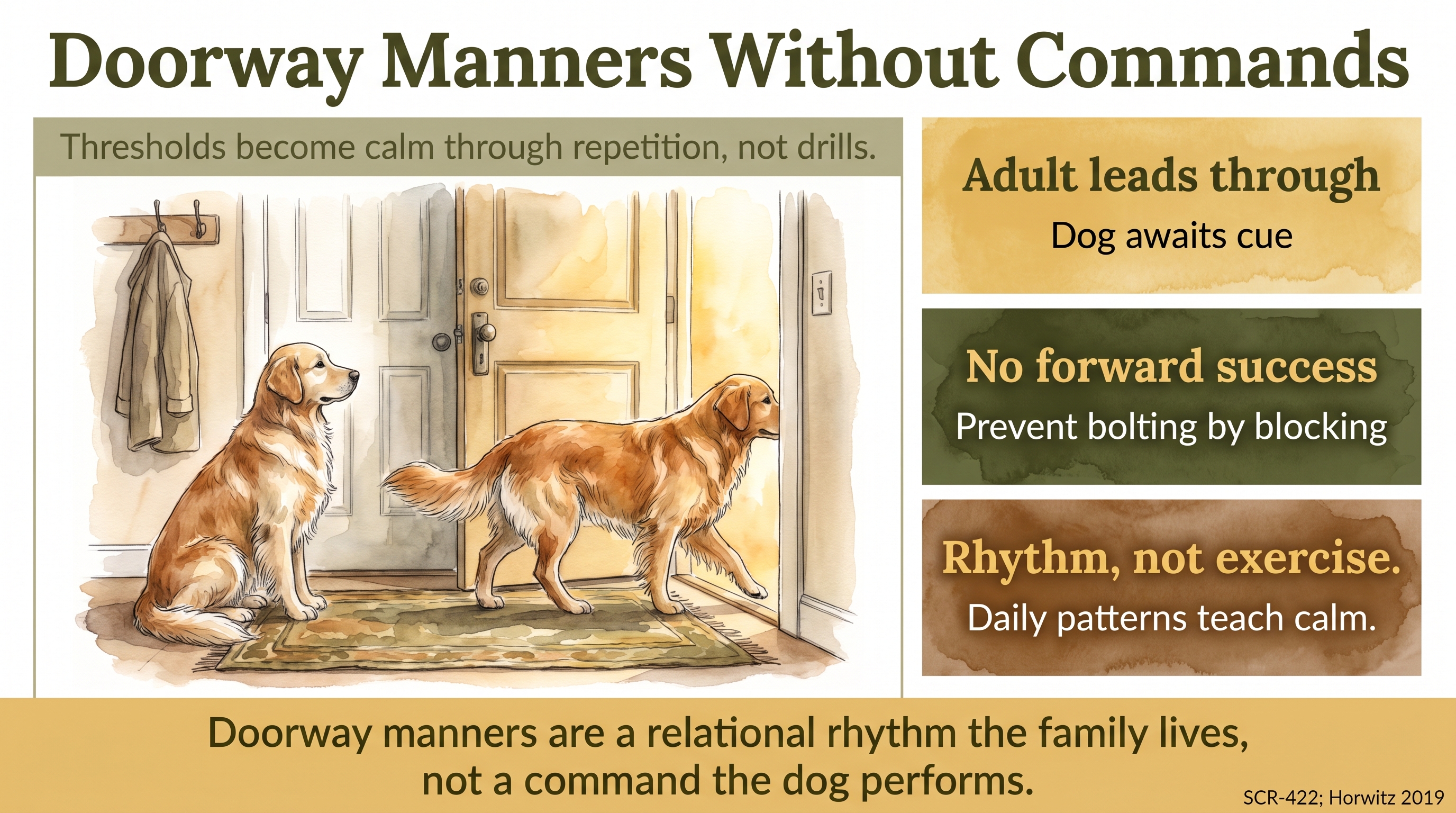
Doorway manners are a relational rhythm the family lives, not a command the dog performs.
Key Takeaways
- JB doorway manners are built as a repeatable family rhythm in which the adult leads through the threshold and the dog follows calmly.
- Crowding a doorway becomes less likely when it never produces forward success and when the threshold stays emotionally ordinary.
- Formal threshold exercises can work, but JB prefers a relational version that lives inside daily movement rather than in occasional special routines.
- The doorway-manners claim is primarily observational, supported by prevention and repetition logic rather than by a direct experimental comparison.
The Evidence
- JB breeder and family observationGolden Retrievers and family dogs
Dogs living in calm adult-led households often develop reliable threshold waiting through repetition of the same physical sequence rather than through a dedicated stationary routine at every doorway. - JB prevention observationfamily dogs
Threshold rushing is easiest to prevent when crowding never opens the door and calm following becomes the only successful pattern.
- Learning literaturedogs
Repeated successful outcomes strengthen behavior patterns, which supports the prevention claim that blocked rushing and successful calm following shape threshold behavior over time. - Predictability and routine literaturedogs
Stable daily patterns reduce uncertainty and make coordinated household movement easier for dogs to interpret.
- JB synthesishousehold thresholds
The claim that relational doorway rhythm is more durable than prompted doorway routines is an applied household philosophy rather than a directly compared canine trial.
No published study directly tests the practical implications of doorway manners without commands for domestic dog raising programs. The application to household dog raising remains an interpretive synthesis rather than a directly tested intervention finding.
SCR References
Sources
- Hiby, E. F., Rooney, N. J., & Bradshaw, J. W. S. (2004). Dog training methods: Their use, effectiveness and interaction with behaviour and welfare. Animal Welfare, 13(1), 63-69. https://doi.org/10.1017/S0962728600026683
- Bouton, M. E., & Todd, T. P. (2014). A fundamental role for context in instrumental learning and extinction. Behavioural Processes, 104, 13-19. https://doi.org/10.1016/j.beproc.2014.02.012
- Amat, M., Camps, T., Le Brech, S., & Manteca, X. (2014). Separation anxiety in dogs: The implications of predictability and contextual fear for behavioural treatment. Animal Welfare, 23(3), 263-266. https://doi.org/10.7120/09627286.23.3.263
- Just Behaving program observation disclosure. (2026). Boundary: this internal observation is limited to JB-raised Golden Retrievers whose families continued the JB framework after placement; cohort size, time window, and counting rule are deferred in this revision. Treat as program observation supporting the adult-led threshold-rhythm outcome claim, not as published external evidence.