Grief and the Family
The loss of a family dog is a real grief event. It should not need defending, but families often feel they have to defend it anyway because the surrounding culture can still minimize pet loss as though the bond were decorative. JB rejects that minimization. A dog who shared the household rhythm for years occupied real emotional, physical, and relational space in family life. When that dog is gone, the absence is not imaginary or disproportionate. It is the cost of a true bond. Observed-JB
Grief after the loss of a dog is not only sadness about an animal. It is grief about a routine, a witness, a source of touch, a presence in rooms, and a way the family organized part of daily life.
What It Means
Why the House Feels Different
Families often notice grief physically before they can describe it well.
The quiet feels wrong.
The kitchen feels wrong.
The walk time feels wrong.
The door no longer opens toward the same presence.
That is because the dog was woven into the house as rhythm, not just as affection. When the rhythm disappears, grief shows up in practical places. Documented
Families Grieve Differently
One of the kindest things people can remember is that there is no single correct shape of family grief.
Children may ask direct questions or seem briefly fine and then collapse later.
Adults may become weepy immediately or unexpectedly numb.
Partners often move at different paces.
Some people want to talk constantly. Some need silence first.
None of this proves more love or less love. It is simply how grief distributes itself through different nervous systems and roles in the family.
The Breeder Can Still Matter Here
This is one reason the lifelong breeder relationship matters. A breeder who knew the dog, knew the litter, and knew the family's arc can receive the grief without dismissing it. Families often want to send photos, tell stories, or simply say the dog's name to someone who understands why the loss feels so large. Observed-JB
That is not indulgence. It is part of how communal grief works in any real social structure. The relationship does not have to stop at the edge of the hardest day.
The Question of Another Dog
Sooner or later many families ask some version of the same question: when should we get another dog?
JB does not impose a timeline.
Another dog is not a replacement.
Waiting a long time is not a failure of openness.
Moving sooner is not proof the earlier dog meant less.
The healthier frame is to ask whether the family is ready to begin a new relationship for its own sake rather than trying to erase the pain of the last one. The breeder can help with that conversation when the family wants it, but the timing remains the family's.
Two Common Reactions JB Tries to Soften
One reaction is rushing immediately toward another puppy because the empty house feels unbearable.
The other is declaring that the family can never do this again because the grief feels too large.
Both reactions are understandable. Neither needs to become a permanent verdict in the first raw phase of loss. Observed-JB Time usually clarifies what shock initially shouts.
Family Note
If your house is very quiet right now, JB wants to say plainly that the quiet means something. It means the dog mattered. It means ordinary days were not ordinary after all. They were a life together. You do not need to apologize for missing the dog more than other people understand. The measure of the grief is not embarrassment. It is love with nowhere immediate to go.
What This Is Not
This page is not prescribing a grief timeline, it is not saying every family should get another dog, it is not saying every family should not get another dog, it is not reducing grief to a clinical checklist, and it is simply refusing to make the bond smaller now that the dog is gone.
Why It Matters for Your Dog
Grief matters because it tells the truth about the scale of the relationship. A family that built years of daily life around a dog cannot expect the loss to feel light. The answer is not to become less attached next time. The answer is to understand that attachment was the point.
The bond was never only useful while the dog was alive. The grief that follows is evidence that the dog really occupied the secure place the family gave it. That pain is not proof the bond was too much. It is proof the bond was real.
The family does not need to hurry out of that truth. It can live there for a while. In time, memory becomes less jagged. The house becomes possible again. The love does not go away. It changes form.
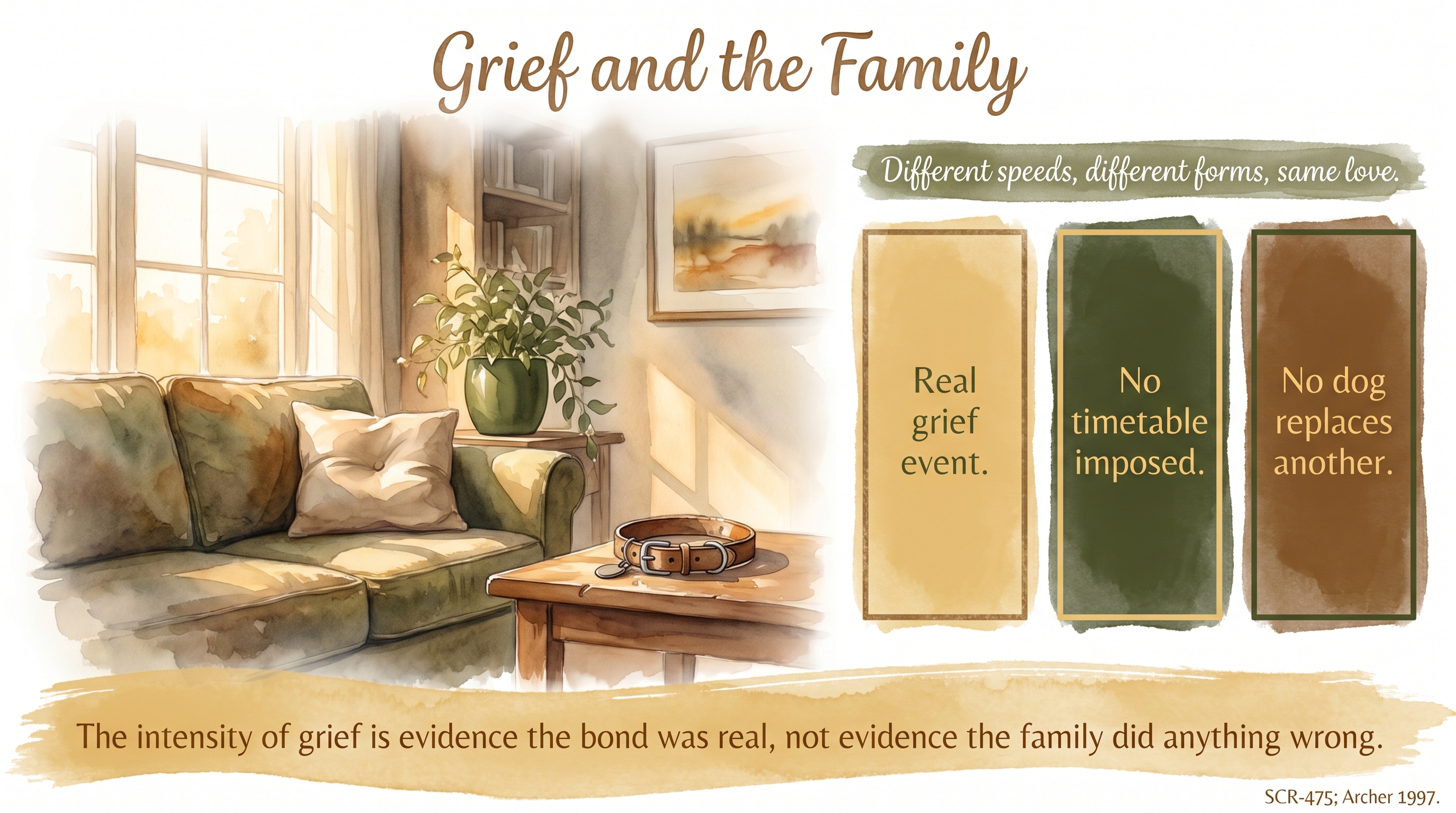
The intensity of grief is evidence the bond was real, not evidence the family did anything wrong.
Key Takeaways
- The loss of a family dog is a real grief event and should not be culturally minimized.
- Families grieve at different speeds and in different forms, and that variation does not measure love.
- Another dog is not a replacement, and JB does not impose a timetable for deciding about a future dog.
- The intensity of grief is evidence of the bonds reality, not evidence that the family loved wrongly.
The Evidence
This entry uses documented claim-level tags beyond the dedicated EvidenceBlocks below. These claims should remain tied to the entry Sources and SCR references during the next evidence-chain authoring pass.
- companion-animal bereavement literaturehumans grieving companion animals
The death of a companion animal can produce grief responses that are clinically and emotionally significant, especially when the bond was central to daily life.
- JB breeder and family observationfamily dogs
Families often grieve not only the dog but the disappearance of the daily rhythm that had quietly formed around the dog for years. - JB community practiceGolden Retriever families
The question of whether and when to welcome another dog is best handled thoughtfully rather than either rushed or permanently decided in the first acute wave of grief.
No published study directly tests the practical implications of grief and the family for domestic dog raising programs. The application to household dog raising remains an interpretive synthesis rather than a directly tested intervention finding.
SCR References
Sources
- Uccheddu, S., Ronconi, L., Albertini, M., Coren, S., Hotzel, M. J., & Pirrone, F. (2022). Domestic dogs (Canis familiaris) grieve over the loss of a conspecific. Scientific Reports, 12, 1920. https://doi.org/10.1038/s41598-022-05669-y
- Lykins, A. D., McGreevy, P. D., Bennett, B., Paul, N. K., & Gotsis, N. (2023). Attachment styles, continuing bonds, and grief following companion animal death. Death Studies. https://doi.org/10.1080/07481187.2023.2265868
- Just Behaving program observation disclosure. (2026). Boundary: this internal observation is limited to JB-raised Golden Retrievers whose families continued the JB framework after placement; cohort size, time window, and counting rule are deferred in this revision. Treat as program observation supporting grief-stage guidance for JB program families, not as published external evidence.