Greeting People at the Door
If you want to know whether a household is truly calm, watch what happens when the doorbell rings. That moment reveals everything. In many homes, visitor arrival is the highest-arousal event of the day. The dog runs, leaps, vocalizes, crashes into the entryway, and rehearses a greeting style that later becomes embarrassing, physically difficult, or simply exhausting. JB treats visitor arrival differently from the start. The humans greet first. The dog joins only from calm. The arrival is not suppressed, but it is deliberately stripped of the emotional charge that makes greeting circuits self-build for years. That is a strongly observed JB prevention claim rather than a formal experimental protocol. Observed-JB
What It Means
Greeting people at the door begins before anyone knocks. It begins in the family's decision about what visitor arrival means in the house. In the JB household, visitor arrival means the humans move to the door at an ordinary pace, the dog is not invited to detonate into the entryway, the visitor enters the house as part of the household rhythm, and the dog meets the visitor only once the dog's body is soft enough to do so. Observed-JB This does not mean the dog is excluded from social life. It means social life is organized so that arousal does not become the price of participation.
Why This Circuit Builds So Fast
Excited greetings are one of the easiest behavior loops for humans to create by accident because they feel emotionally satisfying on both sides. The visitor feels adored. The family feels proud that the dog is friendly. The dog experiences contact, touch, eye contact, speech, and motion all at once.
That is a powerful cocktail.
If it happens repeatedly from puppyhood, the dog does not merely get excited when visitors arrive. Observed-JB The dog learns that visitor arrival itself is supposed to be an activation event.
By age three, the family says the dog has always greeted this way.
Usually that is true.
Usually the dog has practiced it hundreds or thousands of times.
What the JB Version Looks Like
The household stays calm when the bell rings.
The handler moves to the door without urgency.
If the dog follows, it follows in a calm body. If the dog rushes, the dog is quietly redirected away from the threshold, blocked by body position, or allowed to wait a few steps back while the humans handle the entry first.
The visitor is coached in advance if needed to please come in quietly, please not reach for the dog right away, and please ignore the dog for the first minute.
That one minute often changes everything. A dog that is not instantly fed social excitement usually begins to downshift. The dog realizes the visitor is not an explosion. The visitor is simply now inside the house.
Only then does greeting happen, if greeting is needed at all.
What About Dogs That Already Jump
Many families are not starting from zero. The greeting circuit may already be built. JB still does not recommend making the doorway louder in response. The more helpful tools are subtle: body blocking, stepping between dog and visitor, turning away from the jumping, removing social access briefly, and guiding the dog back into space and calm.
This is where indirect correction matters. The dog is being shown that explosive entry into the social space does not open the social space. Calm does.
The correction is informational, not punitive.
What This Is Not
A calmly greeting dog is not an unfriendly dog.
This point matters because many families fear that reducing greeting excitement will make the dog colder or less affectionate. In reality, the opposite is usually true. A dog that greets calmly can still be very warm, very social, and very bonded. The difference is that the dog is not losing regulation at the door.
This page is also not arguing that every dog must greet every visitor. Some dogs simply do better when the visitor becomes background. A polite pass-by, a brief sniff later, or no special interaction at all can be entirely healthy.
The deeper principle is not "make the dog love strangers less."
It is "stop teaching the dog that strangers entering the home are emergencies."
Why It Matters for Your Dog
Visitor arrival is one of the clearest places where prevention pays out over years. A dog that does not build the jumping-and-hyping circuit in puppyhood is far less likely to be a fifty-five-pound or seventy-pound adult crashing into guests later.
There is also a welfare angle. Dogs that become extremely activated by every arrival often spend much of life anticipating and recovering from social spikes. When greetings are made ordinary, the dog can stay softer through the whole event.
The easiest jumping problem to solve is the one the family never starts. When visitors are asked to ignore the dog briefly and the handler quietly blocks explosive greetings, calm becomes the route into social contact.
This change also helps humans. Observed-JB Families stop dreading packages, relatives, children's friends, and everyday comings and goings. The front door becomes what it should have been all along: an entrance, not a detonator.
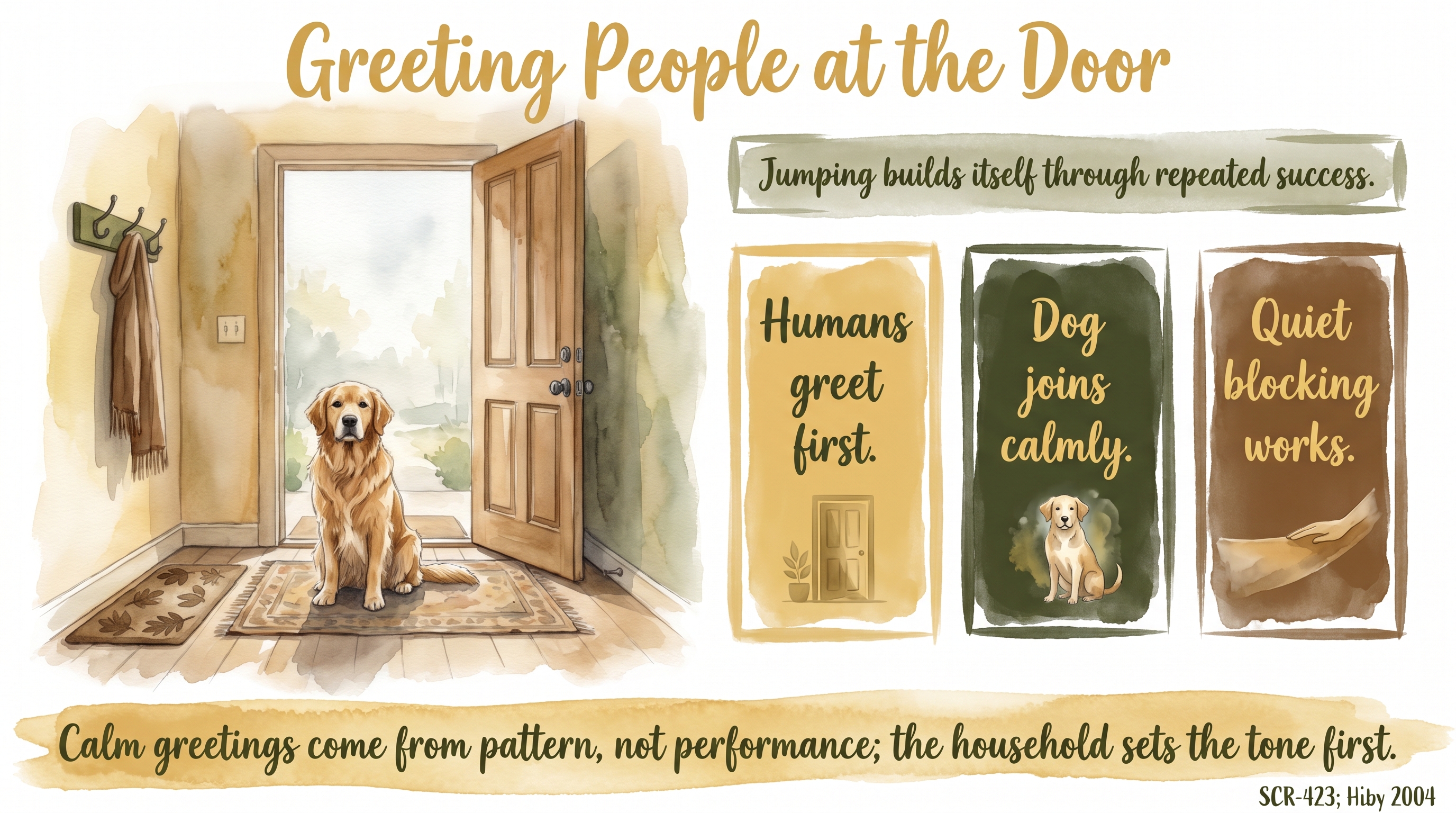
Calm greetings come from pattern, not performance; the household sets the tone first.
Key Takeaways
- Visitor greetings stay calmer when the humans greet first, the dog joins only from regulation, and visitors ignore the dog briefly at entry.
- Jumping and explosive greetings often build themselves through repetition because the social payoff is intense and immediate.
- Indirect correction works best here as quiet blocking and removal of social access, not as punishment.
- The strongest JB greeting claim is observational, supported by owner-state and arousal research rather than by a formal visitor-arrival trial.
The Evidence
- JB breeder and family observationGolden Retrievers and family dogs
Dogs whose visitors ignore them briefly and whose handlers block jumping without drama tend to settle into calmer greeting patterns than dogs whose arrivals are repeatedly celebrated. - JB prevention observationfamily dogs
Excited greeting circuits are highly self-building because each successful jump or rush is paired with intense social contact and repetition.
- Owner-behavior literaturedogs
Handler behavior and emotional tone alter canine arousal and behavior outcomes, which supports the claim that how the humans receive visitors matters to the dogs response. - Arousal-regulation literaturedogs
Repeated activation around predictable contexts can become stable behavior patterns, especially when the context keeps producing intense social payoff.
- JB synthesishousehold greetings
The claim that ordinary visitor handling yields the most durable family-dog greeting style is an applied prevention framework rather than a directly compared controlled trial.
No published study directly tests the practical implications of greeting people at the door for domestic dog raising programs. The application to household dog raising remains an interpretive synthesis rather than a directly tested intervention finding.
SCR References
Sources
- Sundman, A.-S., Van Poucke, E., Svensson Holm, A.-C., Faresjo, A., Theodorsson, E., Jensen, P., & Roth, L. S. V. (2019). Long-term stress levels are synchronized in dogs and their owners. Scientific Reports, 9, 7391. https://doi.org/10.1038/s41598-019-43851-x
- Schork, I. G., Manzo, I. A., De Oliveira, M. R. B., da Costa, F. V., Palme, R., Young, R. J., & de Azevedo, C. S. (2022). How environmental conditions affect sleep? An investigation in domestic dogs (Canis lupus familiaris). Behavioural Processes, 199, Article 104662. https://doi.org/10.1016/j.beproc.2022.104662
- Hiby, E. F., Rooney, N. J., & Bradshaw, J. W. S. (2004). Dog training methods: Their use, effectiveness and interaction with behaviour and welfare. Animal Welfare, 13(1), 63-69. https://doi.org/10.1017/S0962728600026683
- Just Behaving program observation disclosure. (2026). Boundary: this internal observation is limited to JB-raised Golden Retrievers whose families continued the JB framework after placement; cohort size, time window, and counting rule are deferred in this revision. Treat as program observation supporting calm greeting practice at the door, not as published external evidence.