Greeting Other Dogs on Walks
One of the most counterintuitive JB positions is that most dogs on walks do not need to greet most other dogs. Many families have been taught the opposite. They assume a sociable dog should say hello often, and they worry that calmly passing another dog is somehow withholding an important experience. JB sees it differently. On-leash greetings are constrained, narrow, and often much more artificial than people realize. Two dogs are funneled into close proximity while attached to humans, unable to widen distance, arc naturally, or leave cleanly if the interaction feels wrong. Under those conditions, a brief calm greeting can be fine, but the assumption that every walk should include several dog-to-dog introductions is neither necessary nor especially aligned with how stable adult dogs prefer to move through the world. That is a strongly observed practice claim built on canine communication logic rather than on a direct experimental program comparing greeting frequency outcomes. Observed-JB
What It Means
The JB default on walks is simple: most of the time, we pass. Passing is not failure, passing is not deprivation, and passing is the normal mature social act of two dogs continuing on with their own groups unless there is a good reason to interact.
That stance can feel almost rude to humans because humans often imagine dogs as permanently eager to meet all available conspecifics. Observed-JB Stable dogs are usually more selective than that fantasy allows.
Why On-Leash Greetings Are Different from Free Social Contact
In more open canine interactions, dogs use distance, curved approaches, pausing, scent acquisition, head turns, ground sniffing, and exit options to negotiate social space. Observed-JB Leashes shrink many of those choices. Humans also bring tension into the line, emotional anticipation into the body, and hope or anxiety into the moment. The result is an interaction that may look friendly on the surface while actually being quite narrow in communicative options. This is one reason greetings can go wrong so quickly: one dog cannot widen space, one handler shortens the leash, the dogs are brought nose-first together, and arousal rises before enough information has been exchanged.
JB prefers to treat dog greetings with more respect than that. Observed-JB
What the JB Alternative Looks Like
A calm handler notices the other dog, checks the state of their own dog, and makes an ordinary decision. Usually the pair continues moving. If both dogs are visibly soft, both handlers are comfortable, and there is space for a brief loose interaction, then greeting can happen. If any of those pieces are missing, the walk keeps its rhythm and passes by.
That changes what the dog learns. The dog learns the walk is with the handler, other dogs exist without needing to become events, not every dog is available, and calm passing is normal social life. This is often a relief to the dog as well as to the human.
Socialization Is Not Greeting Quantity
Many families carry a lingering fear from puppyhood that if the dog does not greet enough other dogs, something social will be missed forever. That fear comes from a very thin understanding of socialization.
Socialization is not the same as greeting quantity.
It is about exposure quality inside sensitive developmental windows. It is about the dog learning what the world is, not about collecting interactions the way a child collects stickers. Much of the truly foundational dog-social exposure should already have been shaped earlier, by the breeder, by litter life, and by thoughtful early transitions.
The adult family dog walking down the street does not need to prove sociability to itself over and over.
Why It Matters for Your Dog
Dogs that learn every walk might contain multiple greetings often start scanning for them. Other dogs become the point of the outing. The handler becomes transportation between opportunities. That shift alone can create pulling, fixation, frustration, and disappointment.
Dogs that learn calm passing instead often become more settled because the social expectations of the walk stay lighter.
Stable dogs do not make every social encounter larger than it needs to be. Calm passing is often a more precise and more mature signal than forced sociability on a tight line.
This matters especially for Goldens because their general sociability can tempt families to over-socialize the wrong way. A friendly dog does not need endless narrow greetings. In fact, friendliness often stays cleaner when it is not constantly rehearsed under artificial conditions.
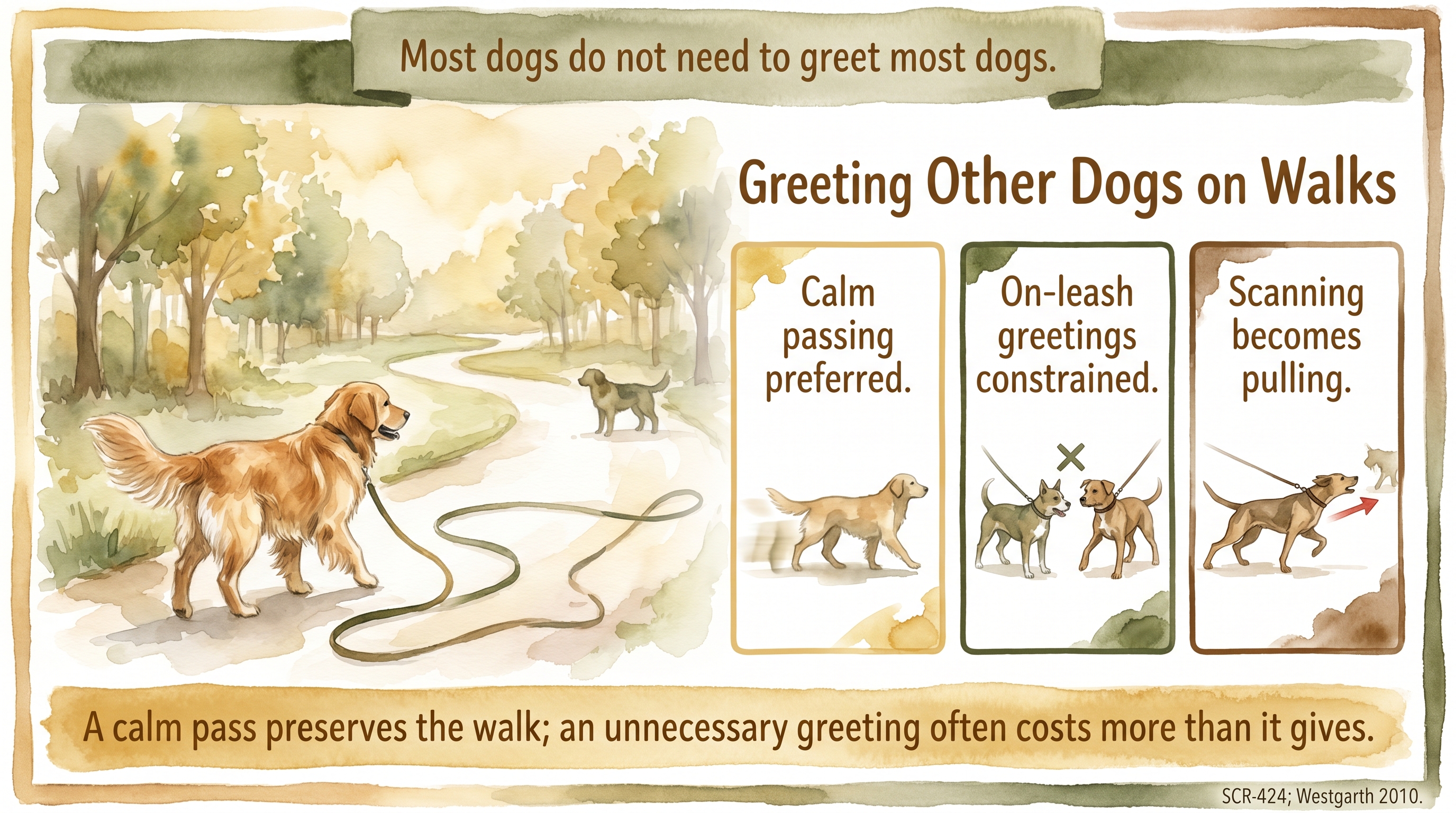
A calm pass preserves the walk; an unnecessary greeting often costs more than it gives.
Key Takeaways
- Most dogs on walks do not need to greet most other dogs, and calm passing is often the more mature social default.
- On-leash greetings are more constrained than many families realize because dogs lose distance, arc, and exit options that matter in natural social exchange.
- Dogs who expect frequent greetings often start scanning and pulling for them, which can quietly degrade the quality of the walk.
- The JB claim is observational and communication-based, with strong canine body-language support but no direct greeting-frequency trial.
The Evidence
- Canine communication literaturedogs
Dogs rely heavily on distance management, curved approaches, pausing, and subtle social signals during interaction, many of which are constrained on leash. - Body-language literaturedogs
Leash tension and narrowed movement options can change the quality of dog-dog social exchange and increase the chance of misunderstanding.
- JB breeder and family observationGolden Retrievers and family dogs
Dogs who mostly pass other dogs calmly tend to carry less scanning and frustration into everyday walks than dogs who expect frequent greetings. - JB observationfamily walks
When greetings are reserved for clearly calm moments with mutual handler consent, the walk retains more of its low-arousal relational character.
- JB synthesiscompanion-dog walking life
The claim that most adult family dogs do better with selective greeting than with routine on-leash sociability is a practical interpretation of canine communication science and breeder experience rather than a direct randomized trial.
No published study directly tests the practical implications of greeting other dogs on walks for domestic dog raising programs. The application to household dog raising remains an interpretive synthesis rather than a directly tested intervention finding.
SCR References
Sources
- Hiby, E. F., Rooney, N. J., & Bradshaw, J. W. S. (2004). Dog training methods: Their use, effectiveness and interaction with behaviour and welfare. Animal Welfare, 13(1), 63-69. https://doi.org/10.1017/S0962728600026683
- Ziv, G. (2017). The effects of using aversive training methods in dogs: A review. Journal of Veterinary Behavior, 19, 50-60. https://doi.org/10.1016/j.jveb.2017.02.004
- Horowitz, A. (2009). Attention to attention in domestic dog dyadic play. Animal Cognition, 12(1), 107-118. https://doi.org/10.1007/s10071-008-0175-y
- Bradshaw, J. W. S., Pullen, A. J., & Rooney, N. J. (2015). Why do adult dogs play? Behavioural Processes, 110, 82-87. https://doi.org/10.1016/j.beproc.2014.09.023