Dental Care at Home
At-home dental care is one of the most important health routines families can adopt and one of the most commonly skipped. That matters because periodontal disease is among the most widespread chronic problems in adult dogs, and much of it is slowed or prevented by ordinary consistent home care. The medical side of that statement is well documented. The JB contribution is not a new dental claim. It is the insistence that toothbrushing becomes realistic only when mouth handling is built calmly from puppyhood onward. In that sense, dental care is where preventive medicine and relationship handling meet directly. Documented
What It Means
The gold standard for home care is still simple mechanical plaque disruption through daily or near-daily toothbrushing with dog-safe toothpaste. Everything else sits below that, including accepted dental chews, some dental diets, and selected adjunctive products. These are helpful, yes, but equal to brushing, no.
Why Home Care Matters So Much
Dental disease builds quietly. Dogs continue eating and behaving fairly normally while inflammation, tartar, and gum disease advance. Documented Families therefore underestimate the issue until odor, visible tartar, or pain is already obvious.
By then, the mouth is asking for more repair than prevention.
Home care changes that timeline. It keeps the ordinary bacterial load lower and makes the mouth a part of routine stewardship rather than a once-a-year surprise.
How JB Frames Toothbrushing
JB treats toothbrushing the same way it treats coat care, nails, and ears: as calm handling built in small passes. The dog does not have to wake up one day and suddenly accept a full meticulous dental routine. The progression can start with a finger near the lips, move to calm touch around the muzzle, include a brief look at the teeth, involve a tiny wipe or brush stroke, and stop while the dog is still comfortable. Documented
This is why puppyhood matters so much. A dog who has learned that human hands can move around the mouth without struggle is much easier to keep healthy for life. Documented
The Limits of Chews and Bones
Families often hope chewing alone will solve dentistry. Chews can help somewhat. Some accepted dental products have evidence behind them. But most chew-based help is still secondary to brushing.
Raw recreational bones are the most contested area. Some families report benefit. Veterinary sources also note fracture and injury risk. That means bones do not belong in the category of universal dental advice.
Professional Dentistry Still Matters
Home care does not eliminate the need for veterinary attention. Many dogs still need periodic professional evaluation and, over time, anesthesia-based dental cleaning. That is not failure. It is part of honest lifetime care.
The real goal of home care is not perfection.
It is less disease, less pain, and less need for aggressive intervention than would otherwise occur.
Why It Matters for Your Dog
The dog benefits medically, of course, but the family benefits too. A dog with an easy mouth-handling history is easier to inspect, easier to brush, easier to medicate when necessary, and easier to examine in the clinic.
Dental care is a perfect example of the Prevention pillar. The family does a small amount of ordinary work repeatedly so that a major chronic problem has less room to build quietly in the background.
There is also something reassuring here for families who worry that JB means less medicine or less structure. It does not. JB is fully compatible with rigorous preventive health. It simply wants that rigor carried out inside a calm relationship.
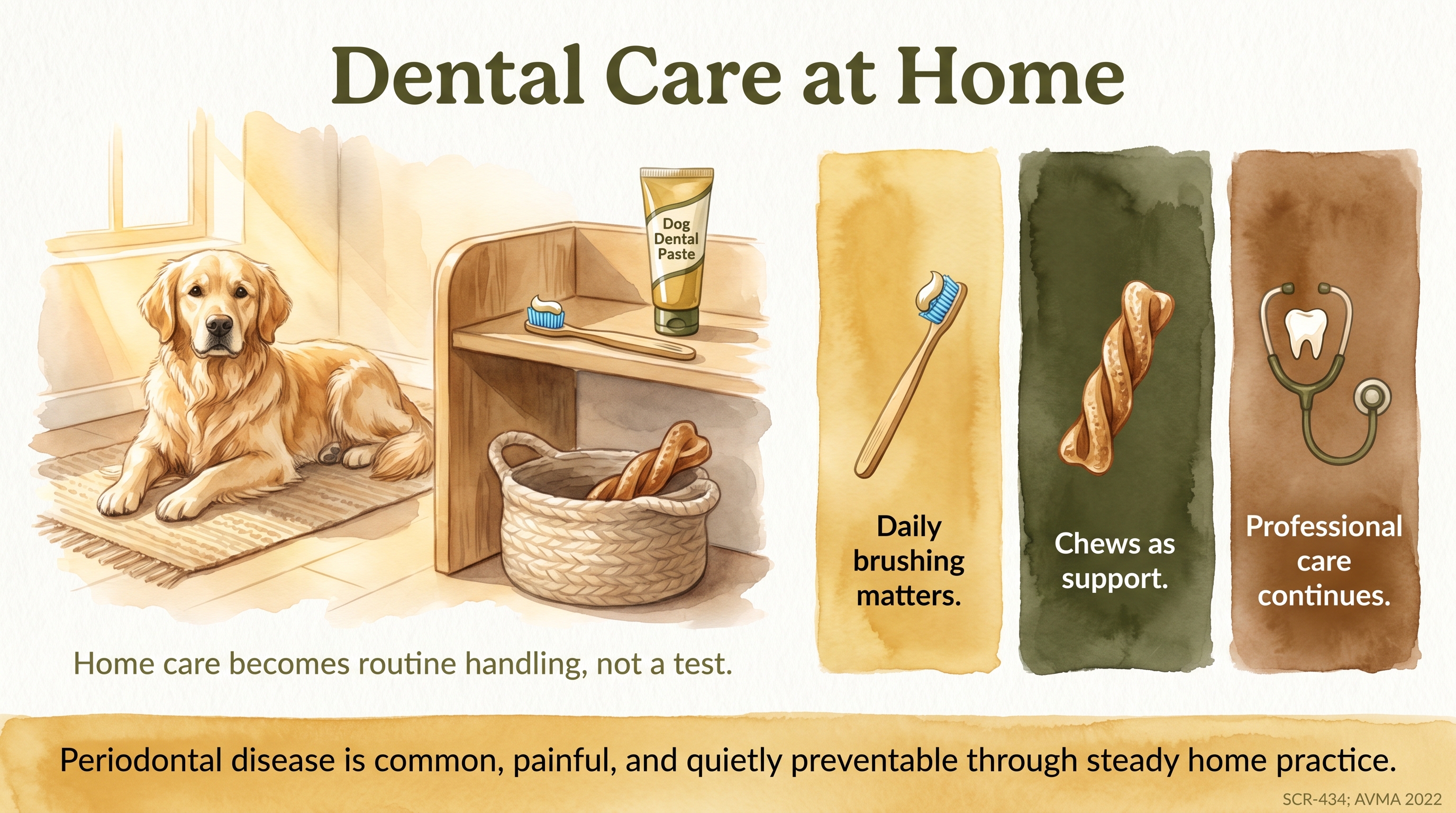
Periodontal disease is common, painful, and quietly preventable through steady home practice.
Key Takeaways
- Home dental care matters because periodontal disease is common, painful, and easier to prevent than to repair.
- Daily or near-daily toothbrushing remains the gold-standard home tool, with chews and adjuncts helping but not replacing it.
- JB adds a handling principle rather than a new medical claim: brushing becomes realistic when mouth handling is built calmly from puppyhood.
- Professional veterinary dental evaluation still matters even in homes with good brushing habits.
The Evidence
- Veterinary dental consensusdogs
Periodontal disease is one of the most common chronic conditions in dogs, and regular home plaque control is a key preventive measure. - Clinical home-care guidancedogs
Toothbrushing remains the gold-standard home intervention, with chews and other adjuncts helpful but secondary. - Professional dental-care standardsdogs
Veterinary dental evaluation and anesthesia-based cleaning remain important because disease below the gumline cannot be managed fully by cosmetic surface care.
- JB breeder and family observationfamily dogs
Dogs introduced to mouth handling in small calm steps tend to tolerate home dental care more readily than dogs first approached only after tartar or resistance is already established.
No published study directly tests the practical implications of dental care at home for domestic dog raising programs. The application to household dog raising remains an interpretive synthesis rather than a directly tested intervention finding.
SCR References
Sources
- Niemiec, B. A. (2012). Periodontal disease. Topics in Companion Animal Medicine, 24(2), 72-80.
- Delaire, C., et al. (2009). Prevalence of plaque and gingivitis in dogs. Journal of Veterinary Dentistry, 26(2), 89-96.
- Lund, E. M., et al. (1999). Dental disease in dogs. Veterinary Medicine, 94(8), 756-766.