Bite Inhibition Development
Compound evidence detail1 SCR / 3 parts
- Observed-JBJB program-observed outcome that human-directed bite inhibition develops in puppies raised without mouth play protocols
- Heuristicthe program-wide interpretation that conspecific calibration combined with consistent human boundaries is sufficient to produce that outcome
- Documentedthe maternal and conspecific calibration pathway, supported by Pierantoni 2011 evidence on early-separation effects on bite-related behaviors
Bite inhibition is the developmental process by which a puppy learns to regulate the force of mouth contact. The basic pattern is widely familiar: puppies begin with poor calibration, social feedback gradually sharpens pressure control, and the dam and littermates appear to provide most of the earliest tuning. The literature supports that broad picture, but it is much thinner than popular dog culture often implies, especially when people start presenting one exact household protocol as scientifically mandatory. Observed-JB
What It Means
What the Puppy Is Learning
Bite inhibition is not the same as "never putting teeth on anything." It is first a calibration process. The puppy learns that not all contact is equal and that too much force changes what happens next.
In natural puppy social life, that feedback likely comes through littermate play stopping or changing after hard contact, dam interruption or tolerance withdrawal, and reduced access to continued social interaction after excessive force. Observed-JB
That is why bite inhibition is better understood as a social-development problem than as a late obedience drill.
What the Evidence Best Supports
SCR-030 is the key entry here because it makes two important moves at once. First, it supports the claim that bite-pressure calibration is naturally shaped through maternal and conspecific interaction. Second, it pushes back on the popular training claim that structured human mouth-play protocols are biologically necessary for bite inhibition. Observed-JB
The Pierantoni data inside that SCR are especially relevant. Puppies separated from mother and littermates around thirty to forty days showed higher later behavioral problems, including play biting, than puppies separated at the more standard sixty days. That does not prove one complete mechanism, but it does support the idea that early conspecific context matters.
Why It Matters for Your Dog
What Human Families Often Misunderstand
The most common misunderstanding is to treat human-directed mouthing practice as though it were the documented natural route by which puppies learn bite control. Observed-JB The evidence does not support that strong claim.
What it supports more clearly is that puppies benefit from natural early calibration with dam and litter; that human boundaries still matter once the puppy joins the family; and that allowing unlimited human-directed mouth play is not the only scientific path to adult control. Observed-JB
This is why the prevention framing appears here. A puppy may learn soft-mouth control socially without the family needing to intentionally rehearse hard-on-human mouthing as a developmental exercise. Observed-JB
The Main Uncertainty
The uncertainty is not whether puppies learn calibration socially. They clearly do. The uncertainty is how far the literature lets us go when we talk about long-term outcomes after variations in litter duration, breeder practice, or later human handling.
The evidence base is still modest, and much of the surrounding dog-culture advice is more clinical folklore and trainer doctrine than controlled experimentation. That is why this page stays at an observed ceiling rather than pretending the science is cleaner than it is.
The bite-inhibition literature supports a narrower point than many people expect: natural early social calibration matters, and there is no documented necessity for deliberately rehearsing human-directed mouthing as a formal protocol.
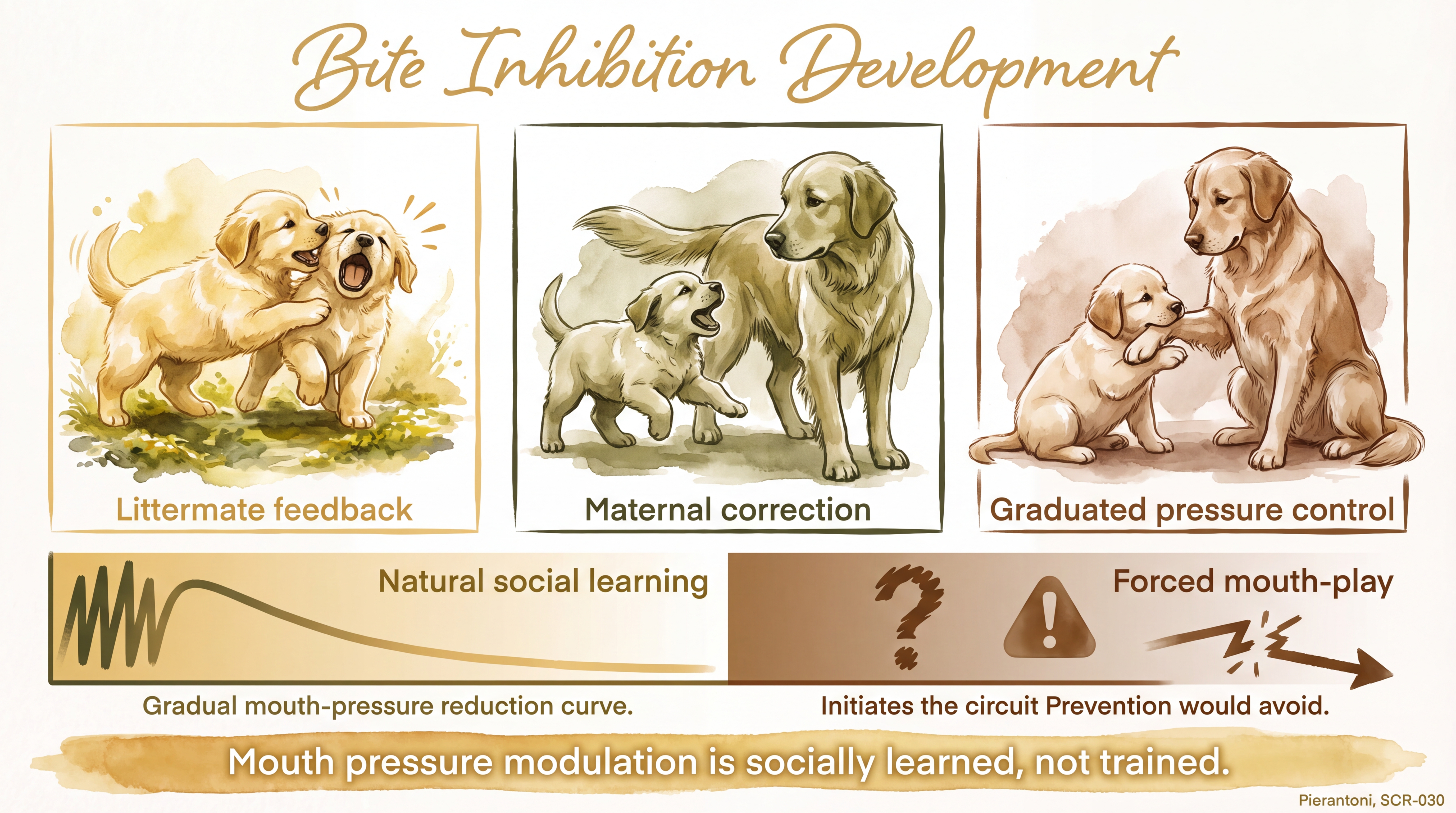
Mouth pressure modulation is socially learned through natural feedback, not trained through forced exercises.
Key Takeaways
- Bite inhibition begins as a social calibration process, not as a late obedience exercise.
- The best support still points to dam and littermate interaction as the earliest natural tuning system.
- The literature does not show that formal human mouth-play protocols are biologically necessary for bite inhibition.
- The evidence base is real but modest, so strong claims about one perfect household method should be treated cautiously.
The Evidence
This entry uses observed claim-level tags beyond the dedicated EvidenceBlocks below. These tags mark JB program observation or practice-derived claims that need dedicated EvidenceBlock coverage in a later content pass.
- Pierantoni, L. et al. (2011)domestic dogs
Earlier separation from mother and littermates was associated with higher incidence of later behavioral problems including play biting, supporting the role of early conspecific calibration. - Bray, E. E. et al. and retriever puppy social-cognition work summarized in SCR-051retriever puppies
Young puppies are already highly responsive to social information, supporting the broader developmental plausibility of early socially mediated calibration.
- Feuerbacher, E., & Wynne, C. (2015)domestic dogs
Physical contact retained stronger reinforcement value than verbal praise alone, which loses functional value across repetition. This matters because many human bite-inhibition scripts rely heavily on praise and verbal theatrics without clear evidence that those elements are the core calibration mechanism.
- domestic dogs
No published study directly tracks how early dam and littermate feedback shape bite-inhibition development across breeder and family settings in domestic dogs.
SCR References
Sources
- Bray, E. E., Gnanadesikan, G. E., Horschler, D. J., Levy, K. M., Kennedy, B. S., Famula, T. R., & MacLean, E. L. (2021). Early-emerging and highly heritable sensitivity to human communication in dogs. Current Biology, 31(14), 3132-3136.e5. DOI: 10.1016/j.cub.2021.04.055.
- Feuerbacher, E. N., & Wynne, C. D. L. (2015). Shut up and pet me! Domestic dogs (Canis lupus familiaris) prefer petting to vocal praise in concurrent and single-alternative choice procedures. Behavioural Processes, 110, 47-59. DOI: 10.1016/j.beproc.2014.08.019.
- Pierantoni, L., Albertini, M., & Pirrone, F. (2011). Prevalence of owner-reported behaviours in dogs separated from the litter at two different ages. Veterinary Record, 169(18), 468. DOI: 10.1136/vr.d4967.