Are Golden Retrievers prone to cancer?
Compound evidence detail1 SCR / 2 parts
- Ambiguousany single percentage figure presented as a universal Golden Retriever cancer constant without naming the population, study design, or referral basis
- Documentedthe necropsy and referral cohort findings themselves; cancer as a leading cause of death in Golden Retrievers with honest sourcing and explicit dataset attribution
Yes. Cancer is a major cause of death in Golden Retrievers, and some Goldens die of it young. But that doesn’t mean a Golden is likely to have a short life. Documented
What It Means
How can cancer be common if Goldens live a long time?
What dogs die of and how long they live are two different questions. In an older North American veterinary teaching-hospital study, cancer accounted for about half of recorded Golden Retriever deaths. It was also a leading cause of death for Bernese Mountain Dogs and Boxers in the same records. Those figures tell you what dogs in that study died of. They don’t tell you the odds that a puppy will develop cancer or how old that dog will be if it does. Documented North American mortality study
A separate UC Davis study attributed 424 of 652 deaths (65%) to cancer among Golden Retrievers examined after death at its veterinary teaching hospital. Fleming used records from multiple teaching hospitals. The studies counted different groups of dogs, so neither figure tells you the odds for your puppy. Documented Kent study
In a separate 2024 UK study, the estimated median lifespan was 13.2 years for Golden Retrievers and 11.9 years for large purebred dogs as a group. Those figures describe dogs in that UK study, not what to expect from a particular puppy. A breed can have a relatively long median lifespan and still lose some dogs to cancer early. Both things can be true. Documented UK longevity study · Breed-by-breed results
For more on why different studies report different results, see Cancer Epidemiology in Golden Retrievers and Golden Retriever Lifespan and Longevity.
Why It Matters for Your Dog
Can you tell if one litter has lower cancer risk?
Usually, no. You’ll hear about the grandmother who lived to 15. You’re less likely to hear about the dogs that died young, and a breeder may not have heard about them either. Even a complete account of one litter can’t tell you whether those outcomes are typical.
To put a program’s longevity claim in context, you’d need to know which dogs were counted, how long they were followed and how many the breeder lost track of. That means following whole groups over years, including the dogs that died young and the ones still living. That’s a lot to expect from an individual breeder. Breeding decisions matter, but a few family stories don’t give you a reliable way to compare litters for cancer risk.
The Golden Retriever Lifetime Study shows what that kind of follow-up takes. Morris Animal Foundation enrolled 3,044 young Goldens and designed the study to follow them through life. It can help researchers identify factors linked to cancer, but it wasn’t designed to tell you whether one litter has lower risk than another. Documented Study profile
HeuristicWhat that means for your decision
If you’re deciding whether to bring one home, take cancer seriously and look at the overall health picture of the breeds you’re considering. Goldens aren’t the only dogs that get cancer, and other breeds have health risks of their own.
Use the breed research as a starting point. Goldens can live long lives, and some die of cancer young. If a Golden is otherwise right for your family, weigh that risk as part of choosing the breed. Don’t assume you can shop it away. Heuristic
I wish I had a better answer for families on this one. When you’re picking out a puppy, of course you want to know if there’s something you can do now to spare that dog from cancer later. I’ve looked for an answer to that question. I haven’t found a study, a certification, a genetic test, or records from a breeding program that show me a reliable way to prevent cancer in a Golden Retriever or in any other breed.
That doesn’t mean breeding decisions don’t matter or that the research isn’t worth doing. A study can tell us something about a particular cancer. A test can tell us something about what it was designed to measure. But when a family asks me, “Will this pairing make my puppy less likely to get cancer?” I can’t get to an honest yes from those things alone. I can tell you an older relative lived to 15, and that may be true. It still doesn’t tell you what happened to all the dogs no one mentions, or what will happen to yours.
I raise Goldens, so I have as much reason as anyone to wish there were a clearer answer. But I’d rather you choose a Golden knowing what comes with the breed than choose one because I made the risk sound like something I’d already solved. A Golden can live a long life. Some die of cancer young. Both belong in the answer I give you before you bring a puppy home. Documented
For other things you can ask about or observe when choosing a breeder, see our family question-set for evaluating a Golden Retriever breeder.
When to See a Veterinarian
If you’re worried about a change you’ve noticed in your dog, talk with your veterinarian rather than trying to interpret these breed statistics. The “What the Signs Look Like” section of our cancer guide lists signs to discuss with your veterinarian. For urgent symptoms, see our guide to emergency red flags.
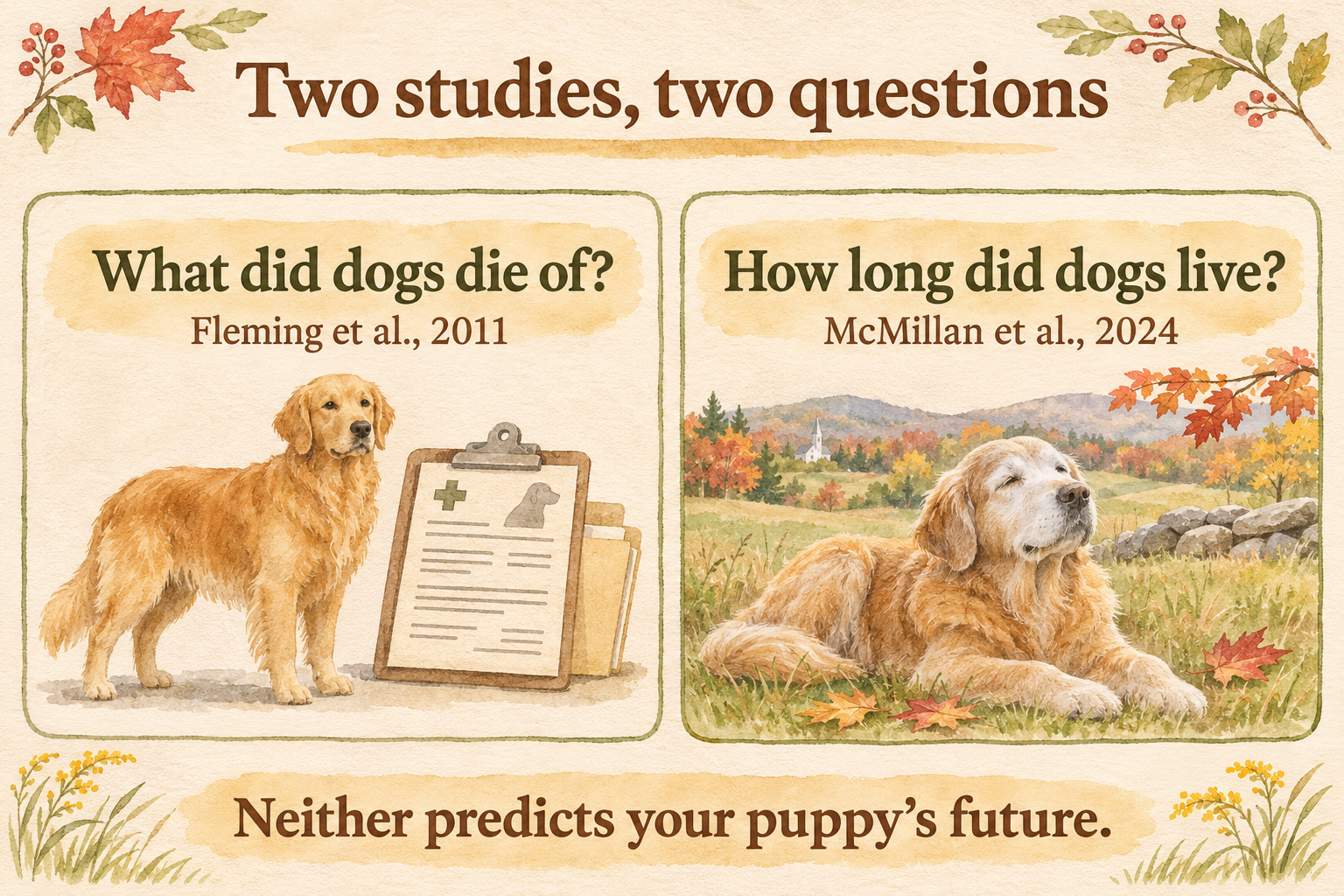
The studies answer different questions, and neither predicts what will happen to your puppy.
Key Takeaways
- Cancer is a serious concern for Goldens, and some dogs die of it young.
- Cause of death and lifespan are different measures. The numbers here belong to the groups studied.
- A breeder’s stories about relatives do not let you reliably compare litters for cancer risk.
- Choose with the breed’s risk in view. No individual puppy’s outcome can be inferred from these studies.
The Evidence
This entry uses heuristic claim-level tags beyond the dedicated EvidenceBlocks below. These tags mark JB interpretive application rather than direct study findings.
- Fleming, Creevy, and Promislow (2011)Domestic dogs, including Golden Retrievers, Bernese Mountain Dogs, and Boxers
Neoplasia accounted for 49.9% of recorded deaths in Golden Retrievers, 54.6% in Bernese Mountain Dogs, and 44.3% in Boxers in North American veterinary teaching hospital records. These are shares of recorded deaths, not diagnosis or lifetime risk estimates. - Kent et al. (2018)Golden Retrievers
Cancer accounted for 424 of 652 deaths among dogs of known age in the UC Davis necropsy sample. Figure 4 shows cancer deaths occurred over a range of ages. Neither result represents all Goldens.
- McMillan et al. (2024)Domestic dogs in the UK, including Golden Retrievers
The estimated median survival was 13.2 years for Golden Retrievers and 11.9 years for large purebred dogs as a group. These are dataset-specific, all-cause estimates, not cancer outcomes or individual predictions.
- Labadie et al. (2022)Golden Retrievers in the United States
The Golden Retriever Lifetime Study recruited 3,044 young Golden Retrievers for longitudinal follow-up to study factors associated with cancer and other diseases. The cohort was not designed to compare cancer risk between specific litters.
- Limits of the cited studiesDomestic dogs, including Golden Retrievers
The cited studies do not compare the cancer risk of specific litters or test a way to prevent cancer in the puppy a family brings home. Selected family histories do not supply a consistent denominator or comparable follow-up.
SCR References
Sources
- Fleming, J. M., Creevy, K. E., & Promislow, D. E. L. (2011). Mortality in North American dogs from 1984 to 2004: An investigation into age-, size-, and breed-related causes of death. Journal of Veterinary Internal Medicine, 25(2), 187–198. DOI.
- Kent, M. S., Burton, J. H., Dank, G., Bannasch, D. L., & Rebhun, R. B. (2018). Association of cancer-related mortality, age and gonadectomy in golden retriever dogs at a veterinary academic center (1989–2016). PLOS ONE, 13(2), e0192578. DOI.
- McMillan, K. M., Bielby, J., Williams, C. L., Upjohn, M. M., Casey, R. A., & Christley, R. M. (2024). Longevity of companion dog breeds: Those at risk from early death. Scientific Reports, 14, 531. DOI. Dogs Trust breed results table.
- Labadie, J., Swafford, B., DePena, M., Tietje, K., Page, R., & Patterson-Kane, J. (2022). Cohort profile: The Golden Retriever Lifetime Study (GRLS). PLOS ONE, 17(6), e0269425. DOI.