What Free-Ranging Dogs Teach Us About Raising Pet Dogs
This entry is a synthesis file, not a report of one experiment. The documented and observed findings underneath it are substantial. Coppinger and Coppinger describe the global dog as a village or street dog more often than as a managed household pet. Boitani and Ciucci contrast dog ecology with wolf ecology. Pal, Paul, and Bhadra document maternal care, allomothering, weaning conflict, and ordinary free-ranging puppy development. Bhattacharjee and colleagues show that free-ranging dogs read human gestures and intentions without formal training histories. Banerjee's activity-budget work and multiple field descriptions show that adult dogs spend much of daily life resting, waiting, and moving economically. Bonanni and Cafazzo document social order that depends more on ritual, spacing, and context than on constant aggression. Those findings are documented or observed. The JB claim that these patterns collectively illustrate the ambient conditions named by the Five Pillars is a heuristic interpretation built on top of them. Heuristic
That distinction matters. Free-ranging dog research does not contain a paper titled "The Five Pillars have now been validated." Documented What it offers is something both stronger and messier: a recurring real-world pattern in which dogs develop functional adulthood through social density, ordinary exposure, adult example, environmental structure, and relatively little formal method.
The task of this entry is to ask what households can learn from that pattern while refusing two errors. One error is romanticizing street life. The other is pretending the relevance to pet raising is nonexistent.
A good synthesis does not erase the distance between data and philosophy. It uses the data honestly enough that philosophy becomes more believable, not less.
That is especially important here because the temptation to overclaim is strong. Free-ranging evidence feels intuitively aligned with JB, but intuitive alignment is not the same thing as direct validation. The right move is disciplined interpretation, not rhetorical inflation.
That discipline also makes the synthesis more practical. Families do not need false certainty. They need a trustworthy map of what the evidence strongly suggests, what it only hints at, and what JB is naming as an interpretive pattern.
What It Means
Lesson One: Daily Life Does More Work Than Formal Sessions
The most obvious free-ranging lesson is that ambient life is doing a huge amount of developmental labor. Village puppies are not educated chiefly by short intentional lessons. They are raised inside a social and physical world that repeats itself relentlessly: adult dogs nearby, humans nearby, food sites nearby, movement patterns nearby, and ordinary low-drama consequence built into everyday life. That is a documented observation. The heuristic extension is that modern pet families often overestimate the role of training sessions because those sessions are visible and scheduled while ambient development is quiet.
If that extension is right even in part, then many modern households are aiming too low. They work on drills while neglecting the day.
Lesson Two: Calmness Looks More Like a Baseline Than an Endpoint
Field descriptions of free-ranging adults repeatedly show large amounts of rest, waiting, low-energy monitoring, and selective movement. Those dogs are not always relaxed in the human wellness sense, and the literature should not be twisted into claiming that free-ranging dogs are magically stress-free. Even so, the overall rhythm strongly suggests that calm functional adult behavior is not usually built by first generating permanent excitement and then training it down. The ecological baseline is quieter.
That is a documented pattern. The JB inference is that calmness may be less like a trick to install and more like a floor that either develops or gets repeatedly disrupted.
Free-ranging dogs do not prove the Calmness pillar in a laboratory sense, but they do provide one of the clearest real-world reasons to suspect that steady low-arousal functioning appears closer to the behavioral baseline observed in free-ranging dog populations. The interpretation that this represents a species baseline relevant to selectively bred household dogs is held at Heuristic confidence.
Lesson Three: Adults and Environment Mentor the Young
Village puppies grow up around adult dogs, maternal withdrawal, allomothers, ordinary human presence, and stable environmental repetition. The social-learning literature in the JB source base adds that puppies can learn from observation early and that adult-dog presence correlates with positive outcomes in other settings as well. Documented The strict claim that non-maternal adult mentorship is the main causal engine remains a research gap. The broader claim that adult presence and ambient example matter a great deal is already more defensible.
That is why Mentorship feels less like a poetic preference and more like a species-congruent reading. The free-ranging world does not raise puppies in isolation and then attempt to substitute method for missing adulthood.
Lesson Four: Prevention and Sparse Correction Are Everywhere
The field descriptions of free-ranging dogs and related natural-rearing literature repeatedly show social order managed through proximity, withdrawal, displacement, spatial claiming, maternal refusal, and brief context-linked correction rather than through long strings of repeated instruction. Documented Puppies learn what fits because the environment keeps showing them what the world permits. That does not eliminate all conflict or all suffering, and it does not prove JB's strongest claims about the mechanics of correction. What it does show is that canine development can be shaped heavily by what is not allowed to become a rehearsed habit and by low-drama social feedback when limits are reached.
That looks strikingly close to Prevention and Indirect Correction, even if the exact conceptual mapping remains heuristic rather than experimentally validated.
The point is not that village dogs are secretly running a codified philosophy. The point is that recurring real-world patterns can make a philosophical description look more biologically coherent. That is a meaningful relationship even when it is not the same thing as proof.
Why It Matters for Your Dog
For families, the value of this synthesis is practical, not academic. It reorganizes attention. Instead of asking first which protocol or reinforcement schedule should handle every behavior, adults can ask what kind of day the dog is living through. Is there enough calm? Enough rest? Enough adult steadiness? Enough meaningful observation? Enough environmental structure to prevent rehearsing the wrong things over and over?
That is a much bigger question than most people are used to asking, but the free-ranging comparison makes it hard to avoid. A species that becomes broadly functional in many unmanaged communities without formal lesson stacks is telling us that ordinary life variables matter enormously. The pet home cannot safely copy the street, but it can stop behaving as though behavior begins only when the pouch or clicker comes out.
Goldens benefit from this reframing because they are so often treated as endlessly trainable social sponges. Owners see willingness and conclude the answer is always more direct teaching. Yet many Golden problems look more like developmental noise than like missing cue knowledge. The dog gets too much emotional electricity, too many invitations into arousal, too little settled observation, and too many mixed adult signals. Heuristic In that context, more training can become paint over wet walls.
The synthesis also helps families understand why adult improvement is often the real intervention. If free-ranging dogs are constantly reading adult dogs and stable environmental regularities, then pet puppies likely need the human to become more like a readable adult and less like an excitable activity director. That does not mean becoming cold. It means becoming legible, proportionate, and hard to destabilize.
Another practical gain is patience with what maturity actually looks like. The free-ranging adult is not impressive because it performs endless named behaviors. It is impressive because it can exist well. It can wait, rest, move economically, read situations, avoid unnecessary escalation, and absorb ordinary community life. Pet families often under-value these quiet capacities because modern dog culture over-values visible performance.
The synthesis further challenges the assumption that correction must be loud to matter. Free-ranging dogs appear to rely heavily on early, precise, socially meaningful interventions. Families can learn from that without pretending every household moment maps perfectly onto village life. If the adult waits until chaos peaks and then responds with intensity, that is probably further from the free-ranging pattern than a quiet early interruption would be.
This lens is especially useful during puppyhood. A young dog does not merely need training games. It needs an atmosphere. The atmosphere should teach what speed feels normal, what rest feels normal, how adults move through the house, how food appears, what boundaries look like, and how correction lands when the dog misses the line. That is ambient education. Free-ranging life seems saturated with it.
The welfare contrast matters here too. Families should not confuse the free-ranging lesson with a call to loosen supervision recklessly. The real lesson is that protection and ambient development need to be integrated. A puppy can be safely contained and still raised in a world full of overmanagement, excessive chatter, and developmental poverty. That is the problem JB is trying to solve.
One final gain is intellectual honesty. The synthesis does not require saying modern training is useless. Specific skills matter. Recall, handling tolerance, cooperative care, leash manners, and safety skills deserve deliberate work. The free-ranging record suggests something narrower and more disruptive: when the ambient world is right, formal training is a supplement. When the ambient world is wrong, formal training becomes an expensive attempt to compensate for a deeper deficit.
That is probably the most important free-ranging lesson for pet families. The day is primary. The method is secondary.
Put differently, households should not expect a few high-quality sessions to compensate for a low-quality atmosphere. The dog is formed by immersion. That is what the free-ranging record keeps making hard to ignore.
This is why the synthesis so often redirects attention back to adult behavior. The family is part of the atmosphere. If the adults are erratic, overexcited, permissive in one moment and punitive in the next, or chronically noisy, the dog is being immersed in that instability all day long regardless of what happens during formal work.
A family can use that insight immediately. When daily life begins feeling heavier and more technical, the first question should not always be which stronger tool to reach for. The first question should often be whether the atmosphere itself has drifted away from the developmental conditions that make dog maturity easier to build.
That is a hard conclusion to market and an excellent conclusion to live by. It puts the burden back where the evidence keeps pointing: on the total quality of the dog's world.
What This Means for a Just Behaving Family
JB families should use this synthesis as a guide, not as a slogan. The underlying observations are strong enough to justify taking the ambient developmental environment very seriously. The pillar-level mapping still belongs in heuristic voice.
Calmness, Mentorship, Prevention, and Indirect Correction all become easier to understand against the free-ranging background. Calmness looks like the floor of ordinary competence. Mentorship looks like adult-guided learning in a social field. Prevention looks like not rehearsing chaos. Indirect Correction looks like brief and meaningful social boundary-setting instead of chronic signal flooding.
Practically, that means a JB home should be designed to carry developmental weight all day long. Adults should be readable. Routines should be stable. Arousal should not be treated as the default fuel of dog life. Necessary training should fit into that world rather than substituting for it.
JB should also keep saying what this entry does not claim. Free-ranging dog research does not prove that every healthy pet home must look the same, and it does not sanctify unmanaged street life. Documented The comparison is useful because it reveals a pattern, not because it supplies a perfect script.
Even with that boundary, the message is unusually strong. If households want a mature, socially functional dog, they should spend less time imagining behavior as something installed in episodes and more time shaping the atmosphere the dog matures inside.
That is where the evidence and the philosophy begin to touch without being confused.
It is also where responsibility becomes clearer. Adults may not control every outcome, but they control far more of the atmosphere than they often realize. Free-ranging dogs teach that the atmosphere is not background. It is the main medium development moves through.
That is the deepest usable lesson for a JB family. If the atmosphere improves, the dog often improves with it. If the atmosphere stays disordered, technical fixes are likely to feel heavier and less durable than the family hoped.
That is why this synthesis belongs at the end of the free-ranging subcategory. It gathers the repeated lesson the other files keep circling: dogs are formed by living through a world, and the quality of that world may matter more than modern method culture is comfortable admitting.
A good family can use that lesson without pretending it solves every problem. It is enough that the lesson keeps redirecting attention toward the place where development is actually happening.
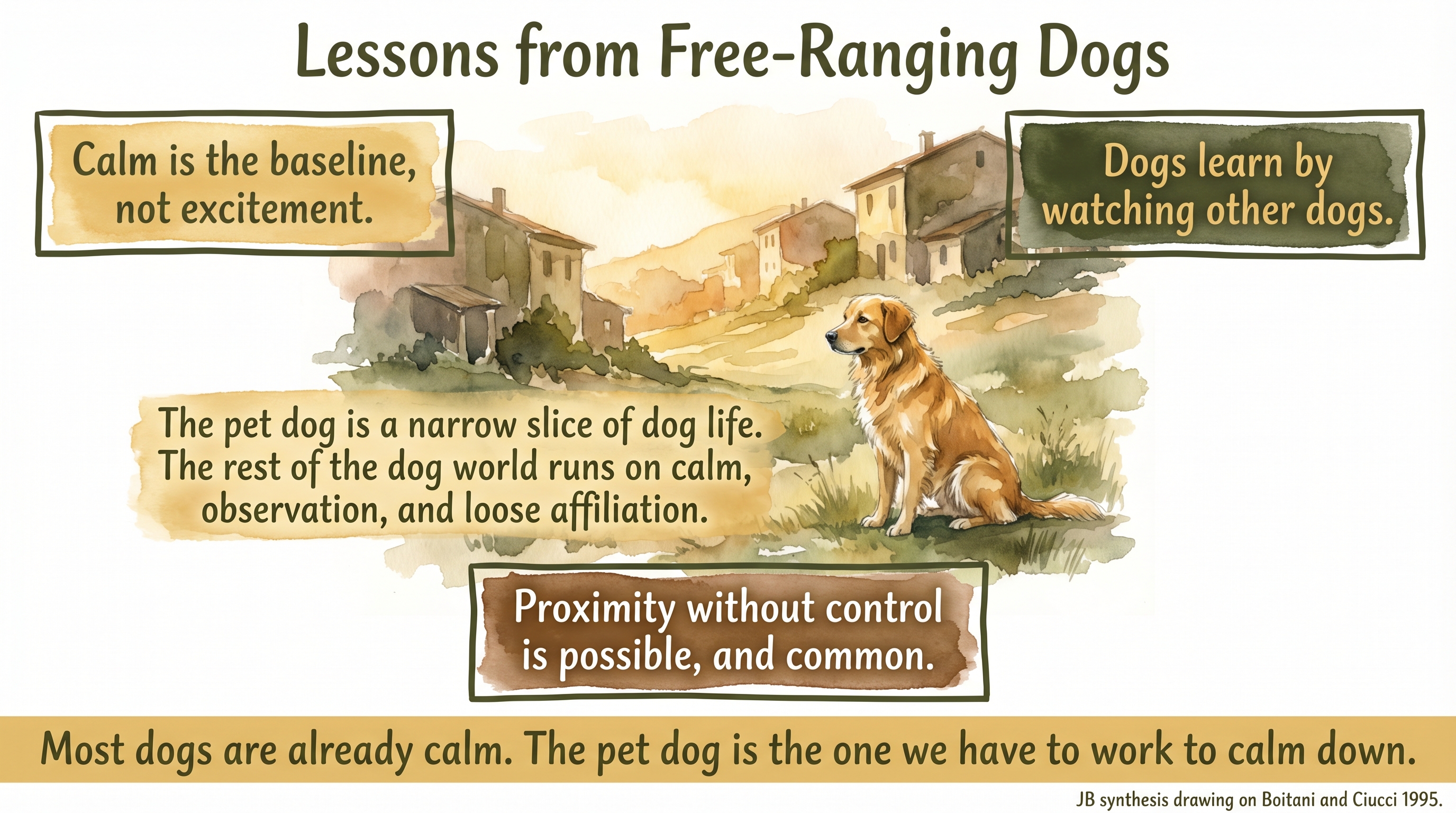
Most dogs are already calm. The pet dog is the one we work to calm down.
Key Takeaways
- The strongest free-ranging lesson is that daily life carries enormous developmental weight.
- Calm adult functionality appears more like a baseline state in free-ranging dog populations studied; the application to selectively bred household pet dogs is held at Heuristic confidence.
- Adult example, environmental structure, prevention, and sparse correction all look more central than modern method culture usually admits.
- The Five Pillars are best presented here as JB's heuristic naming of that pattern, not as a directly tested scientific package.
The Evidence
This entry uses documented claim-level tags beyond the dedicated EvidenceBlocks below. These claims should remain tied to the entry Sources and SCR references during the next evidence-chain authoring pass.
- Coppinger and Coppinger plus Boitani and Ciucciglobal dogs and free-ranging dogs
Place the dog in a commensal ecology where development unfolds in ordinary settlement life rather than inside formal training systems. - Pal, Paul, Bhadra, and Bhattacharjee traditionsfree-ranging dogs
Document puppy development, maternal withdrawal, human cue use, and ordinary community life in unmanaged populations. - Bonanni and Cafazzo traditionsfree-ranging dogs
Show social structure built through context, ritual, spacing, and low-drama signal use rather than constant aggression. - JB social-learning and attachment source setdomestic dogs
Provides additional support for mentorship, adult influence, and human readability as biologically relevant variables.
No published study directly tests the practical implications of what free-ranging dogs teach us about raising pet dogs for domestic dog raising programs. The application to household dog raising remains an interpretive synthesis rather than a directly tested intervention finding.
SCR References
Sources
- Coppinger, R., and Coppinger, L. (2001). Dogs: A New Understanding of Canine Origin, Behavior, and Evolution.
- Boitani, L., and Ciucci, P. (1995). Comparative social ecology of feral dogs and wolves. Ethology Ecology and Evolution.
- Pal, S. K. (2005). Parental care in free-ranging dogs, Canis familiaris. Applied Animal Behaviour Science.
- Paul, M., and Bhadra, A. (2017). Clever mothers balance time and effort in parental care: A study on free-ranging dogs. Royal Society Open Science.
- Bhattacharjee, D., et al. (2017). Free-ranging dogs show age related plasticity in their ability to follow human pointing. PLOS ONE.
- Bonanni, R., et al. (2017). Age-graded dominance hierarchies and social tolerance in packs of free-ranging dogs. Behavioral Ecology.
- Cafazzo, S., et al. (2010). Dominance in relation to age, sex, and competitive contexts in a group of free-ranging domestic dogs. Behavioral Ecology.