How Village Dog Puppies Develop
Village dog puppies develop inside a world that is socially dense, environmentally ordinary, and almost never arranged around formal training sessions. Pal's work on free-ranging dogs in India documented puppies born in protected sites near human settlements and raised primarily by their mothers with varying degrees of help from other adult females. Paul and Bhadra 2017 described mothers balancing time and energetic investment rather than supplying endless care. Bhattacharjee et al. 2017 showed that young free-ranging dogs already respond to human pointing in age-sensitive ways, which means human attunement can develop outside pet ownership. Sen Majumder et al. 2016 found that den placement itself often reflects strategic human proximity. Lord's work on dog versus wolf development added a key comparative piece: dogs have a longer, more flexible socialization window than wolves, which helps explain why puppies can integrate into human settlement life so effectively. Pal et al. 2021 further documented allomothering and other adult-pup interactions in free-ranging dogs, showing that puppy life is not strictly a mother-only channel. Observed-JB
This developmental picture is important because it is both ordinary and selection-relevant. Puppies are born near the species niche, not in a curriculum. They encounter people, older dogs, movement, noise, livestock, food competition, maternal withdrawal, and community routine as part of the background architecture of life.
That does not make village-dog development gentle in every respect. Mortality is high, food can be scarce, and the costs of exposure are real. Even so, the survivors offer a vivid example of how much developmental shaping can happen through ambient conditions rather than through designed exercises.
For JB, that is where the entry becomes strategically important. The documented facts concern maternal care, allomothering, human exposure, and socialization timing. Documented-Cross-Species The interpretive question is whether those facts help explain why calm, socially legible adulthood can emerge without modern method stacks.
What It Means
Birth and Early Care Happen Near the Human Edge
Village dog litters are usually born in sheltered sites that are close enough to human settlement to benefit from safety, warmth, and nearby food opportunities. Sen Majumder's denning work highlighted that free-ranging mothers often choose areas near people rather than remote isolation. That alone is revealing. Puppies begin life not in wilderness exile but in the commensal interface. Pal's research described maternal attendance, nursing, grooming, and protection in this environment, while Paul and Bhadra 2017 examined how mothers adjust care according to changing energetic and developmental pressures.
This means early puppy life is already ecologically social. Human sounds, scents, movement, traffic, and settlement rhythm are part of the nest context from the start.
The Socialization Window Is Filled by Life, Not by Program
Freedman, King, and Elliot 1961 helped establish that dogs have a sensitive period for social development. Documented Lord's comparative work refined the broader point by showing dogs remain open to human socialization longer than wolves do. Village puppies appear to use that openness in a continuous way. They do not receive a checklist of exposures. They live in the middle of ongoing exposure. Humans pass by. Adult dogs move in and out. Vehicles, livestock, food scraps, and ordinary noise recur daily.
That difference between checklist exposure and ambient exposure matters. The village puppy is not being marched from novelty to novelty. The puppy is learning what the world is by residing inside it.
Adult Dogs and Maternal Withdrawal Shape the Curriculum
Pal 2005, Pal et al. 2021, and Bhadra-lab studies all point to an important theme: adult dogs do real developmental work. Documented Mothers nurse and protect, but they also withdraw, refuse, reposition, and gradually alter access. Bhattacharjee et al. 2017 on weaning conflict and milk theft makes this vivid. Puppies do not receive permanent indulgence. They experience graduated frustration inside a stable social system. Allomothers and nearby adults add further texture. Pongracz's review on alloparental behavior in companion dogs suggests the topic is broader than free-ranging populations alone, but village dogs make it harder to ignore.
The result is a development process with mentorship, boundaries, and ordinary correction built into daily life rather than carved out as formal lessons.
Village dog development is one of the clearest real-world examples of puppies learning in the presence of older dogs, older humans, and recurring ordinary life. The literature does not prove the full Mentorship pillar by name, but it strongly supports the biological importance of adult-guided ambient development.
Survivorship Bias Matters, but It Does Not Erase the Pattern
Any honest reading has to mention mortality. Free-ranging puppy survival is poor in many contexts. Disease, injury, starvation, and human hostility filter the population hard. That means adult village dogs are partly the survivors of a harsh sorting process. Still, survivorship bias does not make the developmental environment irrelevant. It means the pattern must be read with two truths at once: many puppies do not make it, and those that do are shaped by dense early exposure, social feedback, and ordinary community life rather than by formal curriculum.
This is exactly why the topic is useful for JB. It shows a real developmental world, not an idealized one.
It also helps clarify what "socialization" may actually mean in natural contexts. Socialization is not a basket of isolated novelty events. It is the repeated conversion of the world from unknown into ordinary. Village puppies appear to receive that conversion continuously.
That is why developmental timing matters so much. A puppy repeatedly exposed to the same calm categories of life during the sensitive period may build familiarity very differently from a puppy exposed to constant novelty without stable structure around it.
Why It Matters for Your Dog
For families, village-dog development is helpful because it pulls attention back to what fills the puppy's days. Modern pet owners often think the decisive developmental question is what happens in short planned sessions. The village-dog record suggests the opposite emphasis. The decisive question is what kind of world the puppy is living in all the other hours.
That perspective can change home life immediately. A pet puppy who spends most of the day in isolation, artificial excitement, or chronic verbal management is not receiving the sort of ambient developmental information that village puppies receive by default. The answer is not to mimic hardship. The answer is to build more continuity, more adult example, more ordinary participation, and more calm exposure into domestic life.
Goldens benefit from this insight because they often look socially gifted enough to fool families into complacency. A Golden puppy may appear easy, affiliative, and eager to please while still lacking deep exposure to ordinary household structure. Village-dog development reminds adults that friendliness is not the same thing as grounded maturity. Puppies need to live alongside competent beings, clear rhythms, and practical limits.
This also reframes socialization. Pet culture frequently treats socialization as a race to collect novel stimuli. Village puppies are exposed to novelty, but it is usually embedded in stable repetition. The same lanes, the same humans, the same resting spots, the same food locations, the same adult dogs, and the same ambient sounds provide a much more coherent learning landscape than novelty tourism does. Families can learn from that by prioritizing calm repetition over spectacle.
Another household implication concerns frustration. Village puppies do not grow up in a world where every impulse is immediately rewarded. Maternal withdrawal, sibling competition, variable access to food, and adult social boundaries all teach something about waiting and adjusting. A pet home obviously should not manufacture deprivation. It should, however, avoid turning the puppy into a tiny client whose every whim is serviced before self-regulation has a chance to develop.
Adult dogs matter here as well. The guide-dog and social-learning literature in the JB source base already suggests better outcomes when puppies grow up around resident adults. Village-dog development provides a free-ranging analogue. Puppies with access to stable adult dogs are living in a different informational world than puppies raised as isolated human projects. Even when a home has no adult dog, the family can borrow the principle by becoming calmer, more consistent, and less verbally cluttered.
This evidence also protects families from overcorrecting fear. A puppy who is unsure does not always need a food transaction or a choreographed exercise. Sometimes the right answer is continued calm exposure in the company of stable adults. Village puppies repeatedly seem to learn the ordinary texture of life through being there while life unfolds.
Households can further use this research to think better about transitions. Documented The move from breeder to family home often strips puppies of dog density, communal rhythm, and ambient guidance all at once. That helps explain why some puppies seem to fall apart despite excellent intentions from loving owners. The new home may have better safety and medical care while still being developmentally poorer in social structure. The JB "soft landing" idea is useful here precisely because village-dog development makes the missing structure visible.
The same point clarifies why prevention matters so much. If the puppy's early world is the foundation, then adults should pay close attention to what gets rehearsed during that period. Repeated arousal, constant audience laughter at mouthing, endless invitation into chaos, and fragmented rest all become more consequential. Village dogs do not avoid all bad circuits, but their developmental environment is not designed around rehearsing them for fun.
One final practical lesson is patience. Village-dog competence emerges over time in a rich environment. Pet owners often expect maturity to arrive on command. Reading development ecologically encourages a slower, steadier standard: build the world, guide the puppy inside it, and let repetition do real work.
The comparison also changes how adults should think about social confidence. A puppy who can lie near activity, recover after a startle, watch older beings calmly, and explore without frantic prompting may be showing deeper development than a puppy who performs many prompted tasks but cannot regulate in ordinary life. Village-dog development gives those quieter milestones more authority.
That matters because modern homes often reward the wrong signals. Excited engagement looks impressive, while relaxed integration looks ordinary. The village-dog lens pushes adults to value ordinariness more highly. A puppy who can simply be in the world well is often further along than a puppy who performs constantly but never settles.
What This Means for a Just Behaving Family
JB families should treat village-dog development as evidence that ordinary life is not a side issue in puppy raising. It is the main stage on which most developmental shaping happens.
Mentorship is the clearest pillar here. Puppies learn in the company of adults. Calmness matters because the ambient world teaches most effectively when it is not emotionally chaotic. Prevention matters because what the puppy never rehearses during this sensitive period may never need laborious undoing later.
The family can apply that by making home life legible. Let the puppy observe competent adult behavior. Protect rest. Use stable routines. Limit needless excitement. Keep correction brief and socially readable rather than dramatic.
Structured Leadership belongs in the picture as well. The adult organizes the world the puppy is entering. That is closer to what a mother or steady older dog does than to what a technician running drills does.
JB should still keep its confidence bands honest. Village-dog development documents ambient socialization, maternal care, allomothering, and ordinary human exposure. Observed-JB The stronger claim that this directly validates every Pillar remains interpretive.
Even with that caution, the lesson is powerful. If a family gets the puppy's world right, a great deal of later behavior becomes easier because it was built better from the beginning.
That is also why the breeder-to-home transition deserves so much seriousness. The puppy is not leaving one social system and entering a neutral space. The puppy is leaving one full developmental ecology and entering another. A JB family should therefore think less like a consumer receiving a product and more like a steward taking responsibility for the next environment the young dog will grow inside.
When that stewardship is done well, later training becomes cleaner because it is being layered onto a nervous system and a social life that already make sense. Village-dog development helps explain why that order of operations matters so much.
It also gives adults a more merciful timeline. Development built through atmosphere is cumulative. A family does not need to force maturity into existence immediately. It needs to protect the conditions under which maturity usually grows.
That is a demanding conclusion because it means the adults are never offstage. Every calm repetition, every predictable transition, and every ordinary moment of shared life is part of the developmental field. Village-dog evidence gives those ordinary moments much more weight than modern dog culture usually does.
It is one of the clearest reminders in the entire category that a puppy is not being formed only during deliberate lessons.
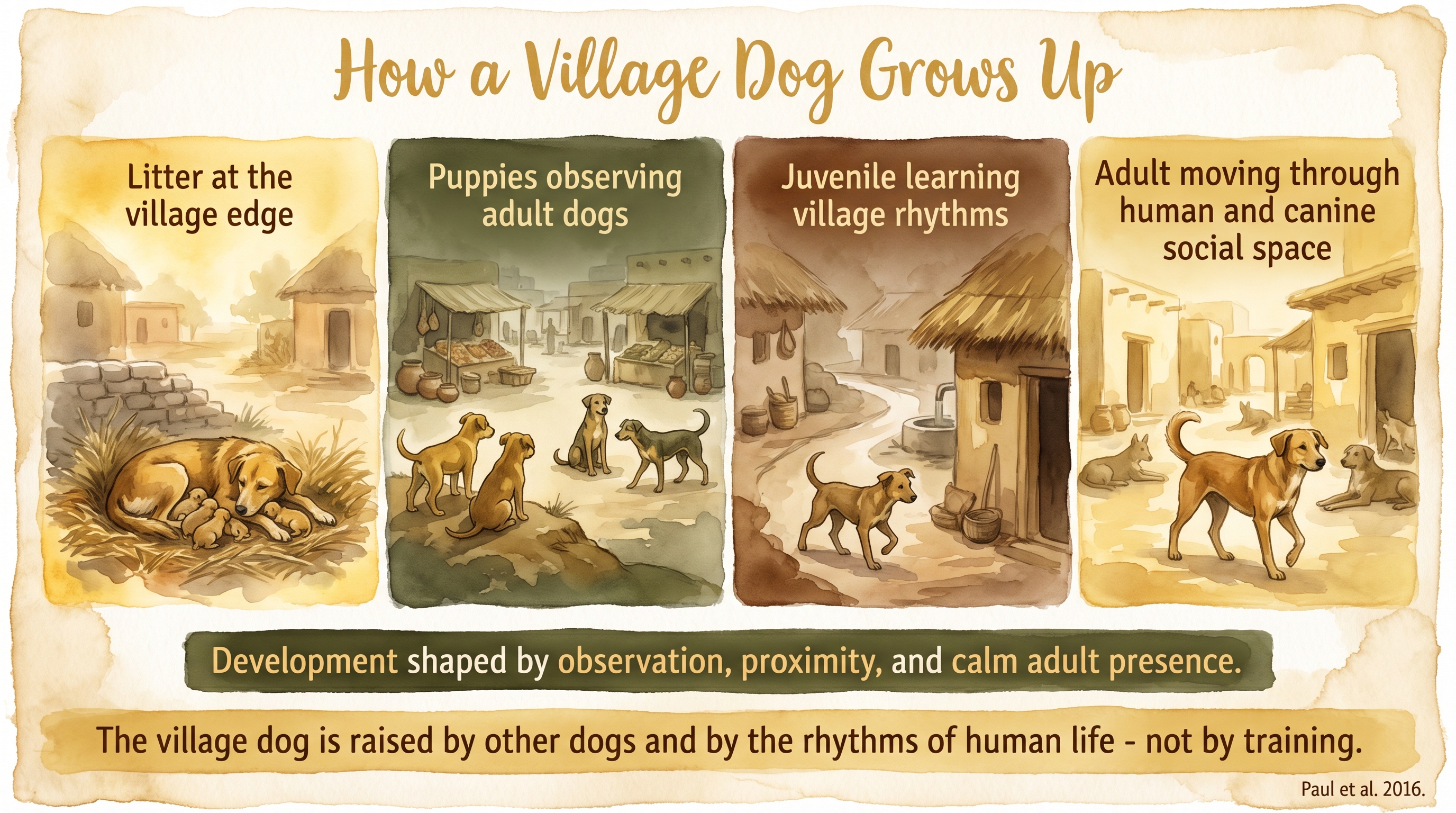
Village dogs are raised by other dogs and by the rhythms of human life.
Key Takeaways
- Village puppies grow up inside ordinary community life rather than inside formal teaching programs.
- Maternal care, adult-dog presence, and repeated human exposure appear to fill the socialization window continuously.
- High mortality complicates the picture, but it does not erase the developmental importance of the ambient environment.
- For JB, the practical lesson is that what fills the puppy's days matters more than isolated training sessions alone.
The Evidence
This entry uses documented claim-level tags beyond the dedicated EvidenceBlocks below. These claims should remain tied to the entry Sources and SCR references during the next evidence-chain authoring pass.
This entry uses documented cross-species claim-level tags beyond the dedicated EvidenceBlocks below. Species and application scope should be checked during the next evidence-chain authoring pass.
- Pal (2005) and Pal et al. (2021)free-ranging dogs in India
Documented maternal care, allomothering, and ordinary pup rearing in unmanaged populations. - Paul and Bhadra (2017)free-ranging dogs
Showed mothers balancing care effort according to ecological cost rather than providing unlimited care. - Bhattacharjee et al. (2017)free-ranging dogs
Found age-related plasticity in following human pointing, showing developmental tuning to human cues. - Freedman et al. (1961) and Lord-related comparative workdogs and wolves
Established the importance of the canine socialization window and its greater flexibility compared with wolves.
No published study directly tests the practical implications of how village dog puppies develop for domestic dog raising programs. The application to household dog raising remains an interpretive synthesis rather than a directly tested intervention finding.
SCR References
Sources
- Pal, S. K. (2005). Parental care in free-ranging dogs, Canis familiaris. Applied Animal Behaviour Science.
- Pal, S. K., et al. (2021). Pup rearing: The role of mothers and allomothers in free-ranging domestic dogs. Applied Animal Behaviour Science.
- Paul, M., and Bhadra, A. (2017). Clever mothers balance time and effort in parental care: A study on free-ranging dogs. Royal Society Open Science.
- Bhattacharjee, D., et al. (2017). Free-ranging dogs show age related plasticity in their ability to follow human pointing. PLOS ONE.
- Freedman, D. G., King, J. A., and Elliot, O. (1961). Critical period in the social development of dogs. Science.
- Lord, K. A. (2013). A comparison of the sensory development of wolves (Canis lupus lupus) and dogs (Canis lupus familiaris). Ethology, 119(2), 110-120. https://doi.org/10.1111/eth.12044