Free-Ranging Dog Welfare and the Pet Dog Contrast
Free-ranging dogs should not be romanticized. Village and street populations offer crucial behavioral insight, but they also live with risks that no responsible family should want to recreate. The World Health Organization continues to identify dogs as the main source of human rabies deaths worldwide, which immediately tells us something about the veterinary vulnerability of unvaccinated dog populations. Boitani and Ciucci 1995 described substantial ecological costs in unmanaged systems. Pal, Paul, and Bhadra's work on free-ranging puppies shows high juvenile risk and strong energetic pressures on mothers. JB's veterinary source base on parasites, stress, and infectious burden makes the same general point from another angle: dogs living with uncontrolled exposure face higher burdens from gastrointestinal parasites, trauma, and untreated disease. At the same time, field researchers repeatedly note that adult free-ranging dogs who survive often display socially functional behavior, broad sensory experience, and ordinary participation in a community rather than a life of isolation. Documented
That creates a comparison that has to be handled carefully. The free-ranging life is often harder physically and medically. The modern pet life is usually safer and longer. Yet the modern pet niche can also generate forms of deprivation that are harder to see at first glance: chronic isolation, sensory poverty, excessive confinement, disrupted sleep, social immaturity, and behavior problems born from ecological mismatch. Documented
The point of the comparison is therefore not to decide which world is morally pure. The point is to ask which elements of each world matter most for canine welfare and functional adulthood.
JB's answer is a hybrid. Keep the safety, medicine, nutrition, and longevity of responsible pet care. Recover as much of the developmental sanity of the ambient dog world as possible.
What It Means
Free-Ranging Life Carries Heavy Physical Risk
No serious reading can avoid the blunt costs. Puppies die in high numbers. Infectious disease circulates more freely. Parasites are common. Vehicles, human violence, and poor nutrition take a toll. The WHO's rabies framing matters because it keeps the discussion grounded in public-health reality. Street and village dogs are not simply happy symbols of canine freedom. In many regions they live with a disease burden no modern family would consider acceptable.
Paul and Bhadra's maternal work also makes clear that rearing under these conditions is energetically expensive. Ecological hardship is written into reproduction itself. A free-ranging bitch must manage offspring, food scarcity, danger, and social pressure with much less margin than a cared-for household dam has.
Modern Pet Life Solves Some Problems and Creates Others
The companion home fixes many of those dangers. Vaccination, parasite control, regular food, shelter, surgery, and emergency care all radically improve survival. Documented A well-kept pet dog is spared enormous suffering that free-ranging dogs face routinely. That is real welfare progress.
Yet the pet niche can generate a different cluster of harms. Category 6 and 7 evidence already show how common fear, anxiety, reactivity, and social incompetence are in modern pet populations. Documented Pet dogs may live longer while functioning worse behaviorally. They may be safer from rabies and cars while becoming more isolated, more over-aroused, more dependent on entertainment, and less capable of ordinary coexistence.
Functional Adulthood Is Not Captured by Longevity Alone
This is the heart of the comparison. Welfare is not only about survival length. It is also about what sort of organism the dog gets to be while alive. Adult free-ranging dogs often appear behaviorally competent in ways that many pet dogs do not: they rest for long periods, navigate mixed-species settings, use social distance effectively, and participate in a community ecology rather than living as highly managed dependents. That does not mean their lives are better overall. It means behavioral functionality and medical safety can come apart.
The free-ranging literature is therefore useful precisely because it complicates simplistic welfare narratives. A longer life is not the only variable. A life with richer ordinary participation but worse disease burden is also not automatically better. Both sides reveal something important.
JB's practical goal is not to send dogs back into a harsher ecology. It is to prevent the crash landing that occurs when a biologically social, settlement-edge species is moved into a medically safe but developmentally impoverished lifestyle.
The Useful Comparison Is Component by Component
Once the romance is removed, the best welfare question becomes modular. Which parts of free-ranging life should never be imported into a pet home? Disease exposure, uncontrolled breeding, traffic danger, starvation, unmanaged injury, and population-control violence should obviously stay out. Documented Which parts of free-ranging life deserve careful recovery? Daily movement, social density, rest in ordinary public life, ambient participation, lower signal clutter, and competence built through living in a world rather than performing for it are much more interesting candidates.
That is why "street dog" is not a moral destination. It is a comparative dataset.
Thinking in components prevents a lot of bad argument. It stops the romantic from claiming that hardship is secretly good for dogs, and it stops the technocratic reader from claiming that comfort alone settles welfare. The comparison only becomes useful when safety, development, behavior, and ordinary quality of life are separated and then recombined honestly.
Why It Matters for Your Dog
Families often make one of two mistakes when thinking about welfare. One mistake romanticizes freedom and assumes that more autonomy automatically means a better dog life. The other mistake treats physical safety as the whole welfare equation and ignores whether the dog is psychologically and socially suited to the life it is living. The free-ranging contrast helps households avoid both errors.
A safe, loved pet dog can still be welfare-compromised if the dog's daily life is chronically frustrating, socially thin, and emotionally noisy. Families sometimes believe that because the dog has premium food, veterinary care, toys, and affection, the deeper welfare question is settled. Then the dog begins pacing, barking, guarding, overreacting, or failing to settle, and the household treats the issue as a narrow training defect. The comparative literature suggests that some of these outcomes are better read as ecological mismatch.
Goldens often reveal this gently at first. A young dog becomes clingy, over-excited, unable to rest unless separated from the action, and confused by normal household change. The family may interpret that as a need for harder training or more stimulation. A welfare reading asks whether the dog has enough meaningful participation, enough adult calmness to organize around, enough rest, enough predictability, and enough chance to mature out of puppy status.
The contrast also helps families think better about "exercise." Free-ranging dogs do move, but not in the same patterned way pet dogs are exercised. Much of their day is made of low-level locomotion, waiting, sniffing, watching, repositioning, and resting. Pet homes often alternate confinement with intense outings. That may be safer than street life, but it may still produce a body and nervous system that never quite settles into a natural rhythm.
Another practical benefit is honesty about deprivation that does not look dramatic. A pet dog can be lonely in a full house if the social structure is chaotic. A dog can be overstimulated while being underfulfilled. A dog can be medically excellent and behaviorally miserable. The free-ranging comparison makes those combinations easier to see because it breaks the automatic assumption that comfort equals whole welfare.
At the same time, the comparison keeps families from doing anything foolish. Some people encounter ecological or cross-cultural dog writing and start fantasizing about off-leash autonomy or benign neglect as if those were the lost secrets of dog happiness. They are not. A suburban American road system, neighborhood complaint system, and disease-control system are not the same as an Indian village edge or a pastoral working landscape. A pet dog needs protective management.
The real insight is more nuanced. A dog can be protected without being overmanaged. A dog can have veterinary care without living in constant emotional clutter. A dog can sleep indoors and still live inside a calmer, richer, more species-sensible daily world.
This also matters for behavior medicine. Documented When a dog presents with chronic anxiety, impulsivity, frustration, or social dysfunction, the intervention should not be limited to symptom control. The welfare comparison encourages adults to examine rhythm, confinement, sleep, dog density, transition quality, and environmental legibility. Those variables may not be as flashy as a new protocol, but they often sit closer to cause.
One more family gain is moral clarity. Studying free-ranging dogs is not an insult to responsible care. It is a way of making responsible care better. By separating what should be preserved from what should be recovered, households can stop swinging between neglect and micromanagement.
That is probably the deepest practical use of this entry. It says we do not have to choose between safety and sanity. We need a better mixture of the two.
The comparison also sharpens what humane ambition should look like. A good home does not merely keep the dog away from disease and impact trauma. It also tries to create a life that is easy for the dog to inhabit: enough quiet, enough belonging, enough routine, enough movement, and enough ordinary participation that the dog is not living in constant compensatory overdrive.
That broader ambition matters because many of the worst modern welfare problems look ordinary at first. A dog is indoors, loved, fed, and physically secure, yet lives in a state of shallow sleep, chronic vigilance, fragmented routine, or emotional overexposure. The free-ranging comparison gives households language for noticing those quieter forms of strain before they become clinical problems.
This also pushes households toward a more serious form of enrichment. Instead of asking only how to entertain the dog, adults can ask how to make the dog's whole day more inhabitable. A welfare lens informed by free-ranging life cares deeply about boredom, but it also cares about rhythm, belonging, and relief from chronic emotional pressure.
A welfare-first family can use that question every day: is the dog's life merely protected, or is it also inhabitable? Free-ranging evidence suggests those are different achievements, and the better homes are trying to accomplish both at once.
What This Means for a Just Behaving Family
JB families should read this contrast as a design brief. Keep the medical and safety victories of modern dog keeping. Remove as much of the unnecessary developmental distortion as possible.
Calmness matters because many pet welfare problems are really chronic state problems. Mentorship matters because socially competent adulthood develops more easily in the presence of stable adults. Prevention matters because once a household normalizes frantic rehearsal, later correction is an expensive substitute for better design.
The practical target is a hybrid life. The puppy should have vaccines, secure containment, veterinary oversight, and nutrition. The puppy should also have rest, ordinary participation in family life, lower emotional noise, gradual exposure, and guidance that is more ecological than theatrical.
JB should speak carefully here. The literature documents that free-ranging dogs face major medical and physical hardship and that many adults still appear behaviorally functional. The stronger claim that modern pet dogs are broadly worse off overall remains too simple and should not be stated that way.
A more accurate conclusion is enough. Modern homes are better at keeping dogs alive. They are not automatically better at raising dogs well. That is the gap JB is trying to close.
For a family, that means asking two welfare questions all the time instead of one. Is the dog physically protected? And is the dog's daily life easy to inhabit as a dog? The first question is familiar to most families. The second is the one the free-ranging comparison forces back into view.
That second question often points toward the most humane improvements. A calmer rhythm, richer ordinary participation, and less emotional clutter can raise welfare without sacrificing any of the medical and civic safeguards a modern home owes the dog.
In JB terms, that means safety should be treated as the platform, not the whole philosophy. A family can satisfy the platform and still miss the deeper welfare opportunity. The richer goal is a dog who is not only protected, but also developmentally at ease inside the life the family has built.
That is why JB treats safety as necessary but not sufficient. A good life for a dog includes medicine and management, but it also includes a daily atmosphere that does not keep forcing the animal to compensate for the human system around it. The free-ranging contrast makes that deeper standard much easier to see.
Seen practically, welfare design matters because the dog should not have to choose between living long and living in a way that still feels behaviorally sane and socially usable.
When those layers align, the family keeps the modern gains while recovering more of the developmental sanity the comparison helps reveal.
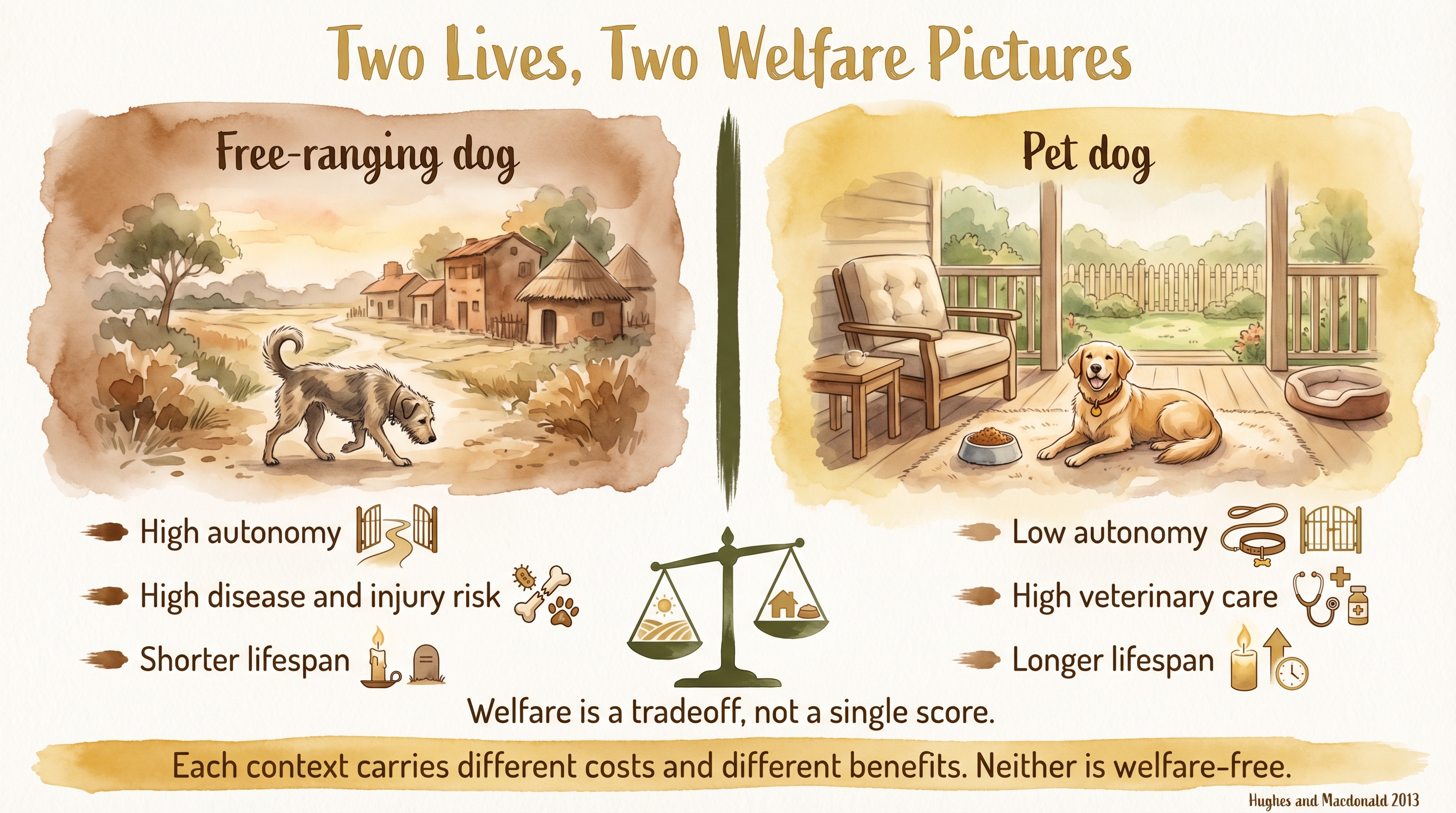
Each context carries different costs and benefits. Neither is welfare-free.
Key Takeaways
- Free-ranging life offers behavioral insight, not a welfare ideal to copy.
- Modern pet life solves major physical dangers while still allowing serious ecological and behavioral mismatch.
- Functional adulthood and simple longevity are not identical welfare measures.
- For JB, the right target is a hybrid: modern safety plus a more developmentally sane daily life.
The Evidence
- World Health Organization rabies guidancedogs and humans
Identifies dogs as the main source of human rabies deaths globally, highlighting the medical cost of uncontrolled dog populations. - Boitani and Ciucci (1995)feral dogs and wolves
Described the ecological hardships and distinct survival pressures of unmanaged dog populations. - Pal, Paul, and Bhadra traditionsfree-ranging dogs
Documented substantial puppy mortality and energetic strain in maternal care under free-ranging conditions. - JB veterinary source base and modern pet behavior epidemiologypet dogs
Shows that improved medical protection can coexist with high rates of fear, anxiety, and behavioral dysfunction in modern household dogs.
No published study directly tests the practical implications of free-ranging dog welfare and the pet dog contrast for domestic dog raising programs. The application to household dog raising remains an interpretive synthesis rather than a directly tested intervention finding.
SCR References
Sources
- World Health Organization. Rabies fact sheet.
- Boitani, L., and Ciucci, P. (1995). Comparative social ecology of feral dogs and wolves. Ethology Ecology and Evolution.
- Pal, S. K. (2005). Parental care in free-ranging dogs, Canis familiaris. Applied Animal Behaviour Science.
- Paul, M., and Bhadra, A. (2017). Clever mothers balance time and effort in parental care: A study on free-ranging dogs. Royal Society Open Science.
- Bhattacharjee, D., et al. (2017). Selfish pups: Weaning conflict and milk theft in free-ranging dogs. PLOS ONE.
- Serpell, J., and Powell, L. (2025). Prevalence and severity of behavior problems in dogs in the United States: A re-assessment. Journal of Veterinary Behavior.